
Through M4CR, Coastal Ecosystem Conservation Becomes Key to Food Security in Bulungan, North Kalimantan
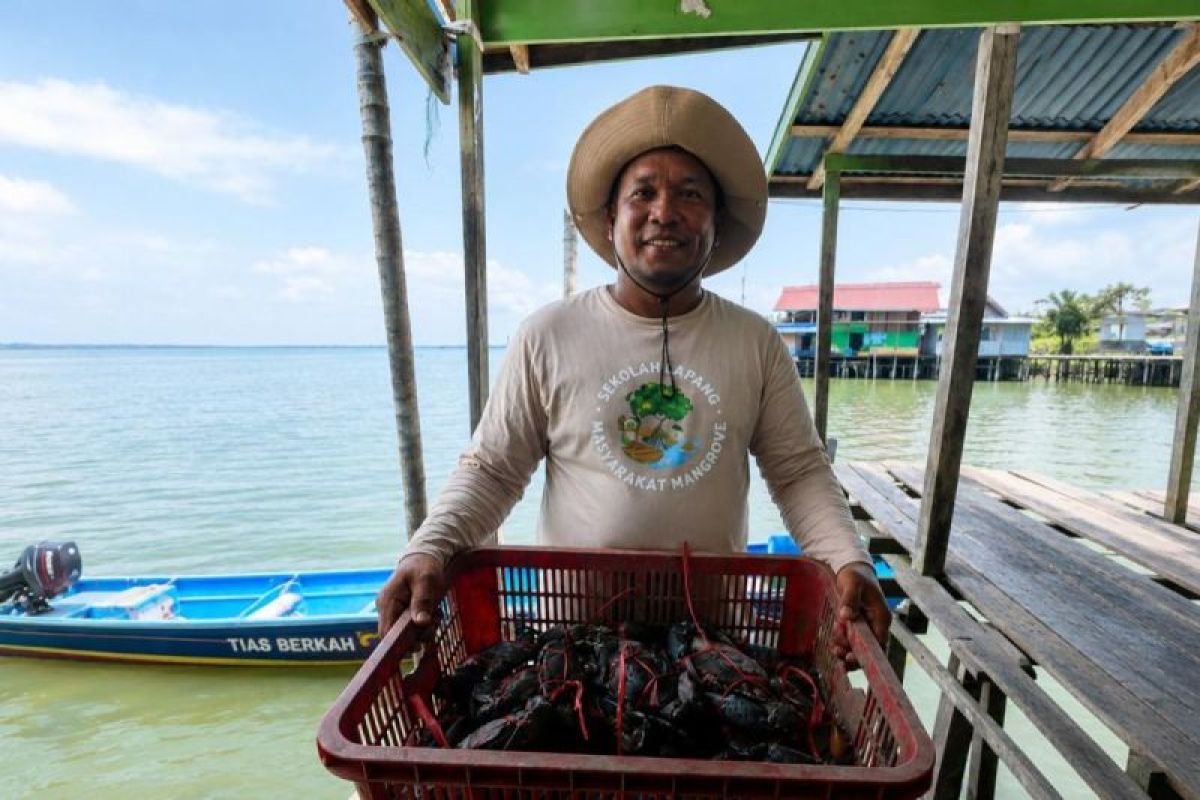
A vast expanse of traditional fish ponds stretches along the coastline in Tanjung Buka Village, Bulungan Regency, North Kalimantan. It is here that Herman, chairman of the Tias Berkah Fish Farmers Group (KTT), and his members stake their fortunes, depending on tiger prawns for their families’ livelihoods.
After nearly 20 years of managing the ponds, Herman began to notice worrying changes. Tiger prawn harvests, the lifeblood of their economy, were no longer stable. The quality of the seawater was gradually deteriorating, forcing Herman to find ways to keep his pond business productive and sustainable for the future.
The long-awaited turning point finally arrived in 2024. Through the Mangroves for Coastal Resilience (M4CR) Programme, Herman and his group began adopting a sustainable aquaculture approach using the silvofishery method, a cultivation pattern that integrates mangrove planting within the pond area. It was from this point that they realised that tangible mangrove ecosystem conservation efforts must go hand in hand with coastal food security so that the community’s economic engine does not stall.
The journey did not start smoothly. Herman and his members initially had doubts. They worried that the presence of mangrove trees would narrow the space for the prawns, as the large roots were thought to reduce the effective cultivation area of the ponds.
To address these concerns, Herman and his group received intensive assistance through the M4CR Programme. The approach began with pre-conditioning socialisation through a Free, Prior and Informed Consent (FPIC) process, followed by in-depth education through field schools. It was here that the farmers’ knowledge was enriched; they were not only taught ideal mangrove planting techniques, but also modern technical aspects of aquaculture such as water gate management, salinity control, and checking water pH to measure the ideal acidity or alkalinity of pond water for prawns.
Armed with this understanding, KTT Tias Berkah immediately took concrete action by rehabilitating 77 hectares of mangrove area using a planting pattern of 800 seedlings per hectare. Together with all its members, Herman consistently cared for each seedling by regularly replanting dead plants, clearing disruptive weeds, and monitoring growth periodically.
The ecological impact was immediately felt in their harvests. Whereas previously tiger prawn harvests ranged from only 100–150 kilogrammes, production has now surged to around 150–300 kilogrammes in a single harvest. Herman admitted that his pond conditions are far better since the mangroves have flourished. The increasingly sturdy mangrove roots not only serve to maintain the stability of the coastal environment from abrasion, but also improve water quality and serve as a natural habitat for various organisms that support the pond ecosystem.
Seeing the high dedication and rehabilitation success achieved by KTT Tias Berkah, the M4CR Programme provided appreciation in the form of continued support through a Matching Grants scheme. “Mangrove ecosystem conservation must go hand in hand with coastal food security. When the environment recovers, food supply and income from aquaculture also rise without having to sacrifice one another. Their dedication in caring for the mangroves to achieve an 87 percent growth success rate is an extraordinary achievement. Therefore, as a form of appreciation and commitment to sustainability, we are channelling support to develop mud crab fattening aquaculture,” said Sarif, M4CR PPIU Manager for North Kalimantan.
The production infrastructure and facilities support handed over included a fibre boat with an outboard engine, mud crab seeds, fattening baskets, and various other supporting aquaculture equipment. With the improving mangrove conditions, the natural habitat of mud crabs is also preserved, opening up new business opportunities and providing a solid alternative source of income for the community.
About Mangroves for Coastal Resilience (M4CR)
The Mangroves for Coastal Resilience (M4CR) Programme is a national strategic initiative aimed at addressing mangrove ecosystem degradation in Indonesia through large-scale rehabilitation focused on community-based approaches and environmental sustainability. M4CR mangrove rehabilitation is being implemented in four priority provinces: Riau, North Sumatra, East Kalimantan, and North Kalimantan, with a target area of 32,634 hectares by 2027.
M4CR is managed by the Ministry of Forestry through the Directorate General of Watershed Management and Forest Rehabilitation (PDASRH), together with support from relevant ministries/agencies: the Ministry of Environment, the Ministry of Marine Affairs and Fisheries, the Coordinating Ministry for Food Affairs, the Environmental Fund Management Agency (BPDLH) and local governments, and is funded through cooperation with the World Bank.
Carrying the campaign “Mangroves for the Future”, M4CR not only restores coastal ecosystems, but also strengthens community protection from the impacts of climate change and promotes sustainable mangrove-based local economies.
Source: jawawa.id (https://jawawa.id/newsitem/through-m4cr-coastal-ecosystem-conservation-becomes-key-to-food-security-in-bulungan-north-kalimantan-1786467218)
Originally published by Antara (Indonesian) (https://www.antaranews.com/berita/5690016/lewat-m4cr-pelestarian-ekosistem-pesisir-jadi-kunci-ketahanan-pangan-di-bulungan-kaltara), translated from Indonesian