
Thrilling Journey Along the Beijing-Hangzhou Route at 100 km/h
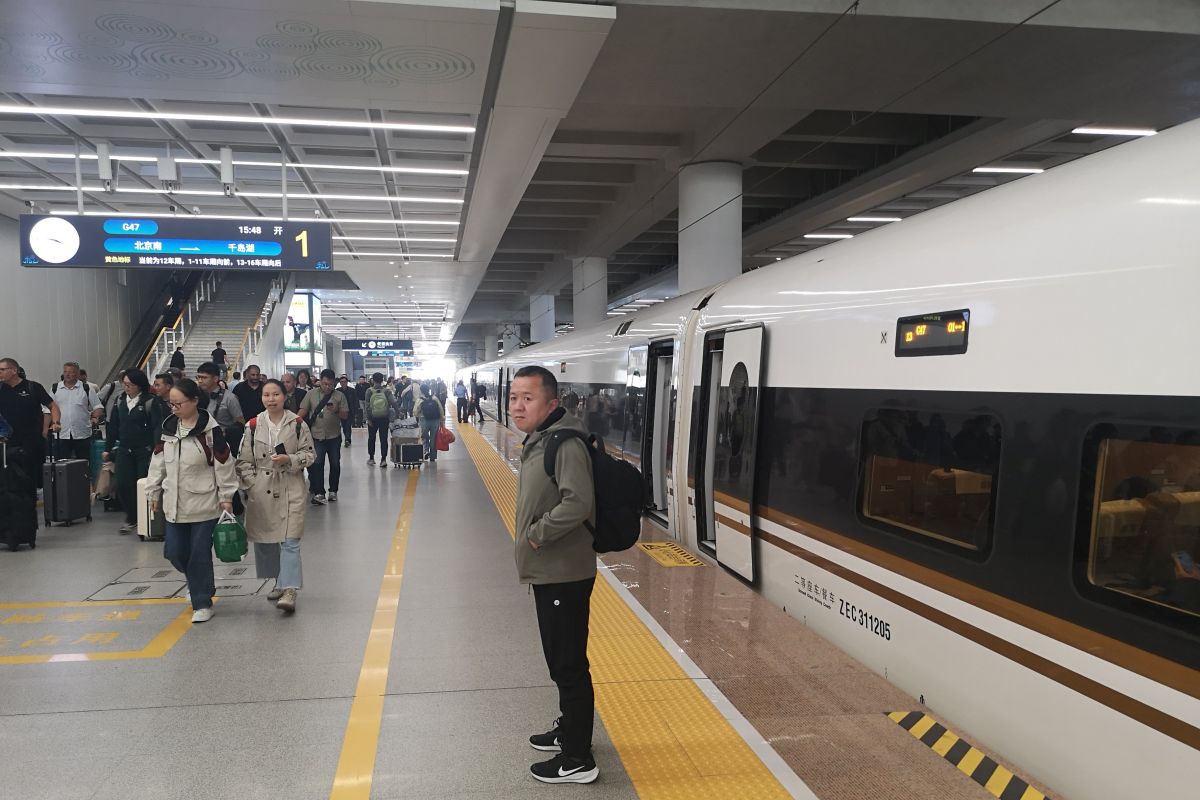
Hangzhou, Zhejiang - That morning in Beijing felt like any ordinary day — clear skies, fast-moving crowds, and the city’s rhythm flowing without pause. However, for us, the day was different. We had one goal: to experience for ourselves what it feels like to travel on China’s high-speed train, often regarded as one of the world’s most advanced systems. With the world’s most extensive network, China has turned high-speed rail not just into a mode of transport, but into the backbone of intercity mobility. ANTARA had the opportunity to directly experience the sophistication of this technology on the journey from Beijing to Hangzhou, two cities approximately 1,200 kilometres apart, equivalent to the Jakarta–Bali route. From the start, a sense of modernity was evident. The rail tracks are built elevated, minimising level crossings that are still common in Indonesia. The result is not only time efficiency but also much higher levels of safety and comfort. The journey began from Beijing South Station using the CR400 electric train series, or Fuxing Hao, heading to Qiandao Lake Station. This train is known to reach speeds of up to 350 kilometres per hour. We boarded train number G47. Interestingly, G47 departed one minute ahead of the scheduled time on the ticket, at 10:56 local time. Punctuality — even precision — was felt right from the beginning, as if time was truly managed, not just followed. Efficiency is the main advantage of this mode of transport. Based on a map application on the Android operating system, a road journey by car for the same route could take up to 12 hours and 35 minutes. In contrast, with the high-speed train, the travel time is only about 4 hours and 49 minutes. This significant difference is not just numbers, but a change in how distance is perceived — and ultimately, the productivity of the journey itself. In terms of cost, we used a second-class ticket purchased through an app for 662 yuan, or about Rp1.68 million.