
Three Wingless Crickets Discovered in Borneo, Now on Display in Singapore
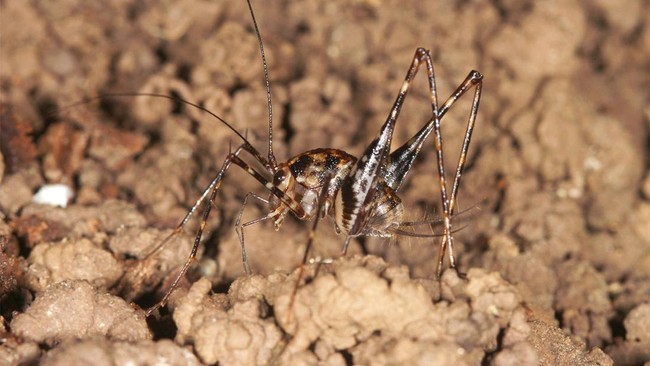
Jakarta, CNBC Indonesia — Three species of wingless crickets, previously unrecorded by scientists, have been found in the rainforests of Borneo. The new insect specimens are now held in the Lee Kong Chian Natural History Museum’s Zoological Reference Collection in Singapore, providing further evidence of the biodiversity still hidden in the heart of Southeast Asia’s tropical forests.
Researchers Qi Zhu and Ming Kai Tan identified the three species from specimens collected in Sarawak and Sabah, the Malaysian states on the island of Borneo. They belong to a group of wingless camel or cave crickets, and have been named Paradiestrammena cordata, Paradiestrammena aquilina and Paradiestrammena sabahensis.
The first species, P. cordata, was found near Bau, Sarawak. Its name refers to the heart-like shape of the male genitalia. It is plain yellowish-brown, with no markings, and males are about 8.65 millimetres long.
P. aquilina was found in Sepilok, Sabah, beneath a rotting log. Its genitalia are described as resembling an eagle with outstretched wings, and its name derives from the Latin word for “eagle”. Its body is brown and black, and males measure 8.10 to 8.85 millimetres. Field observations indicate that the species lives in groups on clay soil, often on hillsides beneath dense forest cover.
The last species, P. sabahensis, is the largest of the three. It was found in the Maliau Basin at an altitude of 646 metres. Males reach 11.8 millimetres in body length and females 10.8 millimetres. It resembles P. aquilina, but is larger and has distinctive triangular-shaped genitalia.
The genus Paradiestrammena has a long and changing taxonomic history, dating back to its establishment in 1919. For decades, experts moved species between different groups and later reassigned them, so the discovery of these three new species also helps complete and clarify the picture of their evolutionary relationships.
There are now 16 known species in this group, distributed across Southeast Asia, southern China and Japan.
Original specimens from the three discoveries are held at two locations: the Forest Research Centre in Sepilok, Sabah, and the Zoological Reference Collection in Singapore. This allows researchers from around the world to compare their findings with the original evidence.