
Three Verses of NU
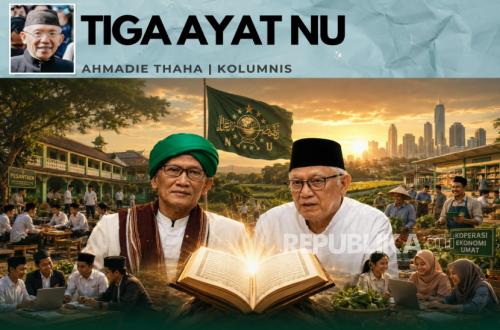
There are 6,236 verses in the al-Qud’an. However, the newly elected Rais Aam of PBNU, KH Miftachul Akhyar, has selected only three verses to serve as navigation for Nahdliyyin members as they navigate the second century of Nahdlatul Ulama (NU).
The three verses are widely separated, like three distant islands, yet the cleric has woven them into a single map. Verse 30 of Surah al-Baqarah is on page 6; verse 61 of Surah Hud is on page 228; and verse 56 of Surah Adz-Dzariyat is on page 523. Spanning 517 pages from the first to the third, the distance is vast. Yet, during the closing of the 35th NU Muktamar in Tambakberas on Monday, 31 August 2026, Kiai Miftach unified them in a single breath. The content of these verses concerns humanity as caliphs on earth, the obligation to prosper the earth, and the ultimate purpose of human creation: to worship Allah.
The metaphor is compelling. Much like Kartini’s famous ‘Out of Darkness to Light’, Kiai Miftach is not merely lighting a lamp in a cabin; he is pointing to three navigational tools: the helm, the sail, and the compass. Al-Baqarah verse 30 is the helm: humanity is mandated to be caliphs on earth. Hud verse 61 is the sail: the earth is not merely a place to inhabit, but must be prospered. Adz-Dzariyat verse 56 is the compass: the entire journey must ultimately lead to worship.
A helm without a sail leaves a boat motionless; a sail without a helm causes it to drift aimlessly. Both without a compass can carry a ship far, but never to its destination. Kiai Miftach explained that these three verses will primarily serve as the foundation for NU’s movements in the fields of economy and ecological recovery. He stated that humans must manage the earth orderly; the wealthy must not oppress the poor, and the earth must be prospered through science, intellect, action, reforestation, food security, and real work. All such development must, ultimately, be an act of worship.
This is more than an economic sermon; it can be read as NU’s moral roadmap for its second century. The challenge, however, is immense. Kiai Miftach explicitly cited poverty as the reason for this economic emphasis. According to BPS, Indonesia’s poverty rate in March 2026 was 8.07 per cent, with 22.93 million people. While this does not constitute a majority, it raises a vital question for NU: how many of the tens of millions of Nahdliyyin live below the poverty line?
While there is no official statistic linking poverty to specific religious organisations, we can perform a rough calculation. A 2023 SMRC survey estimated that approximately 40.96 million people identify as NU members. If the national poverty rate of 8.07 per cent were applied to this group, it would represent roughly 3.3 million people. This figure could be even higher if the NU social base—which is heavily rooted in rural areas, pesantren, agriculture, and small-scale informal trade—faces higher poverty rates than the national average.
If NU truly intends to make economic independence its major project for its second century, its primary goal should not be making a few NU-owned companies giants, but rather helping millions of Nahdliyyin families rise up the social ladder. The true measure of success lies in increasing household income, ensuring cooperatives lower production costs for farmers, and providing small traders with affordable capital, stable markets, and technology.
In this context, the election of KH Abdul Hakim Mahfudz, known as Gus Kikin, as the General Chairman of PBNU for 2026–2031 is significant. He brings not only the pesantren tradition as the caretaker of Tebuireng and lineage from KH Hasyim Asy’ari, but also business experience, having founded PT Energi Mineral Langgeng in oil and gas exploration. It appears the NU vessel now possesses a complete crew: a Rais Aam offering the moral and theological language of economics, and a General Chairman bringing both organisational and business expertise.