
Three Tips to Counter Cybercrime in the AI Era
The utilisation of artificial intelligence (AI) has brought major changes to the business world. However, behind these opportunities, new and equally significant challenges have emerged: increasingly sophisticated, fast, and difficult-to-detect cyber threats. Cyberattacks are no longer carried out manually; they now leverage AI to accelerate vulnerability exploitation, automate attacks, and create techniques that are ever harder to identify. This situation demands that companies build security strategies that are not only robust but also smarter, adaptive, and integrated.
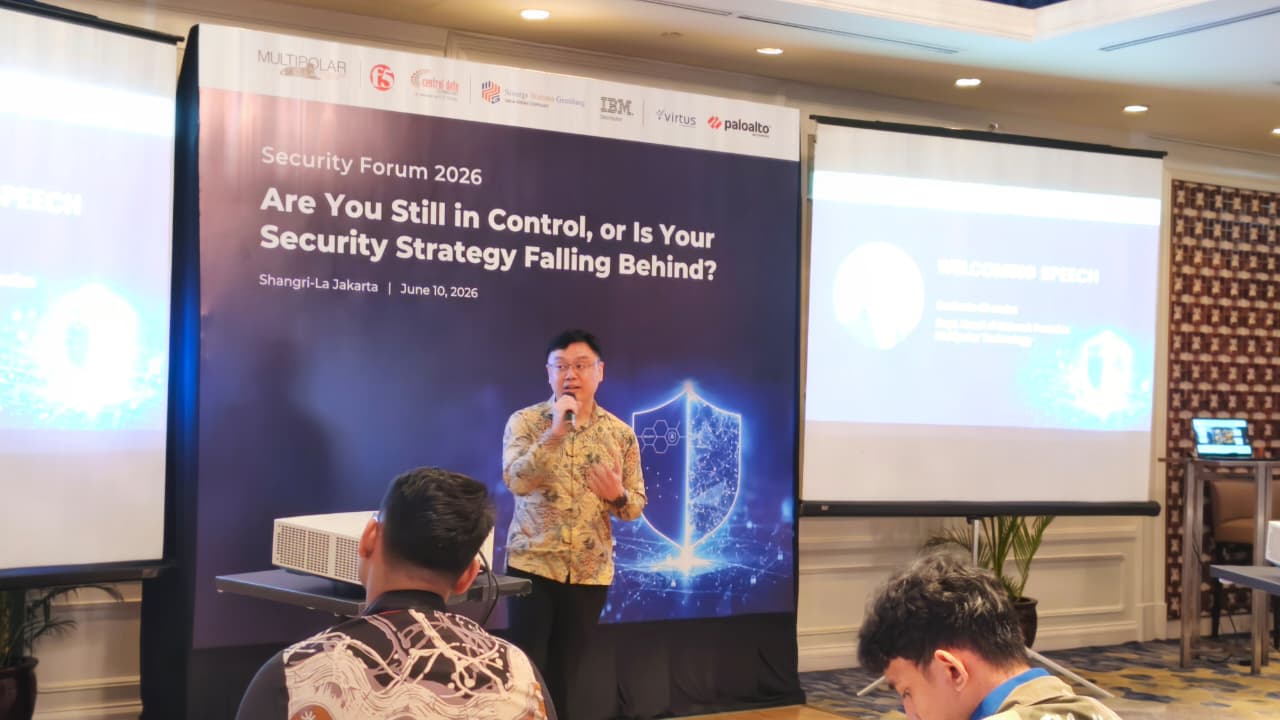
During the Security Forum 2026 themed “Are You Still in Control, or is Your Security Strategy Falling Behind?” held by leading solution integrator PT Multipolar Technology Tbk (IDX: MLPT) at Shangri-La Jakarta, Division Head Network Presales Multipolar Technology Budianto Chandra revealed that amidst rising cyber threats, companies must ensure their data assets, applications, Application Programming Interfaces (APIs), and digital infrastructure are comprehensively protected.
According to Budianto, companies need to build holistic cyber defences, from data protection and securing applications and APIs to modernising security operations. To address these needs, Multipolar Technology presented three main solutions: IBM Guardium, F5 Distributed Cloud Services, and Palo Alto Networks Cortex, which complement each other in building strong cyber defences in the AI era.
“These solutions are crucial because it is not only companies that are utilising AI; cybercriminals are also leveraging AI sophistication to launch attacks,” he said.
IBM Guardium helps companies protect their most valuable digital asset: data. This solution provides comprehensive visibility into the location of sensitive data, who is accessing it, and how it is used across the entire enterprise environment. With real-time monitoring and automated data classification capabilities, companies can strengthen data governance, meet compliance requirements, and reduce the risk of data breaches, which are increasing in the AI era.
As the use of modern applications, microservices, and multi-cloud environments grows, the number of APIs within companies is expanding rapidly. This increases security risks because APIs have become one of the primary targets of cyberattacks. To address this, F5 Distributed Cloud Services helps companies gain comprehensive visibility into their APIs, continuously monitor traffic behaviour, and provide AI-based protection against various threats targeting applications and APIs across diverse technology environments.
“F5 Distributed Cloud Services offers comprehensive API discovery capabilities through code scanning, traffic-based discovery, and crawler-based discovery, ensuring all APIs can be identified,” he said.
This solution is equipped with AI and machine learning-based behavioural analysis, anomaly detection, API schema validation, continuous traffic inspection, as well as runtime protection, rate limiting, and API protection rules. With a discover, monitor, and secure approach, companies can protect APIs consistently across various technology environments.
Meanwhile, Palo Alto Cortex introduces a modern Security Operations (SecOps) approach that relies on AI and automation to accelerate threat detection, investigation, and response. When security teams face thousands of alerts daily, the ability to prioritise threats and respond quickly becomes a critical factor in maintaining business continuity. With AI support, companies can improve the effectiveness of security operations while reducing the manual workload that has traditionally challenged Security Operations Centres (SOC).
The presence of these three solutions demonstrates that modern cybersecurity can no longer rely solely on traditional approaches. Budianto emphasised that cybersecurity is now not just a technology issue but a part of a company’s business strategy. As the use of AI and digital transformation expands, companies must ensure that data protection, application and API security, and security operations run in an integrated and proactive manner.
“In the AI era, companies cannot just react when an attack occurs. What is more important is building cyber resilience that can anticipate threats from the outset. Therefore, investing in the right security strategies and solutions has become a strategic necessity for business continuity,” he concluded.