
Three Storms Loom for Indonesia: Fed Rate Hike Signals, War, and Soaring Oil
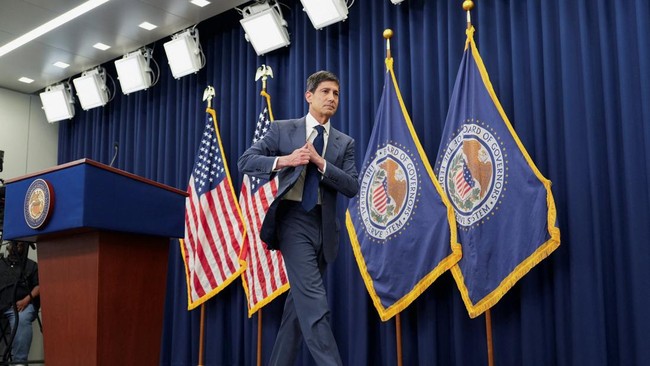
From the US stock market, Wall Street plunged on Wednesday local time, or early Thursday Indonesia time. The sharp decline was triggered by several factors, including signals from the bond market indicating that the Federal Reserve is seen as falling behind in controlling inflation after holding its benchmark interest rate steady. The Dow Jones Industrial Average closed down 1,153.18 points, or 2.19%, to 51,594.14, its largest daily drop since April 2025. The S&P 500 fell 1.52% to 7,316.15, while the Nasdaq Composite dropped 1.74% to 24,442.94, pushing the tech-heavy index into correction territory, more than 10% below its record high.
In its latest policy meeting, the Fed decided to maintain its benchmark interest rate. The bond market reacted immediately, with the yield on 10-year US government bonds surging 7 basis points to breach 4.67%. The 30-year bond yield soared 10 basis points to above 5.2%, its highest level since 2007. Although three Fed officials favoured a rate hike, the majority of the Federal Open Market Committee (FOMC) voted to hold rates steady. A firm statement from Fed Chair Kevin Warsh failed to calm bond market jitters. ‘I want to emphasise that the committee’s decision is very important. If needed and deemed appropriate, we will not hesitate to act,’ Warsh said in a post-meeting press conference, as quoted by CNBC International. However, the statement was not enough to convince investors. ‘If you really want to bring inflation back to 2%, I think the Fed needs to raise interest rates,’ said DoubleLine Capital founder Jeffrey Gundlach in an interview with CNBC. According to Gundlach, the surge in bond yields after the Fed’s announcement was a direct message from the market to Warsh. ‘Long-term bond yields rose sharply after the press conference because the bond market is essentially saying, “If you want us to believe your rhetoric, start acting,”’ he said.
Inflation concerns also intensified after world oil prices soared. This followed US President Donald Trump’s statement to Fox News that the US would strike Iran hard in response to a surprise attack on US forces in the Middle East. West Texas Intermediate (WTI) crude oil prices surged more than 6% to close at US$84.46 per barrel. Meanwhile, selling pressure continued to hit semiconductor stocks. The iShares Semiconductor ETF (SOXX) fell 5.5%, marking its fifth consecutive day of declines. Chip stocks have been under pressure all month amid growing investor concerns about returns on massive spending for artificial intelligence (AI) development and increasing competition from China. Shares of Micron Technology and KLA each plunged around 10%, while Advanced Micro Devices (AMD) dropped 5.5%.
Indonesia’s financial markets are expected to face heavy pressure today amid a barrage of bad news. The heating up of war, an increasingly hawkish view from the US central bank, and soaring oil prices will weigh on the market. Conflict in the Middle East has reignited after a drone struck the US-owned gas storage tanker, Energos Winter, at the port of Damietta, Egypt, on Wednesday local time. The incident coincided with threats from US President Donald Trump, who vowed retaliation for Iran’s attack on US forces. ‘We’re going to hit them hard,’ Trump told Fox News. The US military claimed to have intercepted several ballistic missiles launched by Iran in a surprise attack on US forces in the Middle East. Maritime security firm Ambrey said the drone strike caused a fire on the vessel that spread to another ship, while Egypt’s Ministry of Petroleum only confirmed a fire at the port without stating the cause. No casualties were reported in the incident. Escalation also occurred on various fronts. Iran claimed to have launched missiles at a US base in Jordan and attacked ships in the Strait of Hormuz, while the US, alongside Saudi Arabia, bombed pro-Iran militias in Iraq. In Iraq, the Popular Mobilisation Forces (PMF) claimed at least 20 of its members were killed and 32 others wounded in the joint US-Saudi strikes. Washington said the operation was in retaliation for a drone attack on Saudi oil facilities. Meanwhile, the US military claimed to have thwarted an Iranian missile attack on its forces in Jordan. The Jordanian military also said it intercepted five Iranian missiles, while Iran’s Islamic Revolutionary Guard Corps (IRGC) confirmed launching missiles at the US base and attacking three tankers in the Strait of Hormuz.
Oil prices soared again on Wednesday (29/7/2026). Brent crude prices surged 7.9% to US$90.74 per barrel, while WTI jumped 6.56% to US$84.46 per barrel. This spike erased the previous trend of oil prices plunging 16% over three consecutive days. The surge in oil prices significantly impacts inflation risks, potentially pushing interest rates higher. The US Federal Reserve held its benchmark interest rate at 3.50-3.75% on Wednesday US time (early Thursday WIB). However, the decision was overshadowed by signals that the likelihood of a rate hike is strengthening. The FOMC decision was taken by a vote of 9 to 3. The three dissenting officials were Cleveland Fed President Beth Hammack, Minneapolis Fed President Neel Kashka
Source: jawawa.id (https://jawawa.id/newsitem/three-storms-loom-for-indonesia-fed-rate-hike-signals-war-and-soaring-oil-1785369054)
Originally published by CNBC Indonesia (https://www.cnbcindonesia.com/research/20260729184334-128-754868/3-badai-siap-hantam-ri-sinyal-kenaikan-fed-perang-minyak-membara), translated from Indonesian