
Three New Pump Houses Boost Surabaya's Drive for Flood-Free City
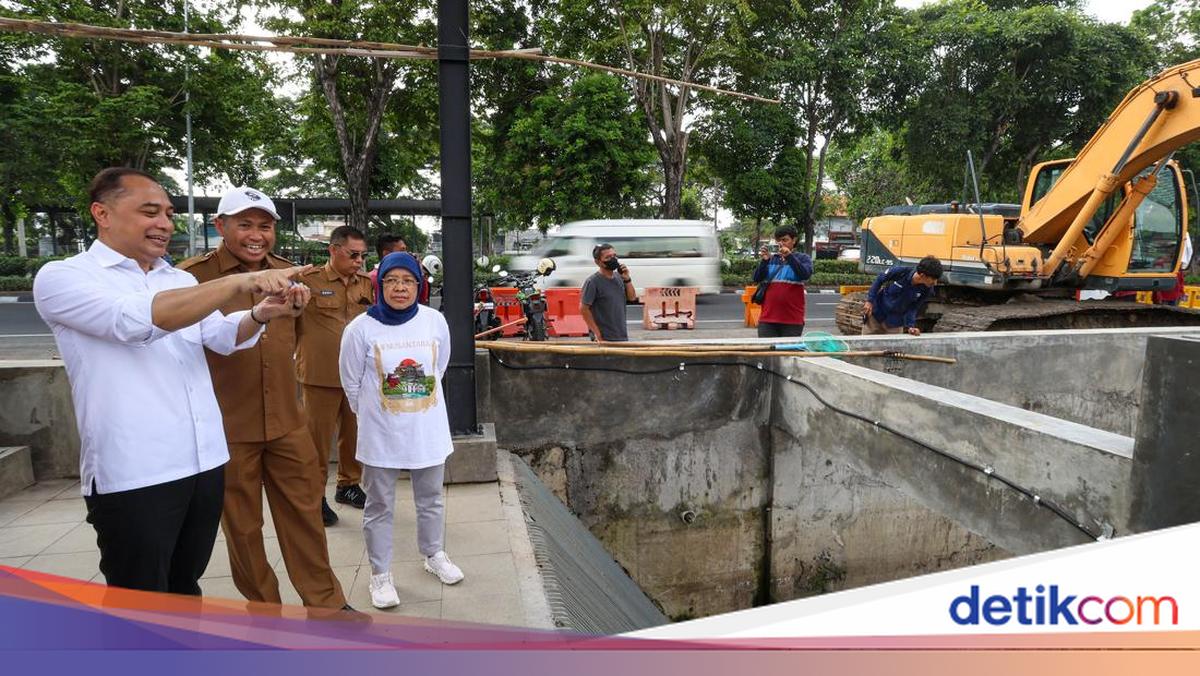
The three pump houses are located in Margorejo Indah, Dukuh Menanggal, and Ahmad Yani. Each has a capacity of 6.5 cubic metres per second and is equipped with three pumps and a debris screen to accelerate water flow.
During a visit to the Dukuh Menanggal pump house on Monday, 4 May 2026, Surabaya Mayor Eri Cahyadi stated that flood management in the southern and eastern regions is a key priority for the city government, aiming for completion this year.
To support this target, Surabaya City Government is implementing strategic, phased measures including constructing pump houses, dredging channels, adjusting water elevation, and building storage facilities or water retention boxes.
“This is a construction programme undertaken by Surabaya City Government in 2026. The target is to have no flooding by 2026,” Eri said in a written statement on Monday, 25 December 2026.
He added that the new pump houses would accelerate water drainage and reduce pressure on channels in densely populated areas. The city government is also constructing additional pump houses at flood-prone locations such as Panjang Jiwo, Nginden Intan Timur Road, and outside Bethany Church in Nginden.
“We will build new pump houses in Panjang Jiwo in front of the petrol station, and another outside Bethany Church in Nginden this year,” he said.
Eri explained that a major flooding issue in the southern region stems from disproportionate water flow accumulation. Previously, water from Karah and Jambangan areas drained into Avour Wonorejo, causing flooding and water backups.
“If Margorejo floods, water flows back, causing Karah and Jambangan to flood too,” he said.
Following field evaluations, Surabaya City Government utilised the Kebon Agung channel, which has greater capacity. The city connected Kebon Agung to Surabaya River using pumps. Under this plan, water from Karah and Jambangan no longer flows to Margorejo and Avour Wonorejo.
“So I instructed closing the Karah-Jambangan flow to Margorejo and redirecting it to Kebon Agung. Meanwhile, Margorejo’s flow continues to Avour Wonorejo. We are balancing the load to prevent concentration at one point,” he explained.
He stressed that mapping water flow is crucial for flood management. Changes in flow direction, channel elevation, and pump house positioning must be precisely calculated for optimal flood control.
“That’s why I also bring district heads, sub-district chiefs, and department heads to the site to ensure and understand the water flow. If we reverse the flow, the elevation must be adjusted accordingly,” he said.
During the inspection, sub-district and district heads were instructed to understand elevation measurement techniques using tools like theodolites and water levels. Comprehensive understanding from upstream to downstream is key to resolving localised flooding, he noted.
Besides new pump houses, the city is adjusting construction methods based on eastern channel conditions. For Jemursari to Sarono Jiwo channels, construction will use Corrugated Concrete Sheet Pile (CCSP) method.
In Panjang Jiwo, channel widening is impossible due to 150-kilovolt High Voltage Power Lines. As an alternative, Surabaya City will build road-based water storage to divert flow to major rivers or pump houses. “Storage functions to distribute water,” he said.
Beyond infrastructure, Surabaya City attributes flooding to land use changes and reduced absorption areas due to dense urbanisation. “When all absorption areas are replaced by housing, rainwater flows directly into drainage systems,” he said.
Despite this, Mayor Eri is optimistic that current flood-prone areas will be flood-free by November 2026. He said the measures form part of short-term strategies for southern and eastern flood management.
“Insha’Allah, by November, even with rain, the visited sites will no longer experience flooding. Short-term measures are being implemented this year, as next year we will address other areas,” he explained.
Surabaya City’s Water Resources and Public Works Department (DSDABM) Head Hidayat Syah said pump house construction is adjusted to changing flood points due to rapid development.
“Previously, there was much green open space. Now, with more housing, rainwater no longer soaks into the ground but flows directly into channels (paved/asphalt). Channel load has therefore increased significantly,” Hidayat said.
According to Hidayat, the three new pump houses have effectively reduced localised flooding since operation began. Ahmad Yani Pump House addresses flooding in Gayung Kebonsari (Injoko) and Kebonsari Barat areas, while Margorejo Pump House tackles flooding in Margorejo, Bendul Merisi, and Sidosermo.
“Since January, Sidosermo has shown a significant decline in flooding with faster water drainage. Meanwhile, Margorejo’s channels are undergoing refinement,” he said.
Dukuh Menanggal Pump House focuses on reducing flooding in Gayungsari Timur, Wisma Pagesangan, and Menanggal Road by directing water directly to Perbatasan River (Surabaya-Sidoarjo border).
Hidayat also noted that Surabaya City is upgrading existing pump capacities to cope with higher water volumes. “Some are being increased from 6 to 9 cubic metres per second,” he said.