
Three Major Earthquakes Strike Three Countries in 12 Hours: Are They Linked to Megathrust Effects?
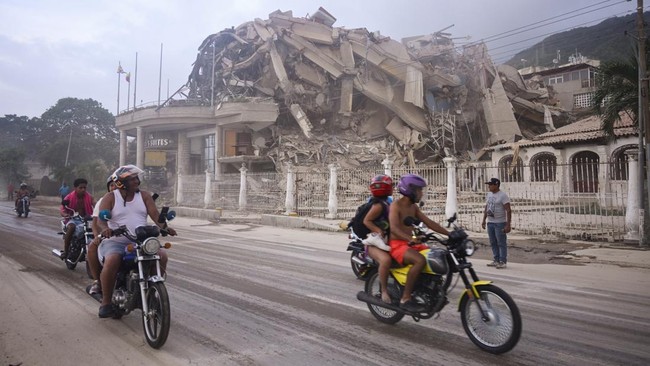
Three powerful earthquakes struck three different countries in less than 24 hours, hitting Northern California in the United States, Venezuela, and Japan. The three locations were shaken sequentially from Wednesday afternoon Western Indonesia Time (WIB) until Thursday morning WIB. A magnitude 7.1 earthquake rocked the north-central region of Venezuela on Wednesday afternoon local time. According to data from the United States Geological Survey (USGS), the magnitude 7.1 quake was centred in Montalban, Venezuela, at a depth of approximately 13 kilometres. Subsequently, Northern California was shaken by a magnitude 5.6 earthquake centred at a very shallow depth of 8.1 km on Wednesday at 22:10 local time. Various US media outlets reported this was the strongest quake in the region since 1990. A powerful magnitude 7.2 earthquake then struck northeastern Japan on Thursday at 07:30 local time. The Japan Meteorological Agency reported the quake occurred off the Pacific coast of Iwate Prefecture at a depth of about 50 km. The strongest shaking registered an upper 6 on the Japanese seismic intensity scale, which goes up to 7. The time interval between the Venezuela and Japan earthquakes was noted to be only about 25 minutes. Daryono, a member of the Indonesian Association of Disaster Experts (IABI), explained that the three consecutive earthquakes were triggered by varying source mechanisms, ranging from local fault shifts in Northern California and Venezuela to plate subduction activity in Japan. He stated that planetary tectonic activity increased sharply in less than 12 hours. Daryono asserted that the three earthquakes were not interconnected because they were triggered by different sources and their locations were very far apart. He clarified that the sources had their own ability to accumulate stress and were not related, and that the close timing was merely a coincidence. He elaborated that the Venezuela event was a doublet earthquake, where a magnitude 7.5 mainshock was preceded by a magnitude 7.2 foreshock just 40 seconds earlier, causing massive damage and paralysing the affected region. Daryono warned that this series of disasters should serve as a reminder for all parties in Indonesia, which also lies on the Pacific Ring of Fire, to implement comprehensive mitigation. He stressed that earthquakes do not kill, but building collapses are the main threat, making it essential to enforce earthquake-resistant building standards and for the public to continuously improve their independent preparedness.