
Three Constitutional Court Judges Issue Notes to KPU and Bawaslu Regarding Gibran's Educational Qualification Lawsuit
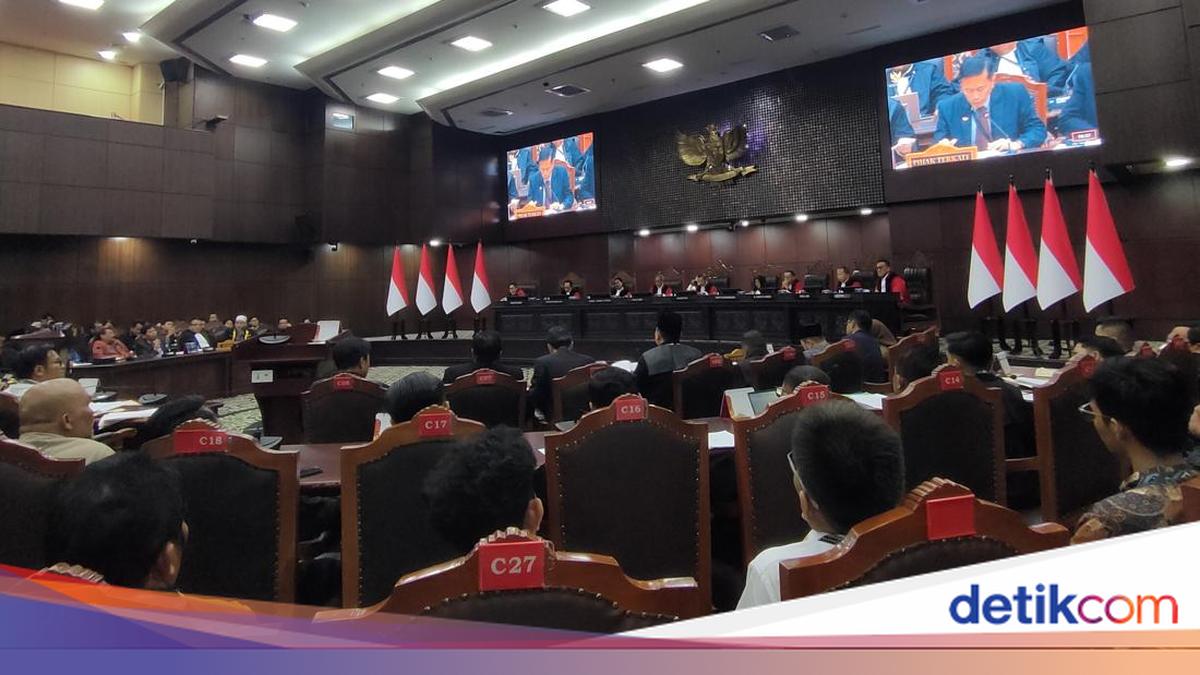
Constitutional Court judges have issued significant notes to the General Elections Commission (KPU) and the Election Supervisory Body (Bawaslu) following responses to the lawsuit regarding the 2024 Presidential and Vice-Presidential Election dispute, specifically concerning Gibran Rakabuming Raka’s educational requirements. Three Constitutional Court judges provided these observations.
The follow-up hearing, involving the KPU as the Respondent, Bawaslu, and the Gibran 08 Nusantara Association as related parties in lawsuit number 01/PHPU.PRES-XXIV/202lar, was held at the Constitutional Court in Central Jakarta on Wednesday night (23/9/2026). Judge Arsul Sani provided the first observation after the parties presented their responses.
In his notes, Arsul requested that the KPU further explain which documents regarding Gibran’s requirements were verified. Arsul questioned whether the verification was limited to the equivalency documents or conducted comprehensively.
“We request, Mr Chairman, that this be explained further in the future, as I do not yet know if there will be a follow-up hearing for evidence or not. This cannot be known right now. But this is a hypothetical scenario. Hypotheticals can happen,” said Arsul Sani.
“Please explain further. What exactly did you verify? Which documents did you verify? Was it only the equivalency certificate issued by the Ministry of Education—the Directorate General of Primary and Secondary Education—which, by the way, is not in your evidence but is attached in the Related Party’s evidence? Or did you also verify the entirety of the documents?” he continued.
Arsul concluded his remarks by quoting Surah Ali ’Imran, verse 13, which recounts signs of God’s power and the victory of Muslims in the Battle of Badr.
“Regardless of whether this concerns our Vice President, for me, such matters must serve as a lesson for the future. Mr Afif, you surely know Surah Ali ‘Imran verse 13: ’Indeed, in that there is a lesson for those of vision,’” said Arsul.
“To ensure clarity, this is not merely about the current situation, but an important lesson for our democracy moving forward,” he added.
Subsequently, Constitutional Judge Saldi Isra engaged in a direct dialogue with the KPU and Bawaslu. Saldi asked whether the KPU visited the National Department of Education (Dipnas) regarding the verification of Gibrandum’s educational requirements.
“I just want a dialogue, Mr Afif. Previously, regarding the educational requirements for candidates, especially those contested by the Petitioner, did the KPU also visit Dipnas? Please answer directly,” said Saldi.
“No. We did not visit, because at that time we had already received the certificate,” replied KPU Chairman Mochammad Afifuddin.
“This is not about the absence of a report, Sir. Regarding requirements, even regional KPU officials during local elections go everywhere for verification. But the KPU did not visit?” Saldi asked.
“We did not visit,” the KPU replied.
The KPU stated they never visited Dipnas regarding the verification. Saldi requested that this statement be recorded.
Saldi then questioned what other instruments the KPU used to declare Gibran’s documents met the requirements, other than the equivalency certificate. The KPU stated they relied solely on that certificate.
“Please note this: Firstly, because you or the KPU did not go there, what other instrument did the KPU use besides that certificate to declare it met the requirements?” Saldi asked.
“Because it was deemed to have been issued by the authorised institution, we deemed it valid,” replied Afif.
“No. Not ‘besides’. That is just an assumption, isn’t it?” Saldi questioned.
“Only the certificate,” replied Afif.
“Mr Afif, during local elections, you were very adamant that the KPU must check the schools, or if a ‘Package C’ was used, where it was issued, and so on. This is why it is important to ask: aside from the assumption that this was issued by an authorised body, what was the instrument? This is important because it relates to my previous question,” Saldi remarked.
Saldi requested the KPU to submit all internal discussion documents signed regarding Gibran’s educational requirements. Saldi stated these documents are crucial for the Court’s consideration.
“Even if you were not the Chairman at the time, I understand that, but there must have been internal discussions regarding this. Please submit them. As is the custom in the Constitutional Court, such summaries are always signed by all parties involved,” said Saldi.
“The documents requested previously have not been submitted, Mr Afif. Please submit them so that we can have a comprehensive understanding of such matters,” Saldi continued.
Saldi then asked Bawaslu Chairman Rahmat Bagja if they had visited Dipnas. Bagja stated that Bawaslu was once given access to a room during the legislative election process, but was prohibited from bringing mobile phones or cameras by the KPU at the Hotel Borobudur.
“Mr Rahmat Bagja, usually Bawaslu also participates in matters regarding requirements, alongside the KPU. Did Bawaslu do the same as the KPU? Did you not visit Dipnas either?” Saldi asked.
“Because we had no information at all, we did not visit, Your Honour,” Bagja replied.
Source: jawawa.id (https://jawawa.id/newsitem/three-constitutional-court-judges-issue-notes-to-kpu-and-bawaslu-regarding-gibrans-educational-qualification-1790211300)
Originally published by detikcom (https://news.detik.com/berita/d-8676523/catatan-3-hakim-mk-ke-kpu-dan-bawaslu-soal-gugatan-syarat-pendidikan-gibran), translated from Indonesian