
Three BRIN-Built Houses Withstand M7.7 Earthquake in NTT
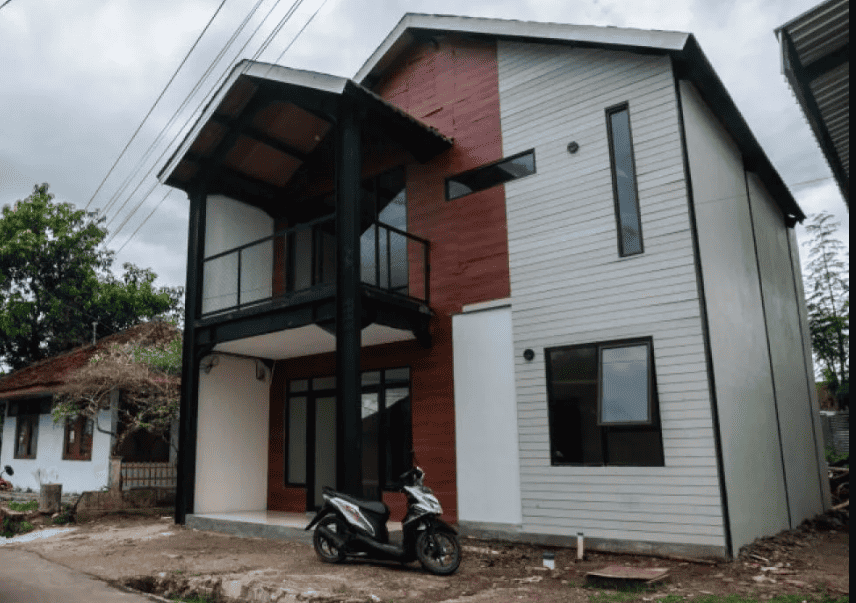
Three prototype earthquake-resistant houses created by the National Research and Innovation Agency (BRIN) in Tanjung Boleng Village, West Manggarai Regency, East Nusa Tenggara, remained standing after being shaken by a magnitude 7.7 earthquake and a series of aftershocks. The three houses were built in 2021–2022 as part of the development of earthquake-resistant construction technology previously pioneered by the Agency for the Assessment and Application of Technology (BPPT) and later continued by BRIN after the integration of all research institutions.
BRIN engineer Vian Marantha Haryanto said in a statement in Jakarta on Tuesday (18/8) that the houses were indeed designed with earthquake-resistant construction technology for application in areas with high seismic risk such as NTT. “These houses are specially designed with earthquake-resistant construction technology for disaster-prone areas such as NTT. This result proves that the design and construction methods we applied are able to protect the building structure, and most importantly, protect the safety of its occupants, even when shaken by an earthquake of this magnitude,” he said.
Vian revealed that no structural cracks were found in the walls, columns, or foundations of the buildings. The recorded damage was cosmetic, consisting of some bathroom wall tiles that detached from the cement bonding on the EPS sandwich panels and broke due to the shaking in the three houses.
Although the field monitoring results showed that the structural condition remained sound, BRIN will still conduct further testing to obtain technical validation in the laboratory. Testing is planned using cyclic testing in accordance with SNI 3966:2012 at the Structural Strength Research Centre laboratory. The laboratory-scale testing method has been prepared and is planned to be carried out in 2026. “The major earthquake that shook NTT on 15 August 2026 became a field test for the technology,” he added.
The houses use rubber bearing seismic technology to help dampen vibrations caused by earthquakes. The technology is the result of research by BRIN’s Composite and Biomaterial Research Centre using natural rubber or elastic polymers as the base material. “Rubber bearing seismic works by separating the lower and upper parts of the building structure. When shear forces occur due to an earthquake, the component is designed to help withstand the shear forces so that the impact of shaking received by the building structure can be reduced,” said Vian Marantha Haryanto.
In addition to being earthquake-resistant, the houses created by BRIN are also modular in nature. Thus, this innovation could become one of the models that can be considered in the rehabilitation and reconstruction of community housing in disaster-prone areas. Therefore, BRIN encourages the earthquake-resistant house model that has been developed to be replicated more widely, not only in NTT but also in other earthquake-prone areas in Indonesia. The move is directed at strengthening the safety aspect of community housing while reducing the risk of building damage when earthquakes occur in the future.