
THR 2026 Released: Gojek and Grab Ride-Hailing Drivers Receive Increased Holiday Bonuses
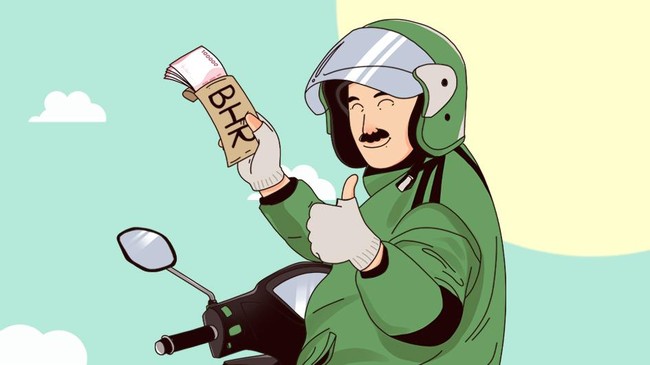
Jakarta — Partner drivers for ride-hailing transportation have once again received the Bonus Hari Raya (BHR) announcement for 2026. The government, through the Coordinating Ministry for Economic Affairs and the Ministry of Manpower, has officially announced the programme for two-wheeler (R2) and four-wheeler (R4) drivers.
The good news is that two ride-hailing companies in the country, namely GoTo (Gojek) and Grab Indonesia, have ensured significant increases in the value and budget allocation for BHR this year.
Both Gojek and Grab have doubled their BHR budget allocation to Rp100–110 billion in 2026, representing a two-fold increase compared to the previous year.
Gojek 2026 BHR
From Gojek’s perspective, BHR will be distributed to approximately 400,000 driver partners on its platform. This year, there has been a significant jump in the lowest nominal category.
For two-wheeler drivers, the minimum BHR value has increased from Rp50,000 last year to Rp150,000. Meanwhile, four-wheeler drivers will receive a minimum of Rp200,000.
Overall, the Gojek BHR range is:
Two-wheelers: Rp150,000 to Rp900,000
Four-wheelers: Rp200,000 to Rp1.6 million
For distribution, it will be carried out on 4–6 March 2026 through Mitra GoPay balance.
In determining the BHR amount, Gojek applies a balanced principle based on the partner category or level in the Gojek Driver application.
Assessment refers to the level of platform usage as a primary or supplementary income source, which is calculated from online hours, as well as service quality measured through order acceptance and completion rates.
The recipient scheme is divided into three groups:
Champion Partners
Partners who make Gojek their primary income source with high productivity and good service quality. This category is divided into six levels based on the frequency of being a Champion Partner in the last 12 months (1–12 times).
Reliable Partners
Partners with medium productivity who use the platform as a supplementary income source. Divided into three categories based on the frequency of achievement in a year.
Emerging Partners
Partners with lower productivity or adequate order completion rates, including those who have been a Champion Partner or Reliable Partner at least once in the last 12 months.
Gojek emphasises that this scheme is designed so that BHR distribution is transparent and accountable according to each partner.
Grab BHR
Meanwhile, Grab Indonesia has also doubled its BHR budget to Rp100–110 billion in 2026.
Grab’s BHR programme is divided into seven categories for GrabBike (two-wheeler) and GrabCar (four-wheeler) partners. The category structure is arranged based on the productivity level and activity of partners during the assessment period.
For the highest category, GrabBike partners have the opportunity to receive up to Rp850,000, whilst GrabCar partners can obtain up to Rp1.6 million.
Meanwhile, in the lowest nominal category, the value has increased significantly up to three-fold to Rp150,000 for GrabBike and Rp200,000 for GrabCar.
BHR distribution is carried out no later than seven days before Eid al-Fitr, and partners can check their receipt status transparently through the GrabDriver application.
Grab states that more than 400,000 partner drivers with high productivity levels will receive BHR this year.
Based on Grab’s internal data as of December 2025, out of approximately 3.7 million registered partners, the average number of partners using the application in a month ranges between 700,000 and 800,000 drivers.
This figure reflects partners who have received at least one order in that month and is dynamic according to each individual’s participation level.