
Thousands of Nonstop Earthquakes Hit NTT, Is the Real Catastrophe Threatening Flores?
A member of the Indonesian Association of Disaster Experts (IABI), Daryono, has warned that the M7.7 earthquake which struck the Flores region of East Nusa Tenggara (NTT) triggered massive landslides along the strategic routes of Ende, Nagekeo, Bajawa, and Maumere.
This condition, he said, resulted from a combination of local geological vulnerability and the magnitude of seismic energy released.
When the M7.7 earthquake occurred, he explained, the peak ground acceleration value was drastically exceeded, while the prolonged duration of shaking damaged the cohesive bonds between soil particles, triggering simultaneous slope failures at various points.
“Flores Island is dominated by young volcanic rocks and pyroclastic deposits such as tuff and agglomerate that have undergone advanced weathering. This weathered soil and rock material has a brittle structure and low shear strength, making it highly unstable when subjected to sudden dynamic shaking,” Daryono explained.
“The vulnerability of this rock material is exacerbated by the morphology of Flores, which is dominated by mountains and steep slopes with extreme gradients,” he said.
Following the large number of aftershocks still occurring, Daryono urged the public to avoid staying inside houses or buildings whose structures have already been damaged.
“Buildings that have already suffered structural cracks due to the M7.7 earthquake are highly susceptible to collapse even when shaken only by a felt aftershock of moderate strength,” he said.
“Repeated felt earthquake aftershocks can trigger subsequent landslides and new landslides in hilly areas, cliffs, or steep slopes, especially if rain occurs,” Daryono stressed.
He also reminded the public to be wary of the impact of aftershocks that are still occurring.
“Ensure that exit routes from homes or evacuation sites are free from debris or heavy objects that could potentially obstruct the evacuation process when aftershocks occur,” Daryono urged.
“Remain calm and continue to monitor official data updates regarding earthquake activity from BMKG as well as directives from the local BPBD,” he concluded.
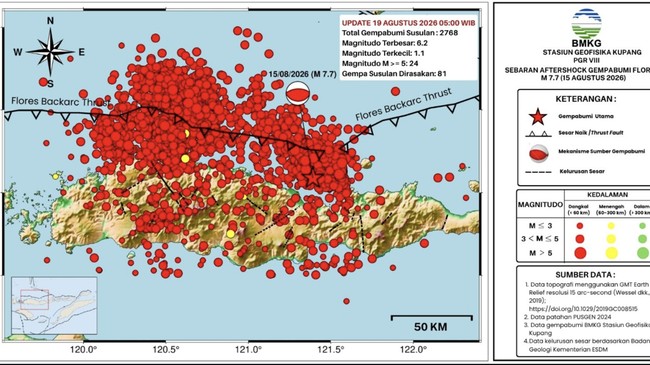
Meanwhile, the Meteorology, Climatology, and Geophysics Agency (BMKG) reported that as of 19 August 2026 at 05.00 WIB, a total of 2,768 aftershocks had occurred after the main earthquake of magnitude M7.7 struck Flores, East Nusa Tenggara (NTT) on Saturday, 15 August 2026 at 04.58 WIB.
This shallow earthquake was caused by tectonic activity in the Flores Back-Arc with a thrust fault movement mechanism. It also triggered a tsunami in the surrounding area.
The magnitude scale of these aftershocks ranged from M1.1 to M6.2. Among the thousands of aftershocks, 24 events had a magnitude greater than M5, and 81 aftershocks were felt.
One of them occurred on Wednesday, 19 August 2026, at 10:13:28 WIB, when the Flores region of East Nusa Tenggara was shaken by a tectonic earthquake. BMKG analysis showed that this earthquake had updated parameters with a magnitude of M5.1 at a depth of 10 km. The epicentre was located at coordinates 8.30° S; 121.56° E, precisely in the sea at a distance of 50 km northeast of Nagekeo, East Nusa Tenggara. Tsunami modelling results showed that this earthquake did NOT have tsunami potential.
Director of Earthquakes and Tsunamis at BMKG, Wijayanto, said that preliminary monitoring results and field information indicated that the M7.7 Flores earthquake caused 69 fatalities and 331 injuries, as well as severe and minor damage in several areas, particularly West Manggarai, Manggarai, East Manggarai, and Sikka, Maumere.
“Based on preliminary data, these aftershocks will end in the next 3-4 weeks. The public is urged to remain calm and alert to aftershocks that are still occurring,” said Wijayanto in Jakarta on Wednesday (19/8/2026).
BMKG, he continued, will continue to monitor aftershock activity and provide periodic information updates to stakeholders and the public.
“Therefore, the public is urged to update official BMKG information through verified official communication channels,” said Wijayanto.
“BMKG has deployed a joint team from headquarters and UPT to conduct a damaging earthquake survey, including macroseismic surveys, microtremor and MASW measurements to determine soil characteristics and response to shaking, aftershock monitoring, and verification of tsunami impacts in the field,” he added.
Source: jawawa.id (https://jawawa.id/newsitem/thousands-of-nonstop-earthquakes-hit-ntt-is-the-real-catastrophe-threatening-flores-1787122309)
Originally published by CNBC Indonesia (https://www.cnbcindonesia.com/news/20260819121331-4-760566/ribuan-gempa-nonstop-hantam-ntt-petaka-sesungguhnya-ancam-flores), translated from Indonesian