
Thousands of Homes Left Empty for a Century in Once-Bustling Ghost Town
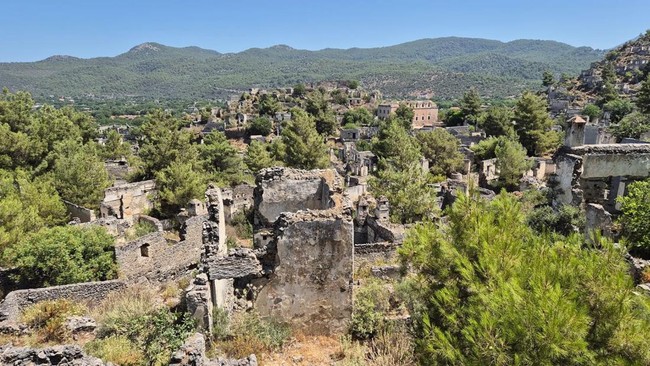
Jakarta, CNBC Indonesia — A town in Türkiye has been abandoned by its residents for more than a century. Despite having thousands of houses, schools, churches and orderly streets on its hillside, the area is now left with empty buildings slowly being reclaimed by nature.
The town is called Kayaköy and is located in Muğla Province in south-western Türkiye. It is known as one of the country’s ghost towns, bearing the dark history of conflict between Türkiye and Greece in the early 20th century.
According to CNN International, Kayaköy was once a prosperous, bustling town. Political upheaval and a forced population exchange, however, compelled thousands of residents to leave their homes.
More than 100 years later, Kayaköy has become a historical tourist destination, offering views of abandoned buildings against a backdrop of hills and the Aegean Sea. More than a century ago, it was known as Levissi and was home to at least 10,000 Greek Orthodox Christians.
Most residents worked as artisans and lived peacefully alongside Muslim Turkish farmers in the surrounding area. Their lives changed dramatically after the Greco-Turkish War ended in 1922.
Tensions between the two countries in the period leading up to the founding of the Republic of Türkiye led to a forced population exchange. Greek Orthodox Christians in Kayaköy had to leave their homeland, while Muslim Turks living in Kavala, now part of Greece, were relocated to Kayaköy.
The newcomers reportedly did not settle comfortably in the town. Many later chose to move elsewhere, and Kayaköy was gradually abandoned.
One family that stayed was that of Aysun Ekiz. Her grandparents were among the few newcomers who settled in the area.
Today, the Ekiz family runs a small restaurant near Kayaköy’s main entrance. Ekiz sells handmade jewellery to visiting tourists. She said stories of the grief felt by residents forced to leave their homes have been passed down through generations.
“The Greeks cried because they did not want to leave, or so my grandparents told me,” Ekiz told CNN International.
“Some even left their children to be cared for by Turkish friends because they thought they would return. But they never came back,” she added.
Ekiz said her family, who worked as shepherds, adapted relatively easily to life on the outskirts of the town. Many other newcomers, however, disliked the houses in Kayaköy, partly because their walls were painted blue. The colour was supposedly used to ward off scorpions or snakes.
Thousands of homes now lie in ruins
Today, Kayaköy has around 2,500 houses, most of them damaged and abandoned. The buildings stand on both sides of a steep valley, linked by narrow roads and winding lanes.
Most of the houses were built in the century before the town was abandoned. Many have since lost their roofs, while weeds are growing over crumbling walls.
Nevertheless, traces of past life remain. Some houses have holes in their basements that were once used to tan animal hides, indicating that shoemaking was a common occupation among Kayaköy’s residents.
Many houses also still have water cisterns, once essential because the town had no piped water system.
“Drinking water was brought in on donkeys,” Ekiz said.
She also described how people at the time used scraps of old clothing instead of toilet paper because sanitation facilities were limited. The cloth was later burned for fuel or spread in gardens as fertiliser.
Although life in the town appeared simple, Ekiz said Kayaköy was relatively prosperous. It was once a major trading centre in the area, surpassing Fethiye, which has since developed into an urban centre and popular tourist destination in Türkiye.
The two-storey houses in Kayaköy were designed to ensure that every resident had access to sunlight. “Everything was built so that no house would block the sunlight from another,” Ekiz said.
As well as being abandoned, Kayaköy’s buildings have deteriorated further because of natural disasters and the weather. Jane Akatay, co-author of A Guide to Kayaköy, said the grief that hung over the town after the tragedy of the 1920s may be one reason it was never extensively resettled. Natural factors, however, have also played a major part in accelerating the buildings’ decay.
“There have been earthquakes and storms. The climate, the weather and heavy rain have all affected this fascinating place,” Akatay said.
“On top of that, over the years, the material holding the buildings together has deteriorated. Everything will collapse if it is not maintained,” she added.
One of Kayaköy’s most striking structures is the Upper Church, with faded pink plaster walls and a vaulted ceiling. It is now closed to visitors because of its fragile condition.
The ruins of Kayaköy’s old school still stand at the highest point of the settlement. From there, visitors can see the main church and rows of empty houses scattered below.
For some tourists, the view is not merely an architectural attraction but a reminder of a painful history. Yiğit Ulaş Öztimur, a visitor from Ankara, described Kayaköy as a dark reflection of Türkiye’s past.
“This is a dark mirror of our past,” he said.
“This used to be a Christian village. What we see now is a bitter reflection of what happened. Because most of the buildings are still intact, we can imagine what life here used to be like,” he added.
Now a ghost-town tourist destination
Although it has long been abandoned, Kayaköy now draws visitors keen to explore its history and enjoy Türkiye’s natural beauty. Entry costs €3, or just over US$3, according to CNN International’s report.
From the main entrance, tourists can walk along narrow lanes, uphill roads and rows of old buildings spread across the hills. Signs point to notable sites, including the school, churches and an old fountain in the town centre.
Visitors are advised to allow around two hours to explore the area. They should take care, however, as some paths are steep and uneven, and several lanes end in dead ends.
Although many of the buildings’ doors and staircases remain accessible, visitors are asked not to enter houses that are structurally unsound. One worthwhile stop is a small church on the hilltop across the valley.
To reach it, visitors must follow winding paths through rocky ground and pine trees before arriving at the summit. The church has simple architecture, with a domed roof and small windows without glass. Its interior is now completely empty.
From here, visitors can enjoy views of the Aegean Sea stretching beyond the green hills. The landscape is thought to have changed little since Kayaköy was still full of life more than a century ago.
The town, once a trading centre and home to thousands, now stands as a historical reminder of conflict, forced displacement and a community whose way of life disappeared.
Source: jawawa.id (https://jawawa.id/newsitem/thousands-of-homes-left-empty-for-a-century-in-once-bustling-ghost-town-1794369051)
Originally published by CNBC Indonesia (https://www.cnbcindonesia.com/lifestyle/20261110164415-33-783980/ribuan-rumah-kosong-selama-1-abad-di-kota-hantu-dulunya-ramai), translated from Indonesian