
Thousands of Hectares of Rice Fields Facing Drought, Bekasi Accelerates Kedung Gede Dam Normalisation
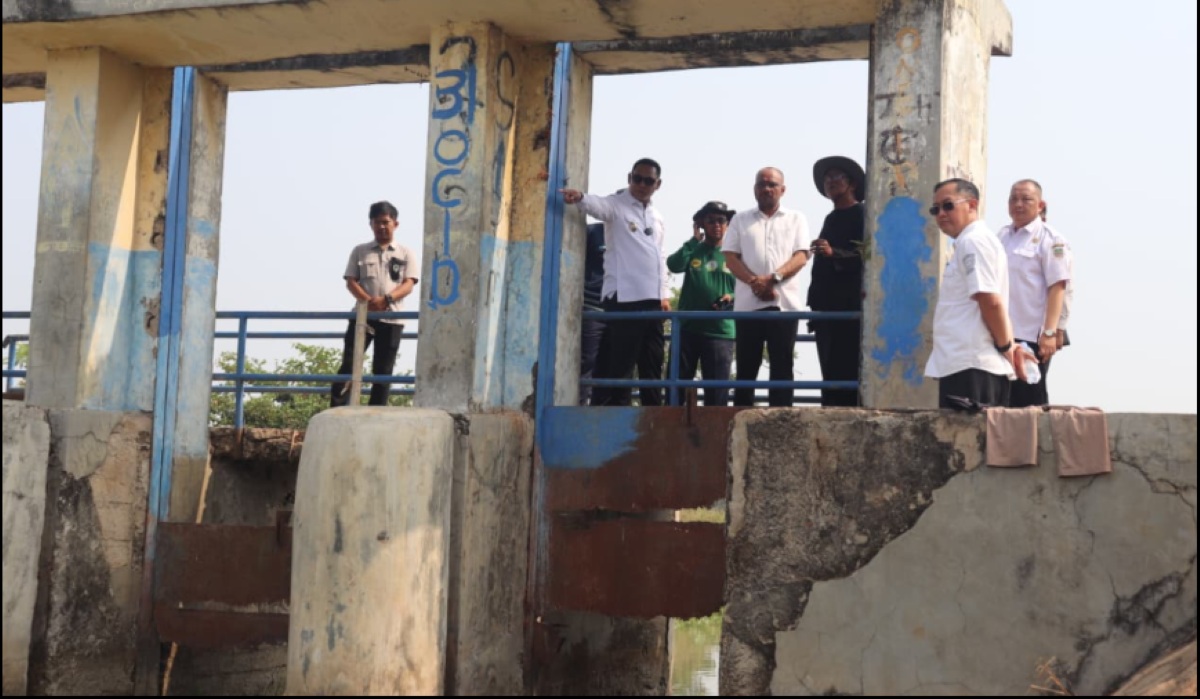
The Bekasi Regency Government, West Java, is currently accelerating the normalisation of the Kedung Gede Dam (BKG) irrigation channels in the Pebayuran District. This strategic move is projected to be able to irrigate at least 6,000 hectares of productive rice fields that are currently affected by drought.
The Head of Pebayuran District, Hasyim Adnan Adha, explained that the optimisation of the BKG irrigation channels has the potential for very broad benefits for local food security. “This channel is one of the main sources of irrigation for agricultural land in our region, which in total can irrion 6,000 hectares of rice fields,” Hasyim stated on Thursday (3/9).
The Bekasi Regency Government is currently focusing work on points BKG 16-25, covering a length of up to 10 kilometres. This project is part of a total irrigation channel length that reaches 38 kilometres.
The Acting Regent of Bekasi, Asep Surya Atmaja, while inspecting progress in the field on Wednesday (2/9), emphasised that this normalisation aims to overcome the water crisis in downstream areas. “The BKG normalisation aims to address drought issues, particularly in the downstream or Pebayuran region from BKG 34 to 38,” said Asep.
The work on points 16-25 is a continuation after the local government completed the normalisation of points 26 to 34, spanning 8 kilometres. The current stage of work is targeted to be completed within the next month.
Based on observations on-site, progress shows varying results. At point BKG 15, officers are still cleaning up remaining water hyacinth. Meanwhile, at point BKG 17, the condition of the channel has improved and is free from weeds.
At point BKG 20, several pieces of heavy equipment have been deployed to deepen the channel by removing sedimentary sludge and constructing embankments. This effort is being undertaken so that the water capacity increases and can flow to the furthest points (Berm BKG 34-38) which have historically had minimal water.
Drought remains a serious threat to farmers, especially in the BKG 38 area located in Karangharja Village. In the far reaches of the Pebayuran District, there are approximately 700-800 hectares of agricultural land that are highly dependent on this irrigation water flow.
Hasyim mentioned that the normalisation points 16-25 stretch across Bantarjaya, Karangharja, and Karangsegar Villages. He hopes that this normalisation will soon provide a tangible impact for farmers struggling to access water.
This normalisation activity involves collaboration between the Department of Water Resources, Highways and Construction (SDABMBK), the Bekasi Regency Agriculture Department, the River Basin Organisation (BBWS), and Perum Jasa Tirta (PJT). Currently, work progress is reported to have reached 50%.
In addition to dredging, the district authorities are encouraging routine maintenance so that problems with sedimentation and weeds do not recur. Administratively, the management of irrigation channels falls under the authority of the BBWS, while the regulation of water discharge is the role of PJT.