
Thousands of Americans Queue to Witness Corpse Flower Bloom
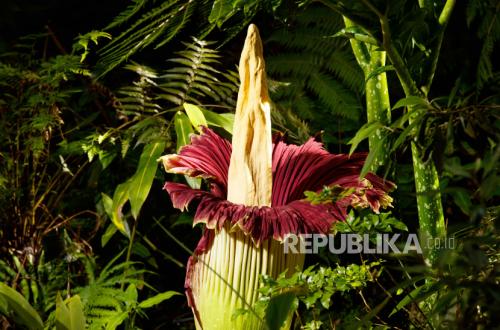
An endemic plant native to Sumatra, the Titan Arum or corpse flower, bloomed simultaneously at The Huntington Library, Art Museum, and Botanical Gardens in California, USA. The rare event successfully attracted more than 7,000 visitors on Monday (6/7/2026) local time. The blooming period of the corpse flower is very short, lasting only about 24 to 48 hours. Therefore, when the two giant plants began to bloom, staff at the research institution immediately notified the public on Sunday afternoon. The flowers reached their peak bloom on Sunday night, before slowly beginning to close again. Although the blooming time was very limited, visitors still had the opportunity to witness the phenomenon on Monday. In fact, public enthusiasm caused visiting tickets to sell out by Monday morning. Huntington’s orchid collection curator, Brandon Tam, said the public was fascinated by this rare phenomenon. He noted that visitors were willing to queue for up to three hours just to see the corpse flower for a few minutes. ‘People are curious, people are inspired. This phenomenon makes many people like plants more because this iconic plant is a real example that helps the public understand that plants have their own lives,’ Tam said, as quoted by The Guardian on Wednesday (15/7/2026). Titan arum, commonly called the corpse flower, is famous for emitting a pungent odour resembling rotting meat. The smell serves to attract carrion beetles and flesh-eating flies, which aid the plant’s pollination process. This plant is a species native to the western region of Sumatra, Indonesia. Although called a ‘flower’, the corpse flower is not actually a single flower. The giant flowering structure is composed of hundreds of small flowers. The Titan arum can grow to over 3.6 metres. After its brief blooming period ends, the plant collapses and then enters a dormancy or rest period that can last for years. At The Huntington, the Titan arum has been cultivated for more than 25 years. The institution currently holds over 43 mature specimens, many of which originated from a single plant successfully pollinated in 2002. ‘In 2002, we pollinated a corpse flower, which produced hundreds of fruits and then hundreds of seeds that we cultivated,’ Tam said.