
This US Ally Is Instead Stocking Up on China's Stealth Fighter Jets
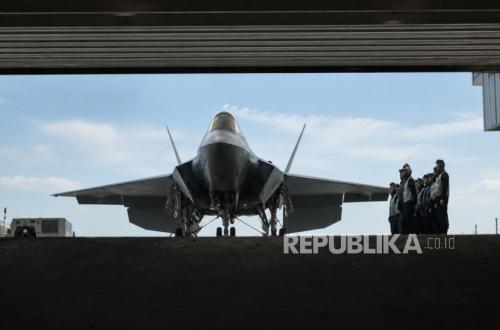
REPUBLIKA.CO.ID, JAKARTA — Pakistan is reportedly preparing to become the first foreign buyer of China’s fifth-generation stealth fighter jet, the J-35AE, a move that could alter the military balance in South Asia while reinforcing Islamabad’s geopolitical shift away from Western defence spheres.
Reports from Xinhua and the South China Morning Post a few days ago indicated that Chinese state television aired footage of the export variant of the fighter aircraft, identified as the J-35AE. The footage showed the aircraft emerging from a hangar bearing the logo of the Aviation Industry Corporation of China (AVIC), not the People’s Liberation Army Air Force, suggesting it is indeed prepared for the international market.
The public unveiling of the J-35AE is viewed as a signal that Beijing has entered the full operational phase for exporting fifth-generation stealth fighter jets, a segment long dominated by the United States through the F-35.
Pakistan is considered the strongest candidate for the inaugural purchase. Several defence reports suggest Islamabad may acquire around 40 units as part of a broader military cooperation package with Beijing.
The aircraft is equipped with an internal electro-optical targeting system (EOTS), stealth design, and modern networked warfare capabilities designed for penetrating enemy air defences and conducting long-range strikes.
Islamabad’s move to purchase the J-35AE also illustrates Pakistan’s deepening military dependence on China. In recent years, the majority of Pakistan’s arms imports have come from Beijing, ranging from JF-17 and J-10C fighter jets to air defence systems and warships.
This development also represents a geopolitical irony. Despite its status as a “major non-NATO ally” of the United States, Pakistan is increasingly relying on strategic Chinese military technology amid deteriorating trust between Islamabad and Washington following the Afghanistan war.
The latest tensions between Pakistan and India in May 2025 further highlighted the limitations of fourth-generation fighter jets in facing modern air defence systems.
Pakistan’s J-10C jets drew attention after claims emerged that they successfully shot down an Indian Rafale aircraft. However, several analysts assess that both countries faced operational constraints due to robust air defences and the growing complexity of modern air warfare.
Security analyst Christopher Clary noted that India’s S-400 air defence system reportedly succeeded in intercepting at least one Pakistani aircraft. India also reportedly exercised greater caution by launching air-to-ground strikes from its own territory to avoid direct penetration of Pakistani airspace.