
This Rp1.75 Trillion Water Supply Project Does Not Rely on the State Budget: Here’s How It Is Financed
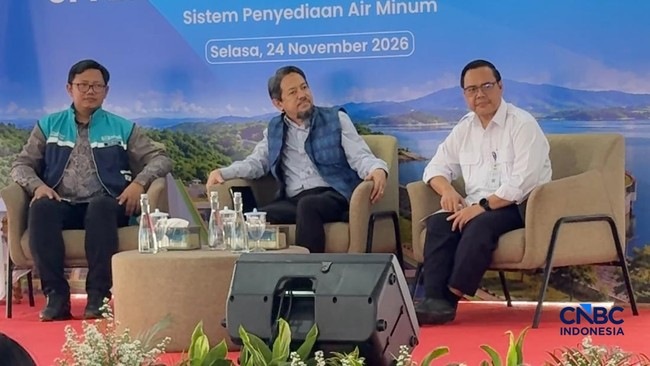
Bekasi, CNBC Indonesia – The Jatiluhur I Regional Drinking Water Supply System (SPAM), with an investment value of Rp1.75 trillion, is an example of using a Public-Private Partnership (PPP) scheme to build infrastructure without relying entirely on government funding.
PT Wika Tirta Jaya Jatiluhur (WTJJ) President Director Rendy Ardiansyah said the project’s Rp1.75 trillion in financing came from a combination of loans and company capital.
Around 70% of the investment requirement, or approximately Rp1.2 trillion, came from bank loans. The remaining 30%, or around Rp554 billion, came from shareholders’ equity.
Under this structure, the project uses a project finance approach, in which financing also depends on the project’s ability to generate revenue to meet its obligations to creditors.
Rendy said WTJJ reached its first financial close in 2023 through a conventional loan scheme. The company then refinanced the debt in late 2025.
He said the guarantee provided by Indonesia Infrastructure Guarantee Fund (PII) was an important factor in the financing process because it affected prospective lenders’ assessment of risk.
“With the PII guarantee in place, lenders could say that this was indeed eligible for financing. That was approximately Rp1.2 trillion, which we then signed off on at financial close,” he said during a presentation on the Jatiluhur I Regional SPAM project in Bekasi on Tuesday (24 November 2026).
Sugeng Paryanto, acting Director of Drinking Water at the Ministry of Public Works’ Directorate General of Human Settlements, said the project was a pilot for using alternative financing to develop drinking-water infrastructure.
Sugeng said limited budgets at both central and regional government level had increased the need for alternative financing schemes. The Ministry of Public Works is also assessing several financing models for use in other regional SPAM projects.
“I think we need alternatives such as these. We can review the results together later: this is the outcome of alternative financing arranged in cooperation with PII, and it has indeed been realised as we see today,” Sugeng said.
He added that the success of cross-regional projects required commitment from all parties, particularly on agreements concerning bulk water tariffs and the division of responsibilities. The central government is responsible for building the main infrastructure, while regional governments are responsible for distribution networks through to household connections.
Meanwhile, Donny Hamdani, acting President Director of PT Penjaminan Infrastruktur Indonesia (PII), said the government chose the PPP scheme as an alternative to relying once again on financing from regular government revenue or the State Budget (APBN).
“The PPP scheme was initiated, its structure and framework prepared, and at the time it was offered through a PPP tender,” Donny said in his presentation.
Donny said several consortia took part. A consortium involving PT Wijaya Karya (Persero) Tbk, PT Jaya Manggala Tbk and PT Tirta Gemah Ripah was one of the bidders and was selected as a partner of the Ministry of Public Works to carry out the project.
Under the project scheme, PII guarantees certain payment obligations forming part of the partnership structure.
Donny said project revenue came from water sales to the offtaker. In the payment chain, Perum Jasa Tirta II has been assigned to make payments to WTJJ for the water supplied.
Separately, the Ministry of Public Works has cooperation agreements with four regional governments: Jakarta, Bekasi City, Bekasi Regency and Karawang Regency. The regional drinking-water companies in each area use the water supplied.
If Perum Jasa Tirta II is unable to meet its payment obligations to WTJJ, PII’s guarantee covers payments of up to Rp125 billion. This assurance helps the company maintain its capacity to meet its obligations to creditors.
“PII has a guarantee covering claims for payment if Perum Jasa Tirta is unable to settle its obligations to WTJJ,” Donny said.
“This gives the business entity—in this case WTJJ—certainty that it can meet its obligations to lenders. That provides assurance and confidence that the project can continue operating well,” he added.
Donny said the guarantee could also reduce project risk, attract greater interest from banks, extend loan tenors and lower interest rates.
The Jatiluhur I Regional SPAM operates under a PPP agreement lasting 34 years and 11 months. Construction began on 19 January 2022, and the partnership is scheduled to end on 19 December 2056. At the end of the agreement, the project infrastructure will be managed entirely by the government.
The project comprises two water treatment plants. The Bekasi Water Treatment Plant has a capacity of 4,400 litres per second and supplies Jakarta, Bekasi City and Bekasi Regency. The Cibeet plant has a capacity of 350 litres per second and serves Karawang Regency.
The project has been operating commercially since 18 December 2024. In its first year of operation, water uptake reached 1,096 litres per second, well above the initial projection of 386 litres per second. With a capacity of 4,750 litres per second, the Jatiluhur I Regional SPAM is expected to serve around two million people, equivalent to 380,000 household connections.
Source: jawawa.id (https://jawawa.id/newsitem/this-rp1-75-trillion-water-supply-project-does-not-rely-on-the-state-budget-heres-how-it-is-financed-1795521096)
Originally published by CNBC Indonesia (https://www.cnbcindonesia.com/news/20261124165402-4-788037/proyek-air-minum-rp175-t-ini-tak-andalkan-apbn-begini-skemanya), translated from Indonesian