
This Market Was Once Bustling During the Ahok Era But Is Now As Silent As a Grave; What Happened?
From the outside, the Nangka Bungur Market area in Kemayoran, Central Jakarta, still appears lively. Trader stalls line the roadside, motorcycles pass by, and customers occasionally stop to find necessities.
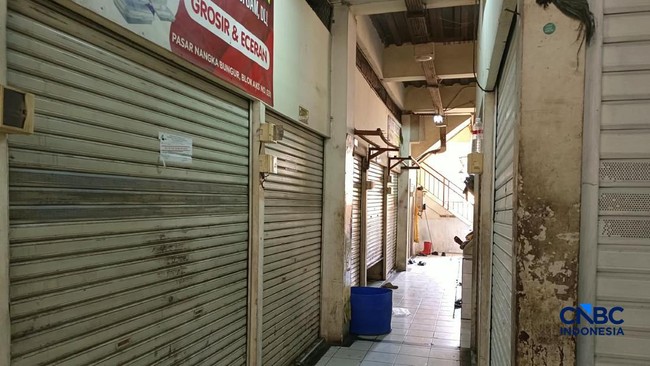
However, a different atmosphere is felt once inside the market. The alleys flanked by kiosks appear deserted. Many shop doors are closed, and only a handful of traders can be seen active.
Based on observations by CNBC Indonesia, only about a quarter of the kiosks inside the market appear to be open. The rest seem to have lost the trading activity that usually serves as the pulse of a traditional market.
In fact, ten years ago, specifically on 29 September 2016, Nangka Bungur Market was bustling with traders and buyers following its inauguration by the Governor of Jakarta, Basuki Tjahaja Purnama, known as Ahok. Ahok even inspected the market, which covers an area of 1,523 square metres and contains 163 business spaces.
The facility is divided into 127 business units and 36 stalls. At that time, traders flocked to fill the kiosks and stalls, and buyers frequently visited the market, which was more modern and clean.
The emptiness of the market’s interior is not without reason. Several traders interviewed by CNBC Indonesia cited difficult access and parking as the primary reasons why customers are reluctant to enter the market.
One trader selling outside the market, Sugi (a pseudonym), said customers tend to choose shopping outside because it is easier to reach the stalls. “The inside is quiet. Parking is difficult and narrow, so no one comes. It is quiet, and goods do not sell,” Sugi told CNBC Indonesia.
According to him, this condition has persisted for quite some time. He even noted that more traders are ultimately choosing to leave the market area to set up stalls on the roadside.
“It has been like this for quite a while. I forget exactly when, but this is how the sales have been,” he said.
Sugi emphasised that the reason he chose to sell outside was not due to the rental prices of the indoor kiosks, but rather the difficult access and cramped parking space. “Not because of the rental price, but because it is quiet. There is no point if it is quiet and no one buys; it results in a loss,” he said.
Customers Do Not Want Hassle
Similar sentiments were expressed by Tono (a pseudonym), another trader who has chosen to sell outside the market. He believes one cause of the indoor market’s decline is the access, which is considered inconvenient for buyers.
“I am not entirely sure, as I am just continuing my business here. But certainly, the inside is quiet. People might be lazy because the parking is a hassle, or perhaps they are lazy to dismount from their motorcycles. Here, they can shop while staying on their bikes,” he said.
For Tino, shopping at roadside stalls allows customers to avoid the hassle of searching for parking or dismounting from their vehicles. They can simply stop in front of the trader, purchase goods, and continue their journey.
He even likened this pattern to a drive-thru. “Yes, it is like buying food at McDonald’s, shopping while driving,” Tono remarked.
This situation has caused trading activity to shift outside the market building. Traders gain access to customers who can easily reach their goods, while customers do not have to bother entering the market alleys.
Some Remain Inside
Despite many traders choosing to move outside, some still maintain their kiosks inside the market, such as Reni (a pseudonym). She admitted that the interior of the market is indeed very quiet compared to the trading activity visible outside.
“Yes, it is quiet; it is so quiet it feels like there is no life (trading activity),” said Rini.
However, Reni has her own reasons for not moving her business to the roadside. She chooses to stay inside because she uses the kiosk as a storage space for her goods.
“Because I also keep my goods here, and I close in the afternoon. Rather than the hassle of having to tidy up my goods when I go home if I were to set up outside,” Reni explained.
“Inside, I only have to close the kiosk,” she added.
Regarding turnover, Reni admitted her sales might not be as high as those of traders outside. However, she still sees a window of opportunity for customers at certain times.
“My turnover might not be as large as those trading outside. But when those outside have closed, like from midday to the afternoon, people still look for goods, and I am still open,” she said.
Outside the market, semi-permanent stalls have now become the busier points. Traders utilise the roadside to bring their goods closer to customers.
However, this choice brings other consequences. The stalls standing on the roadside, combined with motorcycles stopping to shop, make the movement of vehicles and pedestrians increasingly restricted.
Ultimately, the cause of the decline in the interior of Nangka Bungur Market is not merely that traders have stopped selling. Rather, much of the activity has shifted outside because customers find it more practical to shop from the roadside.
Source: jawawa.id (https://jawawa.id/newsitem/this-market-was-once-bustling-during-the-ahok-era-but-is-now-as-silent-as-a-grave-what-happened-1791356122)
Originally published by CNBC Indonesia (https://www.cnbcindonesia.com/news/20261007122820-4-774048/pasar-ini-dulu-ramai-di-era-ahok-tapi-kini-sepi-bak-kuburan-ada-apa), translated from Indonesian