
This is Why the JCI Plunged Over 2%
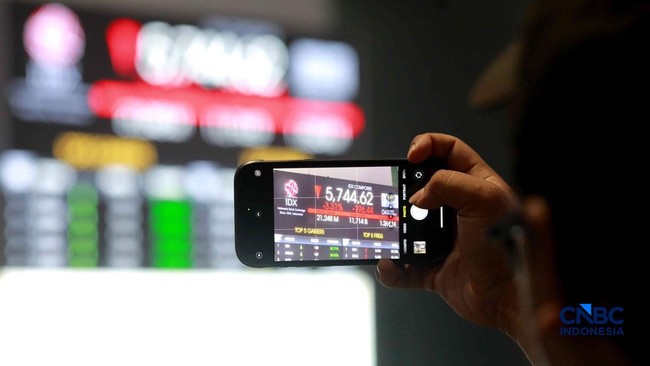
Jakarta, CNBC Indonesia - The Jakarta Composite Index (JCI) fell further during trading on Friday (5/6/2026), continuing the pressure after collapsing nearly 2% the previous day.
At the start of trading, the JCI opened up 0.11% at 5,846.49. However, selling pressure returned to dominate, pushing the index deeper to 5,718.38, a drop of 121 points (-2.08%) less than an hour after the market opened. In morning trade, the JCI touched a high of 5,860 and a low of 5,714.
The majority of shares moved in the red. A total of 469 stocks declined, while only 156 stocks rose and 107 stocks remained stagnant.
Transaction value at the start of trading reached Rp 6.18 trillion, with a trading volume of 7.81 billion shares changing hands across 648,000 transactions. The stock exchange’s market capitalisation was slashed to Rp 10,096 trillion.
Today’s JCI decline occurred in tandem with the rupiah weakening again to touch an all-time record low. Citing Refinitiv data, the rupiah opened down 0.17% at Rp 18,050 per US dollar.
This weakness continued the pressure from the previous trading session. On Thursday (4/6/2026), the Garuda currency closed down 0.45% at Rp 18,020 per US dollar. That position became the weakest level for the rupiah against the US dollar in history.
Meanwhile, the US dollar index (DXY), which measures the greenback’s strength against six major world currencies, was observed moving steadily at 99.438 as of 09.00 WIB. In the previous trade, the DXY closed down 0.12%.
After yesterday’s rout, the JCI is expected to still face a number of pressures today. Several major sentiments, both domestic and external, will drive the market.
The crash on Wall Street, another rise in oil prices, a strengthening US dollar, and the robust US economy could again pressure Indonesia’s financial markets.
South Korea’s Kospi index plunged 4.11%, with large-cap stocks such as Samsung Electronics and SK Hynix falling around 6% and 8% respectively. Meanwhile, the small-cap Kosdaq index also fell 2.41%.
In Japan, the Nikkei 225 index corrected 1.1%, tracking the weakness in the global technology sector. Meanwhile, Australia’s S&P/ASX 200 index fell 0.2% at the opening.
The outlook for the Hong Kong market was also negative. Hang Seng index futures were last traded at 25,158, lower than the Hang Seng index’s close on Thursday at 25,253.40.
The sell-off in Asian markets occurred after mixed movements on Wall Street in local trading on Thursday. The Dow Jones Industrial Average actually hit a new record high after surging 874.86 points or 1.73% to 51,561.93.
Coordinating Minister for Economic Affairs Airlangga Hartarto received a visit from representatives of the rating agency Standard & Poor’s (S&P) Global at the Coordinating Ministry for Economic Affairs office in Jakarta on Wednesday (3/6/2026).
In the meeting, S&P was represented by Kim Eng Tan, Managing Director of Sovereign Ratings for S&P Asia Pacific. The main agenda of the discussion concerned the prospects and resilience of the Indonesian economy amid lingering global risks.
Airlangga said the government used the meeting to explain the national economic condition, which is considered to remain solid despite facing external challenges such as geopolitical tensions, a global economic slowdown, and global supply chain disruptions.
This meeting is an important moment to affirm Indonesia’s economic resilience amid a global situation still full of uncertainty, Airlangga said through his official Instagram account.
According to Airlangga, Indonesia’s economic stability is supported by a combination of measured fiscal and monetary policies, strong domestic consumption, and an improving external sector performance.
He asserted that a number of key indicators still show a positive trend. Inflation remains under control, investment continues to grow positively, and the downstreaming programme is beginning to have a real impact on increasing the added value of the national industry, he said.
On that occasion, the government also outlined various strategic agendas being undertaken to maintain growth momentum, starting from accelerating industrial downstreaming, strengthening energy and food security, to enhancing manufacturing competitiveness.
These steps are part of Indonesia’s economic transformation to become stronger in facing global pressures while being able to grow more competitively in the long term, Airlangga said.
He added that the government remains optimistic that Indonesia’s economic prospects will be maintained as structural reforms and inclusive, sustainable development continue.
As a result of the significant decline, the Indonesia Stock Exchange (IDX) proactively invited institutional investors to global investors to place their funds in the Jakarta Composite Index (JCI), in an effort to curb the declining index trend.
IDX Director of Corporate Assessment I Gede Nyoman Yetna said the exchange had prepared a roadshow programme to strengthen the demand side in the capital market. These activities would target domestic and global investors.
We have met with several stock exchanges abroad so that we can cooperate, including in terms of foreign brokerage firms, so that we can bring listed companies to them and introduce them, thereby attracting investors, Nyoman told reporters at the IDX Building, Jakarta, Thursday (4/6/2026).
Domestically, the IDX will also expand capital market education to various regions. This step is taken by introducing listed companies to domestic investors, both institutional and retail.
Source: jawawa.id (https://jawawa.id/newsitem/this-is-why-the-jci-plunged-over-2-1780631502)
Originally published by CNBC Indonesia (https://www.cnbcindonesia.com/market/20260605094011-17-740331/ternyata-ini-alasan-ihsg-anjlok-lebih-dari-2), translated from Indonesian