
This is Pigai's affirmation regarding the status of human rights defenders
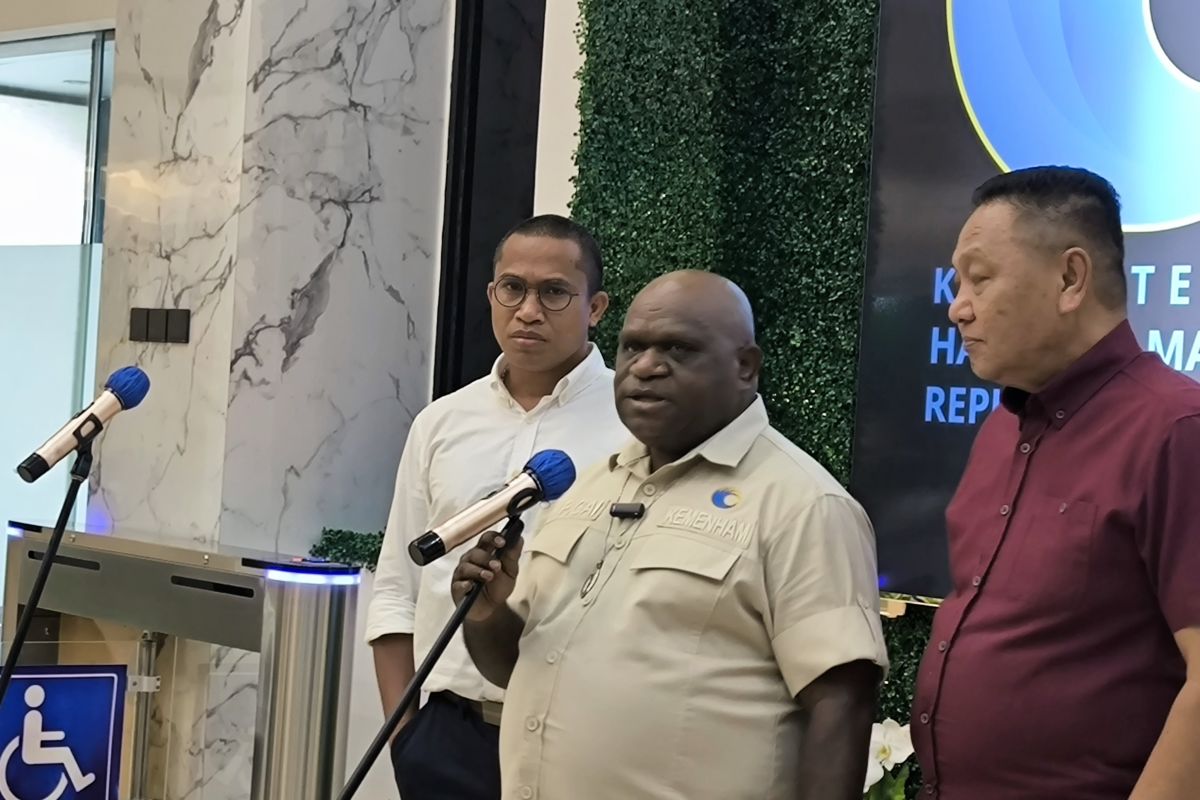
Jakarta (ANTARA) - Minister of Human Rights Natalius Pigai has affirmed that the government does not have the authority to determine who holds the status of a human rights defender, as this falls under the domain of civil society in accordance with international standards.
He stated that state intervention in determining the status of human rights defenders is incorrect and contravenes the global human rights protection system, which involves mechanisms such as the UN Human Rights Council, the Office of the UN High Commissioner for Human Rights, and the Universal Periodic Review.
“Intervention to determine the status of human rights defenders is not right. In accordance with international standards, the human rights protection system in this context comes from the UN Human Rights Council, then the Office of the UN High Commissioner for Human Rights, then the Special Rapporteur, and the Universal Periodic Review,” said Pigai in Jakarta on Monday.
Pigai said that in this context, the government must not regulate or enter the civil sphere.
Therefore, he said, it is highly unlikely for the government to enter and regulate, let alone determine the status of human rights defenders.
“The government’s obligation is to provide legislation that ensures protection for human rights defenders who advocate without pay for the public interest, for the common good, and peacefully. That is what we will ensure, providing certain protection for human rights defenders,” he said.
He explained that the determination of criteria for human rights defenders will be carried out by civil society together with independent institutions such as Komnas HAM, Komnas Perempuan, the Child Protection Commission, and the Disability Commission.
According to him, this principle is in line with the 1998 UN resolution on human rights defenders and strengthening protection for activists, including women.
“Thus, it is ‘clear’ that the government does not determine the status of human rights defenders or activists. It is highly unlikely, because we know the international regulations, especially the UN resolution related to human rights defenders in 1998, as well as human rights defenders for female activists in 2013, which state that the state must not intervene,” he said.
“The state is obliged to protect them and ensure their certain protection. Therefore, in the draft Human Rights Law, we have affirmed that those who are defending at the time, those who need help by meeting certain criteria without pay for the public interest, not by means of violence, are ensured not to be criminalised,” he said.
This step is part of efforts to strengthen the human rights protection ecosystem based on the state’s role as a facilitator, not a determinant of the legitimacy of actors.