
This Book Reveals How Companies Can Remain Profitable Without Damaging the Environment
Pressure on the business world to adapt to climate risks and sustainability demands is increasing. Amidst more frequent hydrometeorological disasters and stricter environmental regulations, sustainability is no longer viewed merely as a business strategy supplement, but as a factor influencing long-term corporate resilience.
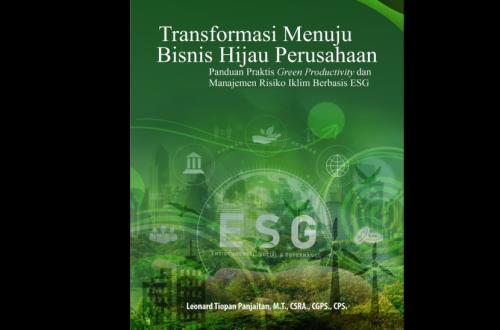
This reality serves as the background for the publication of the book ‘Transformasi Menuju Bisnis Hijau Perusahaan: Panduan Praktis Green Productivity dan Manajemen Risiko Iklim Berbasis ESG’ (Transforming Towards Green Corporate Business: A Practical Guide to Green Productivity and ESG-Based Climate Risk Management) by Leonard Tiopan Panjaitan. Published by Deepublar in 2026, the book reviews various approaches companies can adopt to face climate risks while maintaining business productivity.
Leonard, a consultant at the Trisakti Sustainability Center and co-founder and member of IS2P, notes that a gap still exists between sustainability strategies formulated at the management level and their implementation in the field. “For a long time, many companies have viewed ESG as a compliance obligation. In reality, climate risk has become a tangible business risk that affects both operations and corporate financial performance,” Leonard told Republika on Monday (8/6/2026).
The 723-page book discusses various sustainability issues from the perspective of business and risk management. The discussion covers the impact of climate change on the banking, mining, and other industrial sectors through 2030, while providing technical guidance on applying ESG principles at the operational level.
Leonard explains that the approach used in the book is based on the concept of green productivity, which is the effort to increase efficiency and productivity without sacrificing environmental aspects. According to him, companies do not need to choose between economic profit and environmental preservation; both can go hand in hand through the application of various efficiency instruments such as 5S, Kaizen, or Material Flow Cost Accounting (MFCA).
“There is still a perception that sustainability will increase business costs. In fact, many approaches can actually improve operational efficiency while reducing environmental impact,” he said.
In addition to discussing green productivity, the book also reviews carbon emission measurements, including Scope 3 emissions, which are increasingly becoming a concern for global companies. Several case studies from the e-commerce, nickel mining, and manufacturing industries are used to illustrate the application of sustainability strategies across various business sectors.
Financial risk aspects due to climate change are also a primary focus. Readers are invited to understand simulations of credit default probabilities and potential financial losses triggered by climate risks, particularly for the banking and financial institution sectors.
Leonard hopes that this book can serve as a reference for business actors, regulators, academics, and students wishing to understand the relationship between climate risk and business strategy. “The transition towards a green economy requires a data-driven and implementable approach. It is hoped that this book can serve as a practical guide for all parties involved in this process,” said Leonard.
Amid Indonesia’s targets towards a low-carbon economy, the need for guidance on ESG implementation and climate risk management is expected to increase. Numerous business sectors are also beginning to face greater demands from investors and global markets to demonstrate measurable sustainability performance.