
Third Bilateral Meeting: Indonesia and Singapore Enhance Customs Surveillance Cooperation
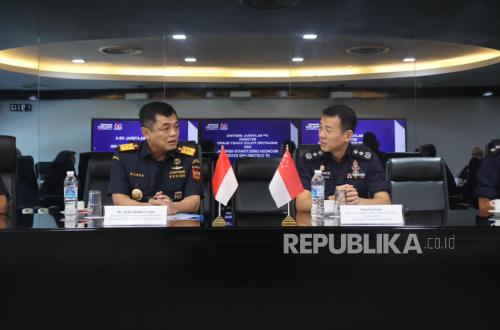
Indonesia’s Customs and Excise and the Singapore Police Coast Guard (SPCG) held the 3rd Bilateral Meeting on 24 April 2026 in Singapore. The meeting was attended by delegations from both institutions, led by the Director General of Customs and Excise, Lieutenant General (Ret.) TNI Djaka Budhi Utama, and the Commander of SPCG, SAC Ang Eng Seng.
Budi Prasetiyo, Head of the Subdirectorate of Public Relations and Outreach for Customs and Excise, stated that this bilateral forum is an implementation of the cooperation based on the Memorandum of Understanding (MoU) signed between Customs and Excise and SPCG on 3 February 2020.
“This meeting is a strategic step to strengthen Indonesia-Singapore maritime surveillance cooperation in preventing smuggling and maintaining border security,” said Budi.
In the meeting, both parties reaffirmed their commitment to strengthening cooperation in safeguarding the Indonesia-Singapore sea border security, curbing cross-border smuggling practices, and maintaining good relations between the law enforcement agencies of both countries. Moving forward, both parties plan to conduct Capacity Building or Training Exchanges, as well as Port Visits by patrol vessels from Customs and Excise and SPCG.
“The bilateral cooperation between Customs and Excise and SPCG is carried out concretely through information exchange, coordinated patrols, rendezvous at sea, and enhancement of personnel capacity,” said Budi.
The results of the meeting indicate that strengthening cross-border maritime surveillance requires consistent, adaptive collaboration based on inter-agency information exchange to maintain border area security and support the effectiveness of customs surveillance.
Budi stated that strengthening international synergy can support more effective surveillance to protect the public from smuggling and cross-border illegal trade. “Through this meeting, Customs and Excise reaffirms its commitment to strengthening customs surveillance, not only at ports and airports, but also actively in the border maritime areas,” said Budi.