
Thin Budgets: Lawmaker Worries Regions Cannot Tackle Forest and Land Fires
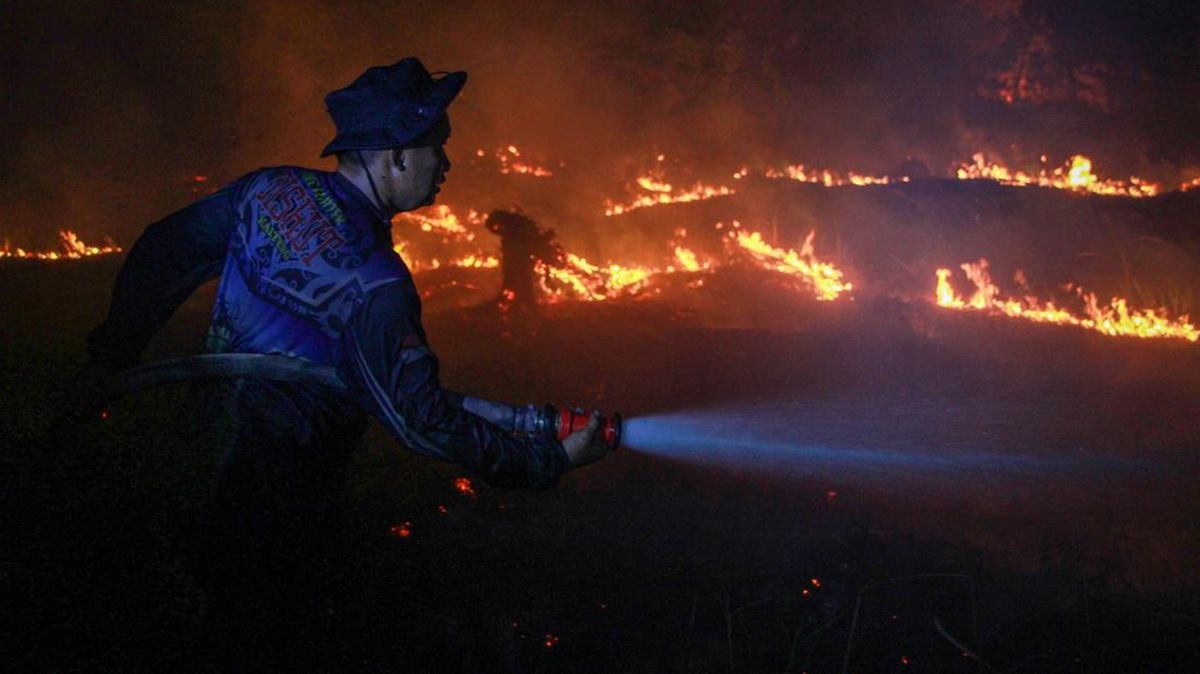
A member of the House of Representatives (DPR) from Central Kalimantan, Bambang Purwanto, has expressed concern about the ability of regional governments to handle forest and land fires (karhutla), particularly from a budgetary perspective amid ongoing spending cuts.
The member of House Commission IV from the Central Kalimantan electoral district urged the central government to step in immediately by providing budget support to strengthen karhutla prevention and response efforts.
According to Bambang, regional fiscal constraints are one of the obstacles to mobilising personnel and integrated teams optimally in the field. It was previously reported that in Kalimantan, field officers have even had to use their own personal funds to fight karhutla.
“Regions are indeed not as aggressive as before in handling karhutla due to limited budgets. Let alone dealing with karhutla, even paying PPPK (government contract workers) is difficult,” Bambang said on Monday (31/8), as quoted by detikKalimantan.
Karhutla remains widespread in Central Kalimantan. By the end of August 2026, the total burned area had reached 7,634.46 hectares.
The scale of the burned area has raised concerns that karhutla response efforts will not be optimal if they rely solely on regional government budget capacity.
“The region’s hope is certainly central government support, not only equipment but also funding support to mobilise integrated teams in the regions. This is given the limited funds available to the regions,” he said.
According to Bambang, regions also need operational funding so that karhutla response teams can move quickly and sustainably.
“Central Kalimantan itself has declared a karhutla emergency status through a gubernatorial decree since 25 May 2026. This condition should serve as a signal for the central government to accelerate support to the regions,” he said.
Meanwhile, the Central Kalimantan provincial government has stated that karhutla response efforts are still ongoing, including in the Tumbang Nusa area of Pulang Pisau Regency, which flared up again on Sunday night (30/8).
The Head of the Central Kalimantan Disaster Management and Fire Service (BPBPK), Ahmad Toyib, said in Palangka Raya on Monday that the fire which flared up again on Sunday night was a continuation of a previously active hotspot.
“Tumbang Nusa is indeed one of our concerns. Last night’s incident was a continuation of the previous fire position which was already burning,” he said, as quoted by Antara.
He explained that firefighting efforts at night faced obstacles due to limited deployment of ground forces. Terrain conditions and the risky location of the hotspots meant personnel could not be forced to approach the fire source.
“If ground forces go in close to the hotspot, it is risky for personnel,” he explained.
In addition, visibility in Palangka Raya and surrounding areas has declined significantly over the past two days, hampering the optimisation of firefighting operations by air.
“Visibility in Palangka Raya and surrounding areas has fallen far below the usual standard. Optimisation of water bombing through the air task force cannot be carried out optimally. The movement of the fire front has become quite fast because it is supported by strong winds at the location,” he said.
Under these conditions, ground forces are the main reliance for preventing the fire from spreading. However, personnel deployment must also take into account fatigue after fighting fires from morning until evening.
Meanwhile, based on data from the Central Kalimantan Karhutla Emergency Response Command Post as of 30 August 2026, a total of 2,222 karhutla incidents were recorded, with a burned area of 6,358.71 hectares. For Pulang Pisau Regency specifically, 54 karhutla incidents were recorded with a burned area of 378.88 hectares.
At the central government level, the Ministry of Environment (KLH) has confirmed that karhutla response efforts in Kalimantan and Sumatra continue to be carried out intensively to prevent transboundary haze.
The Deputy for Environmental Law Enforcement at KLH/Environmental Control Agency (BPLH), Rizal Irawan, stated that karhutla response is being carried out intensively through ground and air operations.
“To date, some of our fellow citizens in Kalimantan and Sumatra are facing forest and land fires, as well as declining air quality. Air operations involve dozens of helicopters and aircraft deployed for water bombing and weather modification, while ground operations are supported by thousands of joint personnel on 24-hour standby at vulnerable points,” Rizal Irawan said in his statement on Monday, as quoted by Antara.
In addition to domestic firefighting efforts, response measures also extend to the regional level to prevent a cross-border haze crisis.
These integrated measures demonstrate the government’s commitment not only to tackling karhutla at the local level but also to maintaining regional air quality stability.
Through synergy between field operations and cross-border monitoring, it is hoped that the potential for a haze crisis can be suppressed as early as possible to protect public health and environmental sustainability.