
These Things Are Deemed Necessary for Independent Political Parties Free from Interference
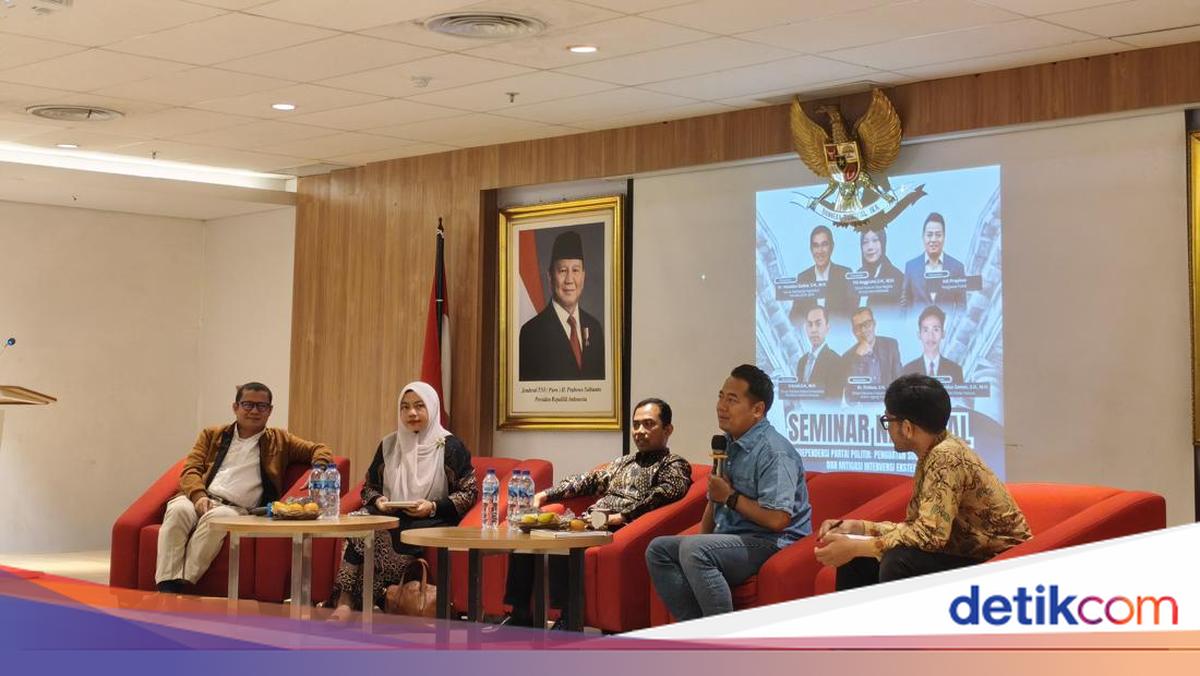
Several observers held a discussion on the independence of political parties. The discussion took place in a national seminar themed ‘Independence of Political Parties: Strengthening Internal Solidarity and Mitigating External Interventions’, organised by Pinter Hukum.
The seminar, held at the National Library Building in Central Jakarta today, Saturday (28/3/2026), was attended by several speakers including Perludem founder Titi Anggraini, political observer Adi Prayitno, lecturer from the Faculty of Law at Sultan Ageng Tirtayasa University Firdaus, and lecturer from the Faculty of Law at Nahdlatul Ulama Indonesia University Erfandi.
At the seminar, Perludem founder Titi Anggraini shared views on efforts that political parties can undertake to remain independent and avoid interference. Titi opined that the phenomenon of interference in a political party still frequently occurs in Indonesia, both from within the party and externally.
‘For example, looking at the dualism in Golkar in 2015, and also PPP, it is inseparable from interventions disguised as government administration, disguised as formalisation of management, which ultimately affects the existence of political parties. It’s difficult to be independent if the legal existence of the party is vulnerable to being shaken by the whims of power,’ Titi stated.
She described Indonesia’s political system and party system design as ‘overkill’. She said that Indonesia’s DNA is multi-party, yet the party system built actually complicates the emergence of new political alternatives.
She explained that the term ‘overkill’ or excessive is exemplified by the heavy requirements to obtain legal entity status in founding a party. She said that to establish a party in Indonesia, one must have offices and party officials across Indonesia as well as officials in 75 percent of districts/cities and 50 percent of sub-districts.
As a result, she said, many parties end up doing ‘tukar guling’ (swapping) with parties that already have legal entity status. Moreover, Titi added, the requirements to become election participants are even heavier.
‘Besides registering with the KPU, there is also administrative verification and factual verification. Plus, the requirement to have 1,000 members per district/city or one per thousand population. That’s very heavy,’ Titi remarked.
She said that the requirements for establishing a party in Indonesia are the most difficult compared to other countries. The heaviness of these requirements, in her view, makes establishing a political party in Indonesia expensive, complex, and not easy.
‘So, friends, our political parties indeed face challenges that are not easy to exist from an institutional perspective,’ she said.
She stated that the heaviness of the requirements for a party to stand ultimately relates to internal party problems that can disrupt independence. According to her, it is currently very difficult to find a political party that fully implements internal party democracy. This includes decision-making, policy-making, nomination or political recruitment, to party financial management.
’Now, for example, in terms of party sovereignty. If you read the party law, sovereignty is said to be in the hands of members. The sovereignty of political parties lies in the hands of members. But there is a footnote, it is implemented according to the party’s AD-ART.
‘So the party’s AD-ART then reduces the authority of members to be sovereign. And that reduction or distortion usually comes from where? It comes from the control of certain elites who are too hegemonic within the party,’ Titi explained.
She noted that hegemony within the party is then linked to control over party financing or funding. When elites dominate by financing and funding the party, in her view, other issues arise, namely dynastic politics.
‘When they can finance and control party funding, it is followed by family structures entering the party structure. In the end, the party turns into like a family company. Where the general chairman is passed down from one generation to the next. It’s hard to talk about independence there,’ Titi stated.
This phenomenon, according to Titi, necessitates the state’s role in increasing state funding contributions to parties more significantly. For her, this is needed because managing a party’s operations is burdensome.
‘That’s why so far, parties cannot escape the vicious circle of party oligarchy. Because they need funds to finance the party. Meanwhile, in our electoral system which is open proportional with weak law enforcement, it is difficult for ideology to truly work institutionally,’ she said.
‘So, in the context of party independence and solidarity, my four proposals earlier: first, we maintain the breath and colour of our multi-party system, the richness of political choices. Second, the parliamentary threshold is no longer relevant, we must find a more relevant formula, namely what I offer is a faction threshold. Third, more significant state contributions for the functioning and ideologisation of parties. And fourth, return political decentralisation, where regions also have control over party management and governance in the regions,’ she added.
A similar view was also expressed by political observer Adi Prayitno. At the seminar, Adi conveyed his view that to create party independence and free from various interventions, political parties must consistently do two things: recruitment and cadre development.
‘The serious problem for parties is regeneration and party recruitment, especially in the context of elites,’ Adi said.
He exemplified that many party elites emerge through ‘shortcuts’ or without recruitment and cadre development. He said that it is not uncommon for party elites to appear suddenly due to factors like having capital or an attractive appearance.
‘Only capital perhaps, ta’