
These Are the Reasons Why SMEs in Indonesia Are Resilient
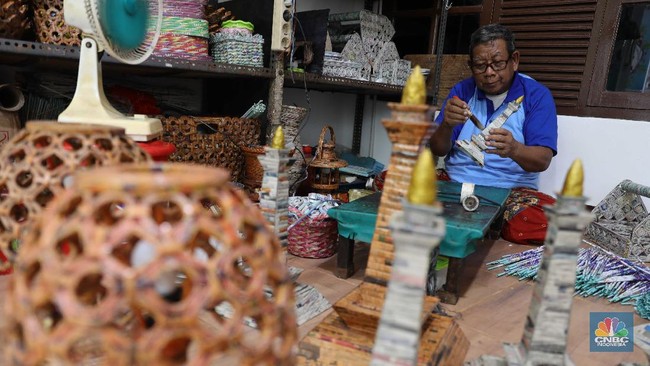
Jakarta, CNBC Indonesia - The micro, small, and medium enterprises (MSME) segment continues to serve as the backbone of Indonesia’s economy, contributing more than 60% to the national Gross Domestic Product (GDP). This segment also absorbs nearly 97% of the workforce.
The number is substantial; based on BPS data, the number of MSMEs is recorded at 65.5 million business units. The large number of MSMEs in Indonesia shows that this segment is capable of surviving any conditions.
Policy and Programme Director of Prasasti Center for Policy Studies, Piter Abdullah, assesses the role of MSMEs, particularly micro and small ones, in Indonesia’s economy as very significant. He believes this segment has characteristics that enable it to face crisis conditions.
“Micro and small businesses or MSMEs are said to be resilient and crisis-proof because there are almost no barriers to entry, so new MSMEs always emerge even in the midst of a crisis,” he told CNBC Indonesia on Friday (17/4/2026).
It is known that Indonesia has been hit by crises several times, as a result of global crises. The first was in 1998, which was part of the Asian financial crisis in mid-1997 in Thailand and quickly spread to other countries in Southeast Asia, including Indonesia.
This crisis was triggered by a combination of high foreign debt, weak economic policies, and currency speculation. At that time, many large corporations, even in the banking sector, collapsed. However, the MSME segment was able to survive and became the backbone of Indonesia’s economic recovery.
It did not stop at 1998; a similar crisis also struck in 2008, impacted by the US subprime mortgage default. The effect was that Indonesia’s economic growth slowed to 4.5% in 2009 from 6.1% in 2008. That growth was the lowest since 2001. However, once again, the MSME segment in the country remained able to survive. This is even shown by the growth in the number of MSMEs during that crisis period.
BPS records year-on-year MSME growth always increasing, as recorded below:
1998 - 36,813,578; 2005 - 47,017,062
1999 - 37,911,723; 2006 - 49,021,803
2000 - 39,748,036; 2007 - 50,145,800
2001 - 39,964,080; 2008 - 51,409,612
2002 - 41,944,494; 2009 - 52,764,603
2003 - 43,460,242; 2010 - 53,823,732
2004 - 44,777,387
Even when facing the Covid-19 pandemic, the MSME segment in Indonesia relatively still survived, with the number reaching 64 million units in 2020, able to grow slightly to 64.2 million units in 2021. This shows that even in the most challenging conditions, where during the Covid-19 pandemic public activities were greatly restricted, MSMEs were able to adapt their business forms and survive by adopting digitalisation for online selling.
Individually, according to Piter, MSMEs are indeed prone to vulnerability and experience bankruptcy at any time. However, at the same time, new MSMEs emerge to replace those that fall.
“Therefore, in aggregate, MSMEs seem undisturbed. This is the reason MSMEs are said to be crisis-resilient,” he emphasised.
Thus, although MSMEs are currently in challenging conditions with global economic uncertainty, as well as geopolitical impacts. However, looking at the historical ability of Indonesian MSMEs to survive various crisis periods, the potential for this segment to continue developing is still very large.
Based on the MSME Business Index for Q3-2025, MSME business activity is still in the expansion phase with an index value of 101.9. This report released by BRI shows that optimism among MSME players is increasing.
The growth of this segment is also reflected in the portion of bank credit. One of them is PT Bank Rakyat Indonesia (Persero) Tbk (BBRI) as a bank focused on targeting the MSME segment. By the end of 2025, BRI’s total credit reached Rp1,521.49 trillion, of which 80% is MSME credit.