
These Are the Eight Food Commodities Indonesia Is Self-Sufficient in for 2026: Rice to Chillies
Jakarta, CNBC Indonesia – The Government says it has achieved self-sufficiency in eight strategic food commodities in 2026. The achievement is an important step towards strengthening national food security, particularly amid geopolitical uncertainty, climate change and the threat of disruptions to global supplies.
The milestone is increasingly significant given that Indonesia previously still relied on imports to meet some food needs. However, self-sufficiency in eight commodities does not mean that all national food requirements are free from import dependence or climate-related risks.
Eight food commodities achieve self-sufficiency
According to the Ministry of Agriculture, the eight commodities declared self-sufficient are rice, maize, sugar for consumption, broiler chicken meat, chicken eggs, shallots, large chillies and bird’s eye chillies.
Based on projections in the national food balance for 2026, production of each of these commodities is expected to exceed domestic requirements.
The achievement is supported primarily by staple foods such as rice and maize. Livestock and horticultural commodities are also projected to record production surpluses, though the size of those surpluses varies.
However, the figures are projections of production and demand for the whole of 2026. The final outturn will need to be monitored to assess whether self-sufficiency can be sustained.
Rice and maize are the mainstays
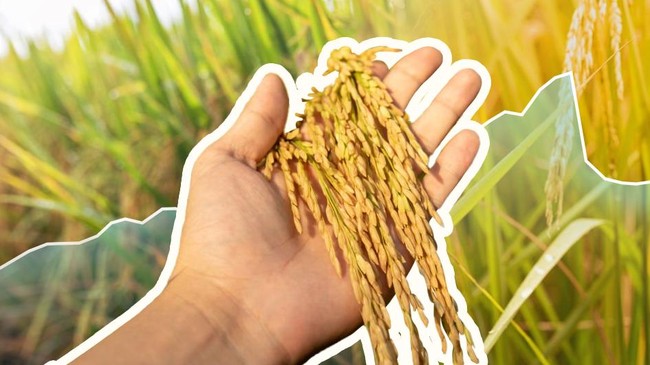
Rice has the largest projected surplus. National rice production in 2026 is expected to reach 34.77 million tonnes, against demand of about 31.10 million tonnes, resulting in a surplus of 3.67 million tonnes.
According to the latest report from the Ministry of Agriculture (20 October 2026), Indonesia produced 34.69 million tonnes of rice in 2025, a 13.29% increase on the 30.62 million tonnes recorded in 2024.
Meanwhile, Statistics Indonesia (BPS) data show that paddy production from January to August 2026 reached 43.89 million tonnes of dry-milled paddy, equivalent to 25.29 million tonnes of rice. Rice output rose by just 0.07% compared with the same period a year earlier.
Maize production reached 16.16 million tonnes in 2025, up 6.74% year on year. Actual production from January to August 2026 stood at 11.86 million tonnes. Maize is a strategic commodity because it is the main ingredient in animal feed, which also affects the cost of producing chicken and eggs.
The Government is seeking to maintain production through irrigation rehabilitation, water-pumping programmes and simpler distribution of subsidised fertiliser. In 2026, the Ministry of Agriculture prepared pumping programmes for 2.2 million hectares of land and irrigation rehabilitation covering about one million hectares.
Nevertheless, relatively modest growth in rice production in 2026 indicates that maintaining self-sufficiency remains a challenge, particularly amid the threat of drought and rising national food demand.
Surpluses in poultry, eggs and horticulture, but distribution remains a challenge
In the livestock sector, broiler chicken production in 2026 is projected to reach 4.90 million tonnes, exceeding demand of 4.02 million tonnes. Chicken egg production is forecast at 6.99 million tonnes, compared with demand of 6.47 million tonnes.
Surpluses are also projected in horticulture. Production of large chillies and bird’s eye chillies is expected to reach 1.52 million tonnes and 1.51 million tonnes respectively, above requirements of 929,000 tonnes and 914,000 tonnes. Shallot production is forecast at 1.32 million tonnes, against demand of 1.25 million tonnes.
Even so, a production surplus does not necessarily guarantee stable supplies and prices, particularly for perishable commodities. According to the Food and Agriculture Organization (FAO), about 25.4% of fruit and vegetables and 14% of meat and animal products worldwide were lost before reaching the retail stage in 2023.
In an FAO study of the large-chilli supply chain in Banyuwangi, East Java, food losses were recorded at 6.93% on the route to traditional markets and 8.67% on the route to regional wholesale markets.
To address distribution challenges, the Government is developing an Integrated Poultry Downstreaming programme. According to the Ministry of Agriculture in August 2026, the project in Bone Regency, South Sulawesi, is backed by an initial state-owned enterprise investment of Rp627 billion. It covers breeding, feed, slaughtering, cold storage and marketing.
The infrastructure is still being developed. Self-sufficiency depends not only on the size of the production surplus, but also on the effectiveness of storage and distribution in preserving food quality, stabilising prices and supporting farmers’ and livestock breeders’ welfare.
Self-sufficiency achieved, but challenges remain
Although eight commodities have been declared self-sufficient, Indonesia still faces several challenges, particularly reliance on imports for certain foods, climate change and distribution.
According to the Ministry of Agriculture (20 October 2026), domestic production of soybeans, garlic and beef still needs to be strengthened. The Government has also set a 2026 import requirement of 3.12 million tonnes of raw sugar for industrial use, even though sugar for consumption has been declared self-sufficient.
“There must be no room for complacency. Rice and maize must continue to be strengthened, while soybeans, garlic and beef remain outstanding priorities. Our goal is not just temporary self-sufficiency, but sustainable food independence,” Agriculture Minister Andi Amran Sulaiman said.
Climate change presents another challenge. The Meteorology, Climatology and Geophysics Agency (BMKG) estimates that 437 seasonal zones, covering 48.77% of Indonesia’s land area, could experience a longer dry season in 2026.
The Ministry of Agriculture has also acknowledged that adequate food stocks do not automatically guarantee affordable prices if distribution problems, high logistics costs and uneven supplies between regions persist.
The next challenge, therefore, is not only to maintain a production surplus, but also to ensure stable supplies and affordable food prices for the public.
Lessons from Vietnam: self-sufficiency must be sustainable
Food self-sufficiency needs to be accompanied by stronger sustainable agriculture, particularly in the face of climate change and limited water resources.
Vietnam offers one example through its programme to develop one million hectares of high-quality, low-emissions rice cultivation by 2030. According to Vietnam’s Ministry of Agriculture and Environment, by August 2026 sustainable farming practices had been adopted on 420,813 hectares, or about 42% of the target.
Trials of the programme showed emissions falling by about 3–4 tonnes of CO₂ equivalent per hectare per growing season, while farmers’ incomes rose by an average of 13.4%.
Indonesia has also introduced water-saving agricultural technology, including Alternate Wetting and Drying (AWD). According to the Ministry of Agriculture, the technology can reduce irrigation water use by about 17–20%.
Indonesia’s challenge, however, lies in consistently scaling up the use of such technology, measuring emissions reductions and developing economic incentives so that low-emissions farming practices also benefit farmers.
This approach is aligned with the Sustainable Development Goals (SDGs), particularly SDG 2 on food security and sustainable agriculture.
Ultimately, the success of self-sufficiency should be measured not only by production volumes, but also by the ability to safeguard food security, farmers’ welfare and the environment over the long term.