
These Are the 8 Demands of Workers for Mayday 2026
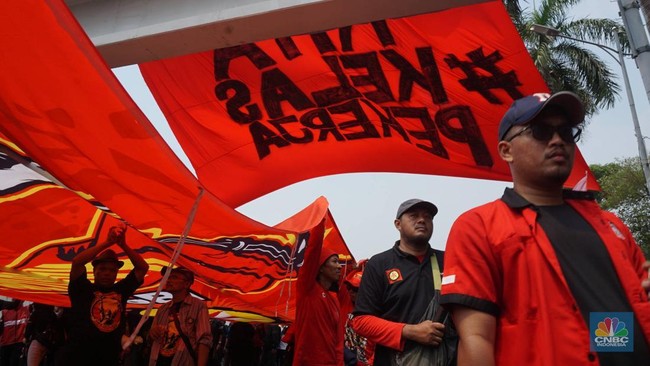
Jakarta, CNBC Indonesia - The All-Indonesia Workers’ Union Association (ASPIRASI) has presented eight workers’ demands to be voiced during the 2026 International Labour Day (Mayday) commemorations. ASPIRASI President Mirah Sumirat views these demands as essential due to the many fundamental problems still faced by workers.
“From waves of layoffs, unfair working practices, to disparities in social protection. Therefore, ASPIRASI is presenting the 8 Mayday Demands for 2026,” she stated in a written press release on Friday (1/5/2026).
The eight demands include, among others, the enactment of a new labour law that favours workers. The new Labour Law must truly side with workers, ensuring comprehensive protection of their fundamental rights, freedom of association without intimidation, strengthening Collective Work Agreements (PKB) as the primary instrument of industrial relations, and certainty of decent, humane, and just work.
“This law must serve as the foundation for creating balanced industrial relations between workers and employers, and ensure that the state acts as a protector, not merely a regulator,” she said.
The second demand is to stop mass layoffs and create decent jobs. This is because ongoing waves of layoffs have caused uncertainty and anxiety for workers and their families. Many workers have lost their livelihoods without adequate protection guarantees, even in strategic sectors and state-owned enterprises.
“This situation shows that protection for workers is still weak and the state has not been optimally present in preventing mass layoffs,” she explained.
According to her, the state must halt unfair mass layoff practices, guarantee job certainty and protection for affected workers. It should also promote the creation of decent jobs, with fair wages, humane working conditions, and job status certainty.
In addition, ensure that companies, including state-owned enterprises, do not use efficiency as a reason to sacrifice workers. “Jobs are not just statistics, but concern human dignity and livelihood,” she added.
Third, control the impact of AI and enforce justice in the world of work. According to her, the development of artificial intelligence (AI) brings major changes to the world of work. On one hand, this technology increases efficiency and productivity. On the other hand, without strong regulations, AI has the potential to replace human roles, widen inequalities, and create new forms of digital-based labour exploitation.
“Many workers now face the threat of job loss, declining work quality, and excessive surveillance through non-transparent algorithmic systems,” she said.
Therefore, the state must be present to control the use of AI so as not to harm workers, ensure fair Human-Machine Collaboration where technology supports rather than replaces humans, protect workers from algorithm-based exploitation and non-transparent digital work systems, and require companies to provide retraining (reskilling and upskilling) for workers affected by automation.
“Digital transformation must not sacrifice human values. Technology should be a tool to improve workers’ welfare, not a tool to eliminate their rights and dignity,” she stated.
The fourth demand is the abolition of sham partnership systems and protection for digital platform workers. The partnership practices applied by many digital platform companies are often merely sham partnerships in reality. Workers are positioned as partners but remain subject to company rules without rights as workers—there is no income certainty, no social security, and no adequate labour protection.
This situation creates a new form of exploitation, where all risks are borne by workers, while profits are concentrated in platform companies.
Therefore, the state is urged to abolish sham partnership practices that harm workers, recognise digital platform workers as employees with clear status and equal rights, limit app deductions reasonably (maximum 10%) so that workers’ earnings are not eroded, require companies to provide social security, labour protection, and decent income certainty, and ensure fair legal protection for online drivers and other digital workers.
“Digital economic transformation must not be an excuse to eliminate companies’ responsibility towards workers. Platform workers are not just partners, but humans entitled to protection, certainty, and welfare,” she said.
Fifth, eliminate discriminatory and exploitative recruitment requirements. According to her, recruitment practices in Indonesia are still coloured by various unfair and irrelevant requirements to competence. From irrational age limits, unreasonable work experience demands for new applicants, to physical and certain status requirements that are discriminatory.
This situation not only closes job access for many people but also opens room for exploitation, especially for young workers (Gen Z) who are often forced to accept unworthy working conditions to gain experience.
Therefore, the state is asked to abolish all discriminatory and irrelevant recruitment requirements. Then, guarantee equal job opportunities for all, without regard to age, gender, background, or physical condition, including for persons with disabilities.
Subsequently, stop exploitative practices against job seekers, such as prolonged internships without job certainty and decent wages. And, promote a transparent, fair, and competency-based recruitment system.
“Job opportunities are the right of every citizen, not a privilege limited by sy