
These are the 5 Provinces with the Highest Number of Elderly, Mostly Women
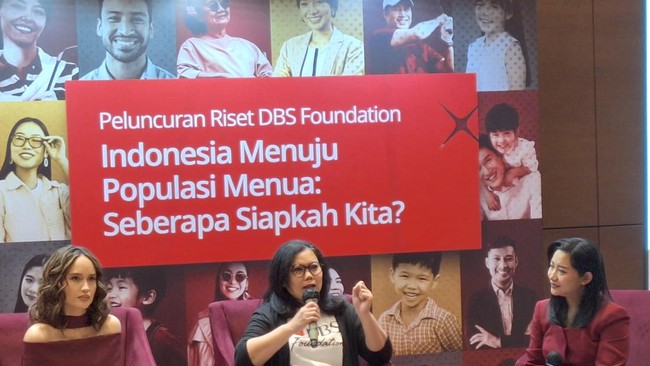
Nazla Mariza, Senior Vice President of Impact Beyond Banking at DBS Foundation, revealed that 16 provinces in Indonesia have entered an ‘ageing society’ phase, meaning that 10% of the population in these provinces consists of elderly individuals.
The five provinces with the highest number of elderly residents include the Special Region of Yogyakarta at 17.78%, East Java at 15.40%, Bali at 15.03%, Central Java at 14.39%, and North Sulawesi at 14.08%. According to Mariza, these provinces are likely to face challenges related to population ageing earlier than others.
Mariza identified three driving factors: low birth rates, increased life expectancy, and the outward migration of the productive-age population. “This means that provinces tending towards an ageing population will see a high surge in demand for healthcare services, elderly care homes, and so on. Meanwhile, provinces that remain relatively young require strengthening of human resources, broader pension coverage, and wider formal employment coverage,” she stated during the launch of the research titled “DBS Foundation: Indonesia Towards an Ageing Population, How Ready is the Younger Generation?” on Thursday (17/09/2026).
The majority of the elderly population is female, and the decline in health among elderly women tends to be higher than that of men. “This does not mean that living longer equates to being healthier. The challenge is how we can invest in health so that we do not just extend our lifespan, but extend our healthy lifespan,” she added.
Furthermore, based on the research, by 2025, nine elderly individuals will be supported by 100 people of productive age. This ratio is on an increasing trend and could reach 15 to 20 elderly individuals in the future. “The goal is how we can ensure that in the future, our elderly are maturing, healthy, and productive, thereby breaking the dependency ratio of the productive generation,” Mariza explained.
During the same event, Mona Monika, Head of Group Marketing and Communications at PT Bank DBS Indonesia, discussed the necessary preparations for retirement. She noted that individuals first need to have an income and a job, yet retirement fund preparation remains largely tied to workers in the formal sector.
“As mentioned, over 50% of the Indonesian population still works in the informal sector, and the white paper clearly shows that the structure or system of pension funds is still very much attached to the formal sector,” she said.
To address this, government policy is required to close the gap, and the private sector also plays a role in helping the public prepare for retirement. “The private sector is involved, as are social organisations and institutions; for example, Laura Place’s foundation has already taken a small part in preparing and closing this gap,” Mona noted.
Mona also mentioned that the DBS Foundation employs an approach through three pillars: education, health, and financial inclusion. “To be able to plan and prepare for our future, we need to have the money first. That is why, through the DBS Foundation, we will run programmes with our NGO partners to open up those access points,” she concluded.
Source: jawawa.id (https://jawawa.id/newsitem/these-are-the-5-provinces-with-the-highest-number-of-elderly-mostly-women-1789639135)
Originally published by CNBC Indonesia (https://www.cnbcindonesia.com/news/20260917152323-4-768757/ini-5-provinsi-dengan-jumlah-lansia-terbanyak-mayoritas-perempuan), translated from Indonesian