
These Are Iran's Conditions for Reopening the Strait of Hormuz
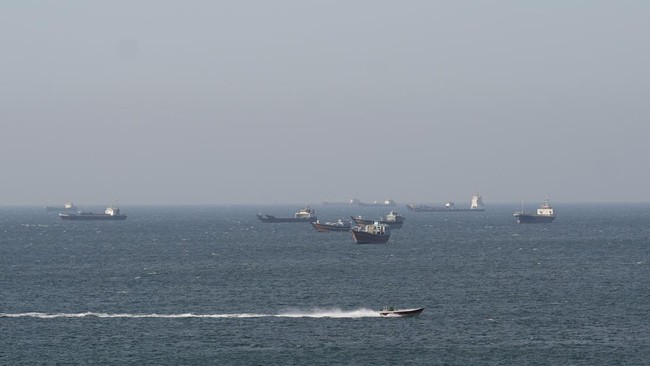
The Iranian government has cancelled the reopening of the Strait of Hormuz and imposed strict restrictions on this vital shipping route, particularly after the United States stated it would not lift the blockade on Iranian ports.
A British maritime agency reported that vessels from the Islamic Revolutionary Guard Corps (IRGC) fired on a tanker attempting to cross the strait on Saturday. A Reuters report also mentioned that an Indian-flagged ship carrying crude oil was attacked in the same waterway.
Meanwhile, Iran’s Khatam al-Anbiya joint military command stated that Tehran has returned the strait to its “previous status” and it is now under strict management and supervision by the armed forces.
Iran emphasised that the restrictions will remain in place unless the United States guarantees full freedom of navigation for ships sailing to and from Iran.
This assertion was reiterated by Iran’s Deputy Foreign Minister Saeed Khatibzadeh along with the IRGC Navy command.
In a statement to journalists on the sidelines of the annual diplomatic forum in Antalya, Turkey, Khatibzadeh said the US cannot impose its will to besiege Iran. He added that Iran is instead acting in good faith to facilitate safe shipping routes through the Strait of Hormuz.
In a post on X, the IRGC Navy command stated that as long as the movement of ships to and from Iran remains threatened, the status of the Strait of Hormuz will remain as before.
“Any violation of commitments by the United States will receive an appropriate response,” it wrote.
Iran had previously officially closed the Strait of Hormuz on 4 March in response to joint US-Israeli airstrikes on its territory. The strait was briefly declared reopened on Friday after a 10-day ceasefire agreement was reached between Israel and Lebanon, as part of broader diplomatic efforts to de-escalate the conflict in the region.
The UK Maritime Trade Operations Centre said it had received a report from a tanker that was approached and then fired upon by “two IRGC warships” about 20 nautical miles northeast of Oman.
The captain said there was no prior radio warning. The agency added that the tanker and its crew were reported safe, and authorities are investigating the incident.
Iran’s announcement of this change in stance came a day after Donald Trump said the US blockade would “remain in full effect” until a permanent peace agreement with Tehran is reached. The US President also said that the temporary ceasefire with Iran, mediated by Pakistan and due to end on Wednesday, may not be extended.
US and Iranian delegations are expected to hold a second round of peace talks, though the timing has not been confirmed. Agence France-Presse reported that Egypt’s foreign minister said on Saturday there is hope for an agreement “in the coming days”.
“We hope to reach an agreement in the coming days,” said Badr Abdelatty, adding: “Not only we in this region, but the whole world is suffering because of the continuation of this war.”
On Saturday evening, Mohammad Bagher Ghalibaf, Iran’s chief negotiator and parliament speaker, said there had been progress in talks with the US but there is still a “large gap”.
Before Iran cancelled its plans, at least eight oil and gas tankers had passed through the strait in a short time when it was open on Saturday morning, according to maritime tracking data.
Around 20% of the world’s oil and liquefied natural gas passes through this narrow strait, which has become a focal point in the US-Israeli war against Iran. The closure of the strait has driven up energy prices worldwide.