
These Are 5 Volcanic Eruptions That Cost the Aviation Industry Dearly
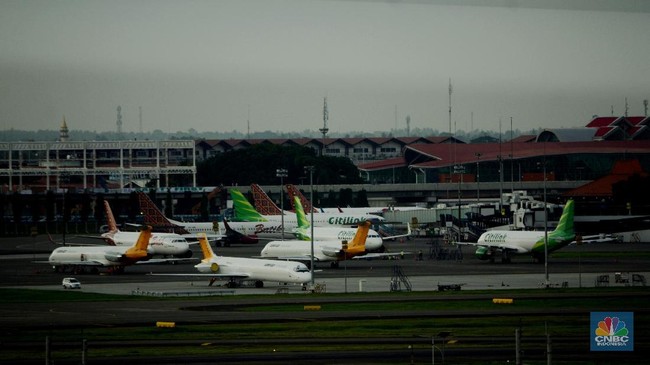
Jakarta, CNBC Indonesia — The eruption of Mount Anak Krakatau has disrupted aviation activity across several parts of Indonesia. The disaster has also brought substantial losses, particularly to the aviation sector.
Volcanic ash that spread into flight paths and airport areas forced eight airports to temporarily suspend operations.
The affected airports included Soekarno-Hatta, Halim Perdanakusuma, Radin Inten II, Husein Sastranegara, Budiarto, Pondok Cabe, Taufik Kiemas, and Atung Bungsu.
The disruption affected 2,961 flights that were delayed, diverted, or cancelled. Around 341,000 passengers were impacted.
A number of airports, including Soekarno-Hatta, resumed operations on Tuesday (8/9/2026). However, airlines still needed time to inspect aircraft that had been grounded during the closure.
As many as 178 aircraft at Soekarno-Hatta had to undergo inspections to ensure they remained airworthy after possible exposure to volcanic ash.
Airlines Could Lose Billions per Day
The Indonesia National Air Carriers Association (INACA) estimates that airlines could suffer losses of up to Rp19 billion per day as a result of the Anak Krakatau volcanic ash disruption.
INACA Secretary General Bayu Sutanto said airlines could lose up to Rp19 billion per day for the duration of the disruption, as quoted by Reuters on Tuesday (8/9/2026).
The losses stem from forgone revenue due to flight cancellations and rising operational costs. Airlines must bear additional fuel costs for route diversions, aircraft parking fees, crew expenses, and services for affected passengers.
The disruption can also cascade into subsequent schedules. According to Bayu, a single delayed aircraft at Soekarno-Hatta can affect the next three to four flights.
Aviation disruptions caused by volcanic eruptions have also occurred in various other countries.
The value of the losses is not always calculated using the same method. Some represent lost revenue, while others include operational costs and aircraft damage.
The following are five volcanic eruptions recorded as causing major losses to the aviation industry.
- Eyjafjallajökull, Iceland
The eruption of Mount Eyjafjallajökull in Iceland in April 2010 became one of the biggest disruptions ever experienced by the global aviation industry due to volcanic ash.
Ash from the eruption was carried by the wind towards northern and central Europe. Governments in several countries then closed their airspace over concerns the ash would damage aircraft engines.
More than 300 airports in 23 countries were affected. Around 100,000 flights were cancelled and the journeys of some 10 million passengers were disrupted.
At the peak of the disruption, around 19,000 flights were cancelled each day. The halted capacity was equivalent to nearly 30% of the world’s scheduled passenger flight capacity.
The International Air Transport Association (IATA) estimated that airlines lost US1.7billioninrevenueoversixdays.AtanassumedexchangerateofRp17, 630/US, this is equivalent to around Rp29.97 trillion.
At the worst point, airlines’ lost revenue reached US$400 million, or around Rp7.05 trillion per day.
Airport operators were also estimated to have lost US$400 million, while air navigation service providers lost around US$200 million. Overall, direct losses to the aviation sector reached around US$2.3 billion, or Rp40.55 trillion.
- Pinatubo, Philippines
Mount Pinatubo in the Philippines erupted in June 1991. The eruption sent ash more than 40 kilometres high and became one of the largest eruptions of the 20th century.
Pinatubo’s ash spread across various international flight routes. At least 16 aircraft in flight entered ash-affected areas and sustained damage.
The United States Geological Survey (USGS) estimated aircraft damage at US100million.AtRp17, 630/US, this is equivalent to around Rp1.76 trillion.
The losses were primarily due to damage to engines and aircraft components. The figure does not include the costs of diverting or cancelling flights to avoid ash dispersion.
- Redoubt, Alaska
The eruption of Mount Redoubt in Alaska in December 1989 disrupted commercial and military aviation around Anchorage.
The most serious incident involved KLM Flight 867 on 15 December 1989. The Boeing 747-400 flew into an ash cloud whilst en route to Anchorage Airport.
All four of the aircraft’s engines temporarily failed. The plane then lost altitude from around 27,900 feet to 13,300 feet within five minutes.
The pilots managed to restart the engines and land the aircraft safely. However, the engines, electronic systems, and airframe sustained damage, with repair costs estimated at US$80 million, or around Rp1.41 trillion.
Four other commercial aircraft also suffered damage from Redoubt’s ash. Airline activity in Anchorage was suspended for several days, even though the airport remained open.
Anchorage Airport was estimated to have lost US$2.6 million in revenue over the several months following the eruption.
- Puyehue-Cordón Caullé, Chile
The eruption of Puyehue-Cordón Caullé in Chile in June 2011 spread ash as far as Australia and New Zealand.
The vast distance did not stop the disruption. The ash cloud was reported to have circled the Earth twice and disrupted several flight routes for days.
According to a report by the Australian Institute for Disaster Resilience, more than 2,000 Qantas Group flights were cancelled and hundreds of thousands of passengers were affected.
Qantas recorded losses of A$49 million due to the volcanic ash disruption. Meanwhile, Virgin Australia estimated the impact on the company at A$7 million.
Thus, the recorded losses for the two airline groups reached at least A$56 million. This figure does not include the impact on other airlines and airport operators in South America, Australia, and New Zealand.
- Mount Agung
The eruption of Mount Agung in November 2017 disrupted flights to Bali and several surrounding areas.
I Gusti Ngurah Rai International Airport was closed for around two days. Hundreds of flights were cancelled and tens of thousands of passengers were stranded.
Citing Reuters, there were 42 airlines serving flights to Bali when the disruption occurred.
Corrine Png, CEO of transport research firm Crucial Perspective, estimated that the closure of Ngurah Rai Airport caused airlines to lose a combined revenue of around US5millionperday, equivalenttoRp88.15billionatanassumedrateofRp17, 630/US.
Calculated over two days, lost aviation revenue was estimated at US$10 million, or around Rp176.3 billion.
This figure does not include the costs of schedule changes, flight diversions, passenger services, and the decline in ticket bookings to Bali following the eruption.
Source: jawawa.id (https://jawawa.id/newsitem/these-are-5-volcanic-eruptions-that-cost-the-aviation-industry-dearly-1788857862)
Originally published by CNBC Indonesia (https://www.cnbcindonesia.com/research/20260908130137-128-766148/ini-5-erupsi-gunung-api-yang-bikin-dunia-penerbangan-rugi-besar), translated from Indonesian