
The World Could Change in Hours: These are the 5 Fed Signals
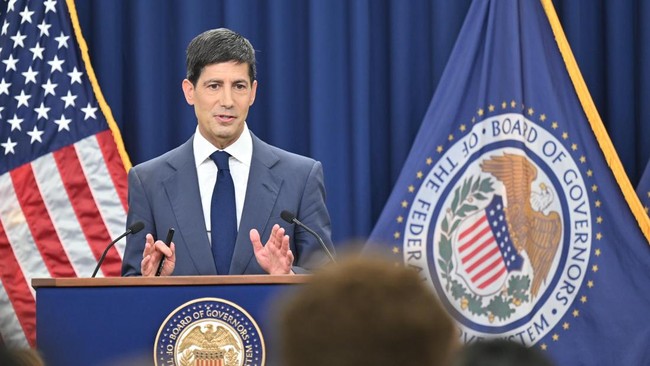
Global financial markets are once again awaiting the interest rate decision from the United States central bank, the Federal Reserve (The Fed), which will be announced on Wednesday (16/09/2026) US time, or early Thursday (17/09/2026) Indonesian time.
The Federal Open Market Committee (FOMC) meeting, held on 15-16 September 2026, marks the third meeting led by Kevin Warsh since he officially replaced Jerome Powell as Fed Chair in May. This FOMC meeting will serve as the greatest test for Kevin Warsh so far.
In the two previous meetings, the Fed maintained interest rates in the 3.50%-3.75% range. However, the upcoming decision is expected to be different. According to the CME FedWatch Tool, the market anticipates a greater than 90% probability of the Fed raising interest rates by 25 basis points. If this prediction holds true, the benchmark interest rate will rise to 3.75%-4.00%.
This probability has increased sharply from approximately 60% previously. Such a rapid change indicates how quickly market sentiment regarding Fed policy has shifted. Although the outcome appears increasingly predictable, the September FOMC meeting still contains several critical elements to watch. This decision could be a pivotal point for the direction of US monetary policy.
CNBC Indonesia has summarised at least five key areas of focus for market participants:
- Interest Rate Decision
The primary focus is undoubtedly on the interest rate decision. The Fed will choose between maintaining rates in the 3.50%-3.75% range or raising them by 25 basis points to 3.75%-4.00%.
If it aligns with market expectations of a hike, this would be the Fed’s first rate increase since July 2023. It would also mark the first interest rate change under Kevin Warsh’s leadership. While the option to maintain rates remains, such a move could surprise the market as it would deviate significantly from current expectations. Scotiabank economist Derek Holt noted that high market expectations have narrowed the Fed’s options, stating, “If rates are not raised when the market expects it, then when?”
- Warsh’s View on Surging Oil Prices
Beyond the rate decision, attention will turn to Kevin Warsh’s views on surging oil prices. Brent crude prices have approached US$110 per barrel following renewed and escalating conflicts in the Middle East. This surge occurred just days before the FOMC meeting.
Rising oil prices could make the Fed’s efforts to lower inflation more difficult. It is crucial to see how concerned the Fed is regarding rising energy costs to interpret future policy patterns. While raising interest rates will not directly lower oil prices, such a policy can dampen demand and prevent energy cost increases from spreading further. Consequently, the market will watch whether WarHM views the oil surge as a temporary disruption or the start of prolonged price pressure. Warsh previously hinted at this during his Jackson Hole speech on 28 August 2026, noting that recent increases in overall commodity prices require attention.
- The Fed’s Strategy to Return Inflation to 2%
The market is also awaiting Warsh’s explanation on how the Fed intends to bring inflation back to its 2% target. Current data shows that price pressures in the US have not yet subsided. Consumer inflation rose by 0.4% month-on-month in August, higher than the 0.2% increase in July. While annual consumer inflation remains at 3.4%, core inflation (excluding food and energy) rose by 0.3% monthly and 2.4% annually.
Greater pressure is evident in the Personal Consumption Expenditures (PCE) price index, the metric most closely watched by the Fed. PCE inflation reached 3.7% annually in July, while core PCE stood at 3.3%—both significantly above the Fed’s 2% target. Furthermore, price increases are widespread; in his Jackson Hole speech, Warsh noted that 54% of goods and services in the PCE calculation experienced price increases of more than 3% over the past year. This indicates that inflationary pressure has become broad-based. Warsh emphasised that the 2% target is firm and remains the goal, stating the Fed must be confident inflation is moving towards the target with sufficient speed.
- The Dot Plot and Kevin Warsh’s Stance
The September decision only addresses the Fed’s immediate step. To understand the future trajectory, the market will look at the latest dot plot. The dot plot represents the projections of Fed officials regarding interest rate positions by the end of the year. In the June projection, the median position was at 3.8%, implying one rate hike throughout 2026. If rates are raised to 3.75%-4.00% in September, that projection will have been met.
Source: jawawa.id (https://jawawa.id/newsitem/the-world-could-change-in-hours-these-are-the-5-fed-signals-1789552815)
Originally published by CNBC Indonesia (https://www.cnbcindonesia.com/research/20260916123439-128-768341/dalam-hitungan-jam-dunia-bisa-berubah-total-ini-5-sinyal-the-fed), translated from Indonesian