
The Whoosh Debt Saga and How Purbaya Plans to Settle It
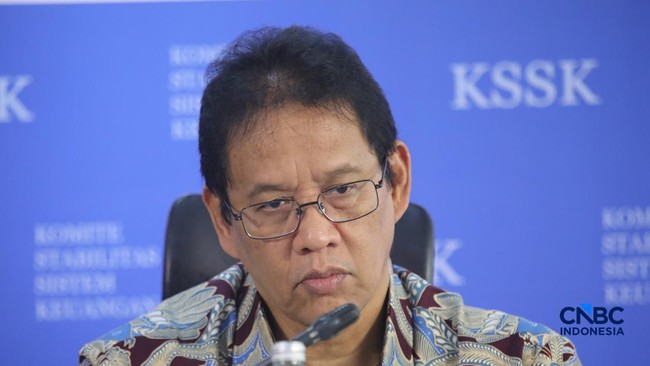
Jakarta, CNBC Indonesia - Finance Minister Purbaya Yudhi Sadewa has confirmed that the Ministry of Finance will take over the debt of the Jakarta-Bandung High-Speed Railway. Purbaya stressed that the transfer process is targeted to be completed by mid-September.
“So, the first discussion is the Jakarta-Bandung High-Speed Railway. This is being handed over from Danantara to the Ministry of Finance. We are accelerating the process, perhaps by mid-September it will already be clear,” Purbaya said during a media briefing at his office on Wednesday (5/8/2026).
The Finance Minister also assured that the debt settlement would not burden the State Budget (APBN).
This is because the management of the Whoosh debt will be pulled into the Ministry of Finance to be managed by a Special Mission Vehicle (SMV) under the ministry. Unfortunately, Purbaya did not specify which SMV would manage the debt.
“It is transferred to the Ministry of Finance, I will manage all of KCIC, but later we will use one of our fiscal SMV hands to manage it. We have many, there is SMI, there is this and others. So it will not directly become the responsibility of the APBN. So even though it is by the government, it will not burden the APBN,” he said.
With this transfer, Purbaya stressed that the share ownership of PT Kereta Cepat Indonesia China (KCIC) will no longer be under the state-owned enterprise consortium, but will be under the coordination of the Ministry of Finance.
The Ministry of Finance will take over 60% of the shares of PT Pilar Sinergi BUMN Indonesia (PSBI), which is a consortium of WIKA, PT KAI, Jasamarga and PTPN III. Meanwhile, the 40% stake held by the Chinese company consortium remains unchanged.
“(KCIC ownership) is with me, not (under KAI). 60% (of shares) is given to us, 40% is with others, there is still China in there. We asked China as well, it seems they still want to continue this project and perhaps if asked we will extend it to East Java,” Purbaya said.
Although ownership has shifted, Purbaya assured that the PSBI consortium will not be dissolved.
“No (it will not be dissolved), the consortium has given its shares to me,” Purbaya said.
The issue of the Whoosh high-speed rail debt has been a polemic for several periods because the project’s debt burden has weighed on the financial balance sheet of PT Kereta Api (Persero).
PT KAI in the project acted as the leader of the consortium company PT Pilar Sinergi BUMN Indonesia, which is the majority shareholder in PT Kereta Cepat Indonesia China (KCIC), the operator of the Jakarta-Bandung High-Speed Railway, also known as Whoosh.
President Director of PT KAI Bobby Rasyidin, when attending a hearing (RDP) with Commission VI of the DPR in August 2025, admitted that the mega project was indeed a time bomb for the company.
“We are also looking into the KCIC issue, this is a time bomb,” Bobby stressed, while assuring that he would coordinate with BPI Danantara in resolving the debt problems.
This statement was made after members of Parliament asked him for a roadmap that had been planned to begin the debt restructuring of the Whoosh high-speed rail.
Member of Commission VI of the DPR from the PDI Perjuangan faction, Darmadi Durianto, said at the time that this roadmap was important because KAI’s debt within a period of 2 years was quite large. Moreover, KAI also bore the burden of the high-speed rail project.
Within a period of just 6 months, Darmadi said, the financial burden borne by KAI reached Rp 1.2 trillion. “From the KCIC burden alone it is already Rp 950 billion multiplied by two. Then, it is now more than Rp 4 trillion. In 2024 it was Rp 3.1 trillion,” he stressed.
At that time, he projected that in 2026 KAI’s debt could reach Rp 6 trillion. If not addressed immediately, it would burden other subsidiaries which should have recorded profits but instead were drowned by the burden of debt interest.
Although the project has placed a debt burden on state-owned enterprises such as PT KAI, Director General of Financing and Risk Management (DJPPR) of the Ministry of Finance Suminto stressed that the state budget was not at all disturbed by the debt polemic.
“So the Jakarta-Bandung High-Speed Railway has no government debt in it,” Suminto said in Bogor, West Java, Friday (10/10/2025).
Suminto said that the project, which has been running since 2016, was purely carried out through a business-to-business scheme, so no government money was involved.
“Because at that time it was carried out by business entities, the Indonesian and Chinese Business Entity Consortium. The Indonesian consortium was led by PT KAI,” Suminto stressed.
For information, KAI is the lead consortium of PT Pilar Sinergi BUMN Indonesia (PSBI) which acts as the Indonesian shareholder in KCIC.
Citing the 2024 audited financial report from the official website of PT KAI, PSBI apparently suffered a loss of up to Rp 4.19 trillion throughout 2024. In the first half of 2025, PSBI again recorded a loss of Rp 1.62 trillion, based on the financial report of 30 June 2025 (unaudited).
Unsurprisingly, the Investment Management Agency Daya Anagata Nusantara (BPI Danantara) as the holding company for state-owned enterprises is currently seeking a solution to resolve the debt entanglement of PT KAI (Persero) resulting from the Jakarta-Bandung High-Speed Railway project.
Chief Operating Officer of Danantara Dony Oskaria revealed that one of the options to be pursued is through capital injection because the Whoosh project loan is very large. In addition, Danantara will also seek other solutions for the company’s sustainability.
Dony viewed that, operationally, KAI’s EBITDA has recorded positive figures, but the company’s equity is too small compared to the value of the loan to build the high-speed rail project.
Therefore, Danantara is still considering additional equity capital or handing over the infrastructure industry to the government.
Another option, discussions with the government are also considering the option of making part of the KCIC infrastructure categorised as state assets, similar to the Public Service Agency (BLU) model.
“So there are several options, but the point is we want KCIC to run well, because it is used by many people, on the one hand we also want the quality of Indonesian railways so that companies serving the public also continue to improve,” he concluded.
These options have also been heard directly by Finance Minister Purbaya Yudhi Sadewa as one of the supervisory board members of Danantara.
After attending the inaugural meeting of the Danantara supervisory board yesterday afternoon, Purbaya stressed that the government has no obligation to bear the debt of the Jakarta-Bandung High-Speed Railway or Whoosh project.
“They said they will still study it, my position is clear, because in their agreement with Indonesia, with China, there is no requirement that the government must pay,” Purbaya explained at Wisma Danantara, Jakarta, Wednesday, (15/10/2025).
Purbaya explained that his party has ensured the government’s position remains clear and firm regarding the financing of the strategic project. According to him, as long as the payment structure is well organised and transparent, lenders such as the China Development Bank (CDB) will not object.
Furthermore, Purbaya said that Whoosh is currently still conducting further studies regarding the financing scheme. Once the study results are complete, they will submit an official proposal to the government for further review.
“It is usual, as long as the payment structure is clear, they have no problem. But we will see what the study results are like later,” he explained.
He also stressed that Danantara has its own capacity to cover the high-speed rail debt estimated at Rp 2 trillion per year.
“I have already said that Danantara receives dividends from state-owned enterprises of almost Rp 90 trillion. That is enough to cover the Rp 2 trillion annual payment for the high-speed rail and I am sure the money will be more each year, more than 90 trillion,” he explained.
Purbaya also recounted that he had criticised Danantara in a meeting because the remaining dividend money from state-owned enterprises was placed in government bonds.
“Some of it, they said, would be placed in bonds, mine again, the government’s again. I criticised earlier, if you place that many bonds in the government, what is your expertise?” he said. “But they said this is only for the last 3 months because there was no time. For future projects they will improve it so that the amount in bonds will be small, more in projects that drive economic development.”
Purbaya also said that the debt payment clause between KCIC and China needs to be reviewed. Whether it is written that the government must pay or not.
According to him, as long as the payment is clear, if the one paying the debt is Danantara it will not be a problem for CDB.
Until finally it was decided that the government would take over the Whoosh high-speed rail debt.
Source: jawawa.id (https://jawawa.id/newsitem/the-whoosh-debt-saga-and-how-purbaya-plans-to-settle-it-1786078264)
Originally published by CNBC Indonesia (https://www.cnbcindonesia.com/news/20260807104333-4-757356/duduk-perkara-utang-whoosh-hingga-akhirnya-dibereskan-purbaya), translated from Indonesian