
The Warrior of the Light: Reading Prabowo through Paulo Coelho's Manual
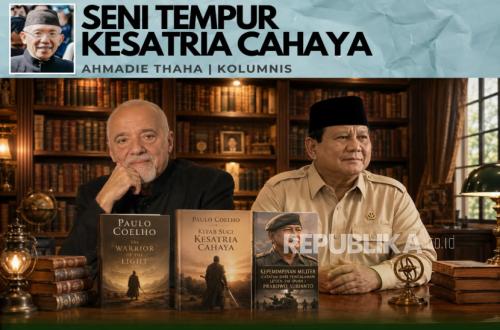
If one wishes to understand Prabowo Subianto, perhaps we need not begin with his political speeches. We might instead open a book he once recommended for young people to read. That book is The Warrior of the Light by Paulo Coelho. The Indonesian version, Kitab Suci Kesatria Cahaya, has long been published. The title sounds very Prabowo — warrior, light, struggle. But its contents are more complex. The Warrior of the Light is not taught to always attack. He is taught to choose his battles, to listen to his opponent, and to use the opponent’s strength. And, most interestingly, he draws his sword only when truly necessary.
In an interview with Najwa Shihab, Prabowo once cited Kitab Suci Kesatria Cahaya as the book that most influenced him. The book, he said, ‘is not thick, is concise, yet full of lessons that stir the spirit.’ He even recommended it to young people who wish to advance and succeed. That statement becomes more interesting because Prabowo himself provides a clue about how to read him through that book. And another book about him is available for comparison. In the 2021 publication Kepemimpinan Militer: Catatan dari Pengalaman Letjen TNI (Purn.) Prabowo Subianto, he mentions Kitab Suci Kesatria Cahaya in the section discussing his self-image. One reviewer of that book even places it on page 473, after a lengthy description of a leader who is brave, calculating, willing to make unpopular decisions, and a blend of a man of action and a man of intellect.
Thus, reading Kitab Suci Kesatria Cahaya alongside Prabowo’s political experience is not merely a game of matching quotations with events. A kind of map can be assembled. We can see which values he appears to have absorbed, how those values manifest in his political attitudes, and where his behaviour must still be tested by the demands of being president. For an influential book does not automatically make its reader the ideal figure of that book. A book is a compass, useful for a human being who can often misread direction.
Let us enter the key points I have extracted from Kitab Suci Kesatria Cahaya, and project them onto Prabowo’s conduct and actions. In this way, the book appears grounded. First: failure is not a reason to stop. One of the core teachings of Kitab Suci Kesatria Cahaya is how to view failure. The Warrior of the Light is not a person without wounds. He becomes a warrior precisely because he has been afraid, has erred, has fallen, and has even felt his life lose meaning. The book affirms that warriors of light ‘have failed’, continue to ask questions, continue to seek meaning, and eventually find it.
This is where Prabowo’s political story feels very close to Coelho’s archetype. He lost the 2014 and 2019 presidential elections before finally winning the 2024 presidential election. Defeat in Indonesian politics is no small matter. It involves political costs, personal wounds, mockery, divisions among supporters, and the temptation to conclude that the door has closed. But Prabowo kept returning to the arena. Even long before the 2024 victory, he repeatedly spoke of failure as part of the journey. Within the framework of Kitab Suci Kesatria Cahaya, failure is not treated as identity. One may lose a battle, but that defeat need not become the defeat of one’s entire life. That is perhaps one of the most concrete parts of the ‘Warrior of the Light’ in Prabowo: persistence. He did not allow the outcome of one battle to determine the entire direction of his life. Interestingly, that attitude ultimately brought him not merely to win an election, but to the seat he had pursued for years.
But here there is an important note. In Coelho’s philosophy, perseverance is not stubbornness. The warrior must be able to distinguish when to keep advancing and when to change course. Kitab Suci Kesatria Cahaya even teaches that persistence must be distinguished from rigidity. A river still heads to the sea, but it does not force its way through rock. It flows around it. Prabowo too experienced a change of strategy. From hard opposition to the Jokowi administration, he later chose reconciliation and entered the government as Minister of Defence. After winning the 2024 presidential election, he continued with a much broader coalition politics. In the perspective of Kitab Suci Kesatria Cahaya, this can be read not as surrendering to an opponent, but as a change of terrain to achieve a goal deemed greater.