
The US Is Quietly Engaging Myanmar’s Junta – But What Is Washington After?
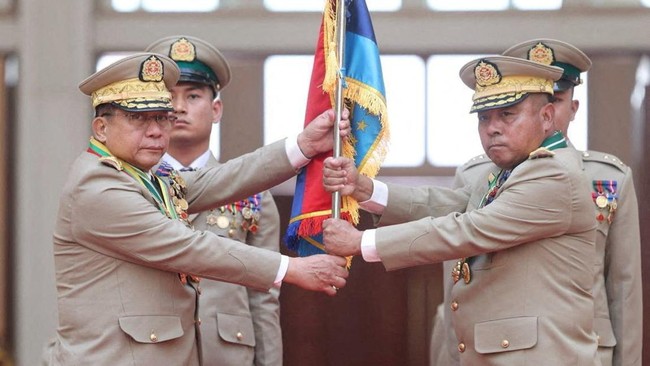
Jakarta, CNBC Indonesia – The United States and Myanmar’s military-backed government held talks in Tokyo, Japan, last week. The meeting was the second in a month, as Washington seeks to restore communication with Myanmar’s generals, who have been shunned since the 2021 military coup.
Three sources familiar with the discussions told Reuters, as reported on Friday (16 October 2026, that the agenda for the latest meeting was not yet known in detail. However, the talks indicate that both sides want to continue dialogue after an earlier meeting in Naypyitaw, Myanmar’s capital, in mid-September.
At that earlier meeting, the two sides discussed efforts to secure the release of a US businessman in detention and shut down online scam compounds targeting Americans. The talks could also pave the way for broader discussions, including over Myanmar’s rare earth mineral reserves.
One source said the US delegation was again led by Michael Vance, Assistant Secretary of State for Intelligence and Research. More than a dozen US officials reportedly attended the meeting in Tokyo. Reuters was unable to confirm who represented Myanmar.
The three sources, including a US official, requested anonymity because of the sensitivity of the discussions.
The US State Department did not respond to a request for comment on the latest meeting. Washington has said, however, that it remains in contact with various groups in Myanmar to discuss issues concerning US interests.
A spokesperson for Myanmar’s military-backed government also did not comment.
Japan’s Ministry of Foreign Affairs said it had “communicated as necessary” with both sides. Tokyo declined to comment further on specific diplomatic exchanges.
The September meeting in Naypyitaw brought Vance together with Min Aung Hlaing, the coup leader who is now Myanmar’s president. According to several sources who previously spoke to Reuters, the meeting opened the way for broader discussions.
The two sides’ return to the negotiating table within a short period suggests they want to maintain communication.
US targets scam compounds and rare earth minerals
A key priority for Washington is to ask Myanmar to help close online scam compounds running various criminal schemes, including romance scams. The operations have cost US citizens billions of dollars, according to sources familiar with the discussions.
Efforts to crack down on the compounds face significant challenges. Some researchers say many operate in areas controlled by militias backed by Myanmar’s military. Some of the proceeds are also suspected of flowing to the military, prompting doubts about the government’s commitment to tackling the activity.
Myanmar’s military-backed government has previously said it is participating in multinational efforts to curb scam operations.
Beyond online crime, US officials also discussed the possibility of gaining access to Myanmar’s substantial reserves of heavy rare earths. These materials are used in a range of strategic products, from electric vehicles to wind turbines.
Washington is aware of the major obstacles. Much of the reserves lie in areas controlled by ethnic armed groups fighting Myanmar’s military. China, the main buyer of Myanmar’s rare earth minerals, could also oppose US involvement in the sector.
Last week, the US also lifted sanctions on the daughter of a Myanmar businessman accused of supporting the country’s military. Washington described the decision as part of a new approach to Myanmar.
“This approach highlights the importance of pursuing dialogue with all groups involved in Burma’s civil war and commits to reviewing the various tools the United States has used to advance its core interests in the country,” the US State Department said in relation to the sanctions decision.
Although communication is being restored, Min Aung Hlaing remains under US sanctions for human rights abuses. The sanctions relate to his role in the military coup and the subsequent suppression of popular resistance, as well as the mass killings and expulsion of Rohingya Muslims in 2016–17, which Washington has declared a genocide.
The United Nations says Myanmar’s military has killed thousands of people in air strikes since the 2021 coup, which triggered widespread civil war.
Hunter Marston, director of Southeast Asia at the Australia-based Lowy Institute, said the latest meeting in Japan showed that President Donald Trump’s administration views Myanmar primarily through a transactional lens.
“Critical minerals and the rare earths Myanmar possesses are seen as a major strategic asset, and are probably what most attracts Washington to the country,” Marston said.
Japan’s role in the talks remains unclear
It is not known whether Japan has any particular interest in the US-Myanmar talks beyond hosting them. Tokyo also facilitated talks between the two sides in the Japanese capital last June. However, there are signs that Japan itself is beginning to seek renewed ties with Myanmar.
Earlier this month, Japan’s acting envoy to Myanmar met the foreign minister of the military-backed government. The meeting was the first known public interaction between them, although Japan has not formally recognised the government.
In September, Hiromichi Watanabe, a lawmaker from Japan’s ruling party, visited Naypyitaw. Myanmar’s state newspaper, Global New Light of Myanmar, said the visit was aimed at reviving bilateral co-operation and resuming development assistance to the country.
Japan’s foreign ministry said its acting envoy raised several issues, including the protection of Japanese citizens and support for Japanese companies operating in Myanmar.
Watanabe’s visit was made in his personal capacity as a lawmaker and, according to the ministry, “in no way pre-empts” the Japanese government’s official position.
Watanabe told Reuters that his visit was intended to prepare conditions that could make normalisation of relations possible. He acknowledged, however, that a number of obstacles remain.
Japan condemned the military’s 2021 overthrow of Aung San Suu Kyi’s elected government. However, Tokyo has not followed the US and several Western countries in imposing sanctions on junta leaders and military-linked entities.
Before the coup, Japan was one of Myanmar’s largest foreign investors. Tokyo sought to balance China’s influence in one of Asia’s remaining open emerging markets. Unlike many Western companies that left after the coup, several Japanese companies have stayed amid political and security turmoil.
Around 300 Japanese companies still operate in Myanmar, according to data from Japan’s trade promotion agency, JETRO. That is down from more than 400 in 2020.
Source: jawawa.id (https://jawawa.id/newsitem/the-us-is-quietly-engaging-myanmars-junta-but-what-is-washington-after-1792241438)
Originally published by CNBC Indonesia (https://www.cnbcindonesia.com/news/20261016173457-4-776998/as-diam-diam-rangkul-junta-myanmar-ada-udang-di-balik-batu), translated from Indonesian