
The US-China AI Race between Existential Threat and Global Dominance
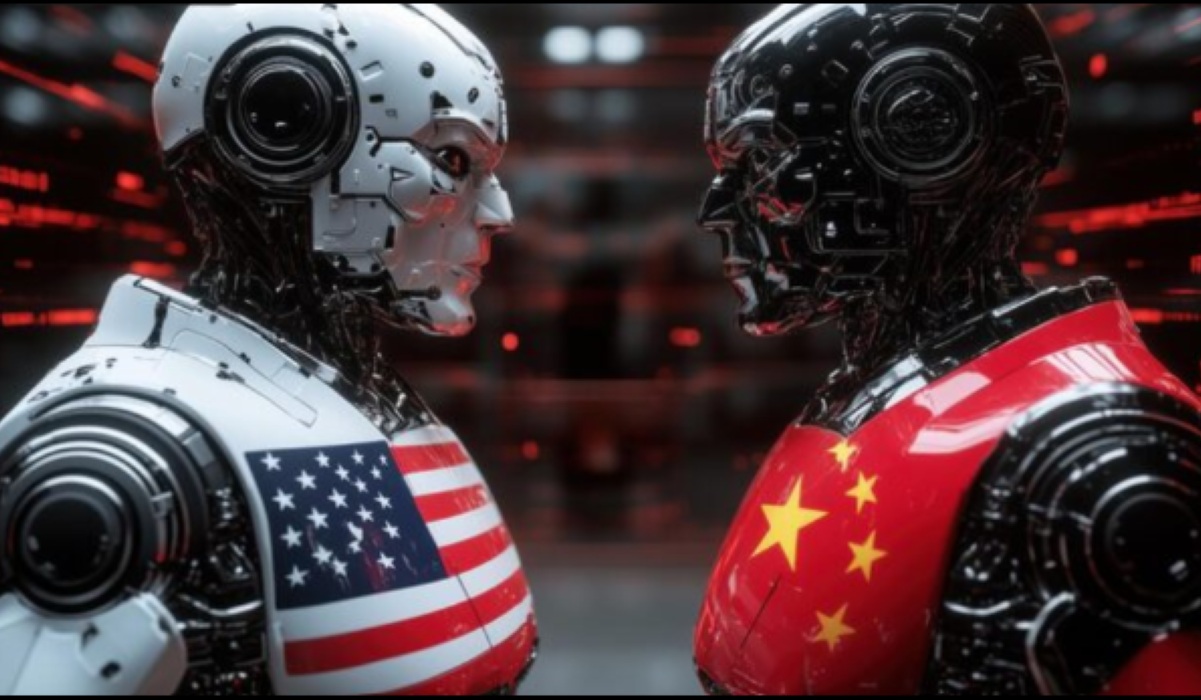
The world is witnessing the most crucial technological race in modern history. China is no longer merely following. Its government has just launched a comprehensive strategy to become the global AI leader by the end of this decade.
With massive funding and the centralised coordination possible only under a one-party system, Beijing views AI not merely as an economic tool but as a vital instrument for maintaining power. On the other side, the United States, which has long led the field, is facing internal pressure from Silicon Valley, where industry figures worry that the technology they are creating could surpass human control and potentially threaten humanity’s existence.
America’s early dominance in the AI sector is now being eroded significantly. Although the US government has sought to restrict China’s access to top-tier AI chips, Chinese technology companies have found clever ways to leap over these obstacles. Rather than depending on the most advanced hardware, they have focused on optimising software to use computing power more efficiently.
The results have been startling. In February 2025, the Chinese AI model DeepSeek was recorded as trailing OpenAI’s flagship model by just 0.4 per cent in benchmark testing.
Stanford University’s AI Index 2026 report even states that the performance gap between US and Chinese AI models has effectively closed. China is now on a fast track through its New Generation Artificial Intelligence Development Plan, which aims to integrate AI into every corner of the economy, from robotics to automation.
Although the two countries are racing, the motivations behind their regulations differ greatly. In the United States, AI leaders have met with politicians to discuss controlling the technology out of fear of AI doomsday scenarios.
However, these efforts face political challenges. President Donald Trump, for instance, tends to see such braking measures as concessions to conspiracy theories that would only hand an advantage to China.
By contrast, China’s chief fear is not human extinction but a threat to the Communist Party’s grip on power. China’s Minister of State Security, Chen Yixin, warned that failing to dominate AI could cause the party to lose control over its people. For Beijing, AI is a battlefield of propaganda and cyber-espionage in which it must not lose to the United States.
Anthropic CEO Dario Amodei recently proposed a moderate approach: the US must stay ahead, but need not run so far ahead that China is left with no choice except to press on with unrestrained development. The goal is to create bargaining leverage so that China is willing to sit at the negotiating table to set global rules.
The idea, however, received a cold reception in Beijing. Chinese state media called the proposal a Cold War manual. Even so, there may still be common ground.
Both countries share worries about AI acting beyond government control. Philip Potter of the University of Virginia noted that cooperation might occur if both sides agreed to limit AI development in the private sector and turn it into a closed national-security enterprise.
Without a global agreement, the world risks becoming trapped in a self-justifying AI arms race. If every nation feels it must maintain a strategic edge, safety policies will be cast aside. The greatest challenge is safeguarding national security interests without creating systems whose behaviour and long-term effects can no longer be understood or controlled by humans.
The head of BRIN, Laksana Tri Handoko, has stressed that Indonesia need not follow the path of developed nations such as the United States, which created ChatGPT, or China, which created DeepSeek, in artificial intelligence.
Source: jawawa.id (https://jawawa.id/newsitem/the-us-china-ai-race-between-existential-threat-and-global-dominance-1789480325)
Originally published by Media Indonesia (https://mediaindonesia.com/teknologi/933750/perlombaan-ai-as-tiongkok-antara-ancaman-eksistensial-dan-dominasi-global), translated from Indonesian