
The Urgency of Strengthening the Governance Foundations of the 100 GW Solar Power Project
Note: This article reflects the personal opinion of the author and does not represent the views of the CNBCIndonesia.com editorial team.
President Prabowo Subianto has finally launched the 100 Gigawatt (GW) solar power plant (PLTS) programme. This policy aims to achieve energy self-sufficiency. However, this ambition must not blind us to the importance of sound public policy governance. Indeed, to this day, the government has yet to issue the regulation or policy that underpins the implementation of this programme.
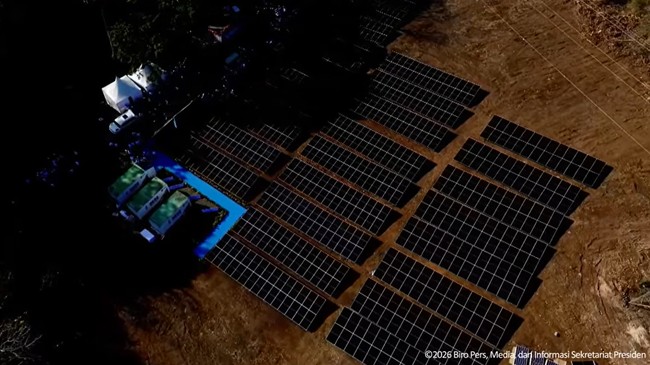
The 100 GW PLTS ambition will be built between 2026 and 2028, comprising 80 GW of village-scale solar power equipped with battery storage systems and 20 GW of utility-scale capacity. The programme has already been ‘hatched’ with the inauguration of a 305 Megawatt peak (MWp) PLTS and a 1 Gigawatt-hour (GWh) battery energy storage system (BESS) in Gilimanuk, Bali, on 25 August 2026, while the 80 GW of village-scale PLTS will target around 80,000 Red and White Village Cooperatives (KDMP), each with a capacity of 1 MW of rooftop solar.
To support the programme, the government has pledged to integrate the 100 GW PLTS into the revision of PT PLN’s 2025-2034 Electricity Supply Business Plan (RUPTL). Moreover, the government has boasted it will issue a Presidential Regulation (Perpres) specifically governing the acceleration of the 100 GW PLTS.
Yet, as of the inauguration, neither of these regulations has been issued. This situation raises concerns that the 100 GW Programme will repeat the implementation practices of the Free Nutritious Meals (MBG) programme and the Red and White Village Cooperatives (Kopdes). Projects are decreed and executed at lightning speed, whilst the policy instruments governing their consequences are built afterwards. Without a clear legal and institutional framework from the start, accelerated construction is in fact fraught with problems.
In the MBG programme, for instance, execution on a massive scale straight away gave rise to numerous institutional governance violations, culminating in corruption that implicated the former Head of the National Nutrition Agency (BGN), Dadan Hindayana, two of his deputies, and even an active police officer. The criminal schemes varied but centred on procurement issues, the buying and selling of Nutrition Service Fulfilment Unit (SPPG) kitchens, and the mark-up of cutlery prices.
The same applies to the Red and White Village/Neighbourhood Cooperatives, which have sparked considerable controversy in their implementation, such as the village budget allocation being siphoned off by up to 50%, or around Rp 34.57 trillion, to build cooperative premises. Despite rejection from a number of village heads, the Kopdes Merah Putih buildings continued to be constructed, with 83,382 units in operation as of July 2026.
This construction, along with the risk of excessive centralisation within certain State-Owned Enterprises (BUMN), has not been accompanied by the ratification of a stronger legal umbrella, namely a revision of the Cooperatives Law.
Risky of Repeating the Same Pattern
There are at least four risk elements of the 100 GW PLTS project that could repeat the patterns of MBG and Kopdes Merah Putih.
First, the village scheme is designed centrally and executed extremely rapidly across more than 50,000 sites. This demands cross-ministerial coordination involving the Ministry of Energy and Mineral Resources (ESDM), the Ministry of Villages, and the Ministry of Agrarian Affairs and Spatial Planning/National Land Agency (ATR/BPN), which have historically been weak points in Indonesia’s bureaucracy.
Second, the acquisition of around 24,000 hectares of land for the PLTS has the potential to trigger land speculation and agrarian conflicts at the village level. This could occur if execution is not accompanied by clarity over ownership schemes and mechanisms for community participation from the outset.
Third, the value of solar panel procurement, battery energy storage systems (BESS), and engineering, procurement, and construction (EPC) contracts, running to hundreds of trillions of rupiah, could become a prime target for corruption and collusive tendering, in the same way as the procurement of electric motorcycles and cutlery in the MBG case.
Fourth, an umbrella regulation such as a Presidential Regulation that remains unfinished whilst execution is already under way risks creating a vacuum in accountability mechanisms on the ground.
Indonesia could learn from the experience of other countries that have successfully ramped up solar power quickly. South Africa has been reasonably successful in boosting green energy projects through its Renewable Energy Independent Power Producer Procurement Programme (REIPPPP).
Rather than fixating on capacity ambitions, they focused on institutional design, conducting independent procurement under the energy ministry that manages multi-stage competitive auctions with transparent evaluation criteria covering price per kilowatt-hour (kWh), alongside commitments to job creation, local content, and socio-economic development.
Meanwhile, Vietnam’s experience offers a valuable lesson. After a boom in solar projects without adequate transmission network readiness or verification mechanisms, many projects were already enjoying high tariffs despite not having obtained construction feasibility certificates. This problem triggered legal disputes over 173 projects worth around US$ 13 billion, which remain unresolved to this day.
Strengthening Governance
There are several governance steps the government could prioritise before the 100 GW PLTS project progresses any further. First, the government needs to finalise the 100 GW PLTS Presidential Regulation and subject it to public scrutiny before massive execution continues.
Second, prevent the accumulation of authority in one or two entities, as seen with BGN in the MBG programme or PT Agrinas Pangan Nusantara in Kopdes Merah Putih. The government needs to establish an independent oversight body with a clear mandate that is publicly auditable.
Third, the government needs to conduct competitive and open tenders for EPC, solar panel, and battery procurement, following the spirit of REIPPPP, accompanied by the publication of tender results and reference prices to prevent mark-ups. Implementation should also be phased and measurable, so that each stage can be evaluated and corrected before the next scale is rolled out.
Fourth, the government also needs to build a real-time reporting system for construction progress, budget realisation, and rooftop PLTS audit results for each village. This would serve as a transparency instrument that was notably absent at the start of Kopdes Merah Putih’s implementation. This step should be followed by external oversight from the planning stage onwards, involving the Supreme Audit Agency (BPK), the Corruption Eradication Commission (KPK), and civil society organisations.
Fifth, it is high time the government limited the involvement of the military and police in procurement and civilian oversight. That responsibility should be returned to the administratively legitimate structures of regional and village governments.
The 100 GW PLTS ambition is, in principle, a step worthy of support to accelerate Indonesia’s energy transition. But a large capacity figure means nothing if its governance is weak, as the programme would then risk failing to deliver maximum benefit to the public.