
The Unsung Heroes Behind the Country’s Energy Distribution
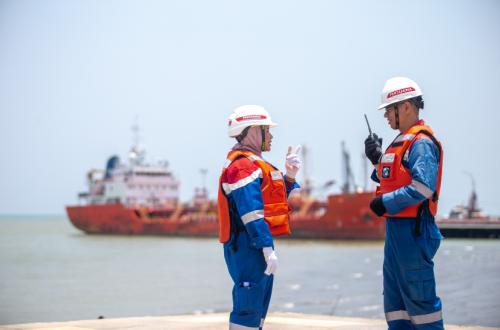
Three times his children were born, and three times Maman Suherman was unable to be by his wife’s side. It was not because he did not want to be with his family, but because each of those precious moments came while he was on duty aboard a ship, far from home.
He has also spent more Idul Fitri holidays at sea than with his family. In 35 years as a ship’s captain, the 57-year-old from Kuningan Regency, West Java, has grown accustomed to distance, longing and family moments that cannot be relived.
“I’ve also spent more Lebaran holidays aboard ship than with my family. It’s normal, because I’m on duty at sea,” Maman said with a smile, speaking to Republika on Thursday (22 October 2026).
That afternoon, Maman was in the wheelhouse of the tugboat TB Transko Dara 3218, moored at the Propylene Jetty in Balongan, Indramayu Regency, West Java. Through the wheelhouse windows, he watched the waters used by tankers carrying oil and fuel in and out of the port.
The cloudless midday sun was scorching, but the dedicated terminal integrated with the Balongan Refinery was relatively quiet. There was none of the bustle of passengers or vehicle horns found at public ports. Here, it was not people who were moving, but energy cargo destined for distribution across the country.
Maman is not the captain of a tanker carrying thousands of tonnes of oil. He commands a tugboat that helps much larger vessels berth and leave the port safely.
The work may be little known to the public. Yet behind every tanker that berths successfully are tugboat crews who must carefully assess the weather, currents, waves and distance from the jetty.
Tankers cannot stop suddenly or turn easily in confined spaces. Without tugboat assistance, manoeuvring becomes far more difficult and risky. A small mistake could cause a collision, disrupt loading and unloading, or endanger maritime safety and the environment.
At Port Balongan, Maman and the nine other crew members of TB Transko Dara 3218 perform this work. They are one link in the chain that enables oil and fuel to move from production facilities to different parts of Indonesia.
Not far from Maman’s vessel, the tanker PIS Cinta, owned by PT Pertamina International Shipping (PIS), was moored. The 2,448-deadweight-tonne vessel had sailed from Pontianak, West Kalimantan, and was being loaded with aviation fuel from the Balongan Refinery before returning to Pontianak.
TB Transko Dara 3218, by comparison, is 33.36 metres long, 11 metres wide and has a deadweight of 256 tonnes. It is far smaller than the tankers it serves, but its manoeuvrability is crucial to controlling the movement of large vessels.
As a tanker prepares to berth, the tugboat helps pull or push it to keep it on a safe course. The tanker must be positioned precisely so that its manifold—the point where pipes connect on the vessel—can be linked to the jetty’s pipeline system.
Cargo is transferred through this connection. A tanker’s successful berthing is therefore not merely a matter of seamanship; it also determines whether energy distribution operations can proceed smoothly.
From the mountains to the sea
Maman was born in Kuningan Regency, at the foot of Mount Ciremai. He describes himself as a mountain child who went on to spend most of his life at sea.
His career began after he completed his studies at a maritime school in Cirebon Regency. His work has since taken him across Indonesian waters and to several other countries.
During 35 years working aboard ships, Maman has encountered a range of sea conditions. One experience that remains vivid is facing waves eight metres high in the Masela Block area of the Arafura Sea, Maluku.
That experience taught him that the sea is not always kind. Weather, waves and currents can change, while the safety of the vessel and its entire crew rests with the captain.
Alongside his practical experience, Maman holds a Master Marine qualification, equivalent to an Indonesian Level I Nautical Officer qualification. It covers navigation, maritime safety, ship operations management, cargo handling, international maritime law and leadership at sea. “Yes, I can operate all types of ships,” Maman said.
His expertise and long experience mean he is still trusted to work, despite having been due to retire on 1 October 2026. His service was extended because of the demand for experienced captains.
But decades of experience have not made the job any easier. Every manoeuvre still requires concentration and coordination, because conditions at sea are never quite the same.
Maman is supported by nine crew members: a chief officer, chief engineer, second officer, second engineer, third engineer, two helmsmen, an oiler and a cook. They share responsibilities on deck and in the engine room, working shifts to keep the vessel operational and prevent fatigue.
For Maman and the crew, TB Transko Dara 3218 is more than a workplace. It is also home during their six-month contracts, after which they are entitled to two months’ leave.
According to Republika’s observations, the vessel has three levels: the upper deck, main deck and below deck. The wheelhouse and navigation area are on the top level, where Maman spends much of his time on duty.
The vessel has six air-conditioned cabins. Their beds can be folded away when not in use to make the relatively small rooms feel more spacious.
There is also a kitchen and dining room where the crew gather. During breaks, they drink coffee, watch television, play gaple, a traditional domino game, or use their mobile phones to relieve the boredom.
Life aboard the vessel unfolds in confined quarters, alongside the same people for months at a time. The crew follow their routines, share stories and pass the days they might otherwise spend with their families.
But when a call for duty comes, all those activities must stop. Navigational safety and operational readiness take priority once again. That afternoon, Maman was preparing to patrol a vessel-mooring facility offshore. “Transko Dara departing for SPM 35,000,” he said.
He informed port staff of the departure by telephone. The handset hung beside his helm chair, near the engine-room indicators and modern navigation equipment, fitted with green and red buttons.
After receiving clearance, Maman began operating the Azimuth Stern Drive (ASD) helm. The propulsion system allows the direction of thrust to rotate through 360 degrees, enabling the tugboat to manoeuvre more freely in confined spaces.
TB Transko Dara 3218 slowly left the jetty. A light breeze and relatively calm waves made the vessel’s movement smooth, with little vibration.
Through the wheelhouse windows, Maman kept a close watch on the waters. The vessel headed towards the 35,000-deadweight-tonne single-point mooring (SPM) facility off Balongan.
The facility is a mooring buoy that connects tankers to an underwater pipeline network used to transfer naphtha and light oil. Its safety must be ensured because it plays an important role in energy cargo operations.
After confirming that the SPM was safe, Maman turned the vessel around and headed back to the jetty. The patrol was over, but the next task could come at any time.
Source: jawawa.id (https://jawawa.id/newsitem/the-unsung-heroes-behind-the-countrys-energy-distribution-1793422269)
Originally published by Republika (https://ekonomi.republika.co.id/berita/tnr7tb416/pahlawan-senyap-di-balik-distribusi-energi-negeri), translated from Indonesian