
The Two Guardians Behind Railway Journey Safety
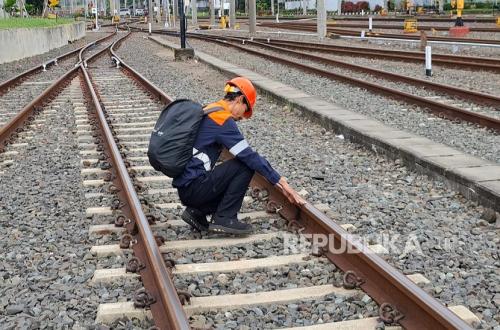
Passengers may only see a train departing from a station, passing through rice fields and residential areas, until it finally arrives at its destination. However, long before the train wheels rotate on the rails, significant work is undertaken to ensure the journey is safe.
Step by step, Track Inspection Officers (PPJ) perform duties to ensure the tracks are in a safe condition. They inspect every single component of the track, from ensuring there are no loose bolts, problematic sleepers, or obstructing gravel, to identifying potential damages that could endanger train travel.
‘No part must be missed during this inspection,’ says Rahmat Haryanto (36), a PPJ in the Daop 6 Yogyakarta region who has been working since 2009.
During an interview, he described his duty of patrolling the track section between Lempuyangan Station and Maguwo Station, covering 6.8 kilometres one way, before returning to Lempuyangan. This totals approximately 13.6 kilometres per single inspection. This distance is covered point by point within the track section under his responsibility.
Rahmat’s inspections usually begin at 16:00 WIB and continue until around 21:00 WIB. Before starting his work, he must undergo a preliminary check. He then uses a helmet, safety shoes, and a safety vest in accordance with applicable SOPs. He is also equipped with various tools, including an adjustable wrench, signal flags, a handheld radio, a mobile phone, a finding logbook, a torch, and signal lamps for night inspections.
Throughout the journey, Rahmat meticulously checks the condition of the rails. ‘We check if the rails have defects, meaning cracks or any other issues in the rail area,’ RHM told reporters on Monday (21/9/2026).
If minor disturbances are found, Rahmat stated that he can perform immediate repairs using the tools he carries. He cited loose or broken bolts on connection plates as an example of a minor disturbance.
As long as the issue remains within tolerance levels and the track is deemed safe, Rahmat can carry out repairs on-site. The process must be handled carefully; after repairing, he re-verifies the track condition and documents the state before and after the repair. If deemed safe, trains can continue to pass.
‘The time required for repairs is about five minutes; we fix it right there,’ he said.
However, if the damage falls into the heavy category, the process differs. Heavy conditions include broken rails, buckled rails, landslides, or tracks covered by soil material. In such circumstances, safety becomes the primary consideration, and trains may be ordered to stop temporarily.
Rahmat then reports findings to the train trip controller in Daop 6 and coordinates with track maintenance officers for further handling. ‘The heaviest risk is stopping the train first. Once we ensure the track can be passed and maintenance has been completed safely, we coordinate again with the control centre so the train can proceed,’ he said.
During his many years of service, Rahmat has faced numerous experiences and challenges, particularly during his posting in Solo. Rahmat admitted to finding children and local residents playing or engaging in activities near the tracks. In some instances, they even placed objects such as stones and wood on the rails.
These objects may seem simple, but for railway travel, items on the tracks can become serious issues.
‘In the past, there were children or residents who mischievously placed stones or wood on the rails,’ Rahmat recalled.
‘Most admitted it was intentional. For example, if we caught them red-handed, we would talk to them and ask why they were placing the stones or wood there. They would say, “I was curious, Mas, I wanted to see what the train looks like.” Most reasons were like that,’ he said.
That experience remains one of the most memorable parts of Rahmat’s duty as a PPJ. Because disturbances on the track do not always stem from infrastructure damage or natural conditions; sometimes, disturbances arise from human activities very close to the tracks.
Nevertheless, Rahmat does not choose to simply remove these objects and leave. That experience made him realise that maintaining railway safety requires more than just checking the physical condition of the tracks; people living near the tracks must also be involved.
He subsequently attempted to build relationships with the community. To the children he encountered, Rahmat does not use harsh reprimands. Instead, he tries to approach them in a more acceptable manner. Occasionally, he brings snacks or sweets, or even provides small gifts during certain moments, so that the education he provides can be heard and accepted well.
Rahmat noted that being on the railway tracks without operational necessity is not only dangerous to safety but can also lead to legal sanctions. This is regulated under Law Number 23 of 2007 concerning Railways, which prohibits the public from using the railway track utility space for purposes outside of railway activities. Violations of this regulation can result in criminal sanctions of up to three months imprisonment or a maximum fine of Rp15 million.
‘We use communication, we provide understanding, including urging the community not to play on the railway tracks because it is dangerous,’ he said.
This approach is applied repeatedly. Rahmat even leaves his telephone number with residents so that communication does not cease once the track inspection is complete. This approach has ultimately led to…
Source: jawawa.id (https://jawawa.id/newsitem/the-two-guardians-behind-railway-journey-safety-1790225899)
Originally published by Republika (https://rejogja.republika.co.id/berita/tluoyo282/dua-penjaga-di-balik-keselamatan-perjalanan-kereta-api), translated from Indonesian