
The Trend of Modern Warteg: A Sign that the Middle Class is Increasingly Squeezed
The emergence of an upscale restaurant with a warteg concept in the Senopati area has sparked widespread discussion on social media. CNBC Indonesia first learned of Salira, the new venture from F&B giant Union Group, through viral content on TikTok’s For You Page (FYP).
Several netizens on TikTok have labelled Salira as a “fancy warteg”. The restaurant serves a variety of home-style dishes commonly found in traditional wartegs, such as terong balado, tahu-tempe bacem, sambal goreng kentang, telur gulai, and gorengan.
Salira also incorporates the distinctive visual elements of traditional wartegs, using glass display cases to showcase the dishes, which are covered with vitrase curtains. Do not forget the exceptionally long kerupuk kresek near the cashier.
However, Salira offers a much larger space, divided into outdoor, indoor areas, and a second floor accessible by glass lift. The tables and seating are also more comfortable and separated, not communal like in traditional wartegs.
This comfort comes at the price of food costs equivalent to premium restaurants in Jakarta. We paid around Rp147,000 for brown rice, melinjo vegetable, fried duck, sambal bawang, and plain iced tea. One visitor who chatted with us admitted paying Rp800,000 for a meal for three with friends.
Middle Class Downgrading
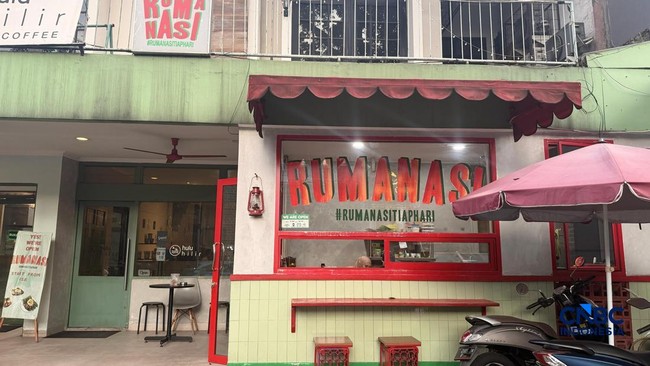
Before Salira, there were already several modern wartegs emerging in Jakarta. However, their prices were still competitive and relatively affordable for the middle class’s pockets. For example, ‘Cahaya Selatan’ in Panglima Polim (closed since March 2026), Wareqpol in Cideng (closed since January 2026), and ‘Rumanasi’ which is still operating with branches in Cikajang and Puri Indah. Rumanasi was also popular when it opened in Cipete, but it has now closed.
At the Cikajang outlet, Rumanasi does not display dishes in glass cases. The menu options are already in the form of rice packages: nasi teri, nasi ayam, nasi tongkol, nasi sapi, complete with egg. The rice package prices range from Rp15,000 to Rp29,000. We paid Rp55,000 for the nasi sapi shanghai package and lemon iced tea drink.
Sociologist from the University of Indonesia, Ida Ruwaidah, stated that the phenomenon of modern wartegs arises as a response to macroeconomic conditions indicating a decline in the middle class. According to BPS data for the 2019-2024 period, 9.48 million middle-class individuals have “downgraded” to the vulnerable middle group and vulnerable poor group.
Meanwhile, data from Mandiri Institute shows that the number of middle-class people experienced a decline again in 2025 by 1.1 million to 46.7 million people, from 47.9 million in 2024.
The wave of layoffs that continues since the Covid-19 pandemic era, combined with the difficulty of finding new jobs amid global economic turmoil, has also impacted Indonesia. For the August-November 2025 period, BPS data recorded the unemployment rate in Indonesia at 7.35 million people.
“Modern wartegs become one form of adaptation for them [the middle class]. They seek places that can still be recreational, but the prices are affordable because they match their financial condition,” said Ida to CNBC Indonesia.
Popular Culture Observer, Hikmat Darmawan, stated that the middle class, which was accustomed to eating at cafes, now faces increasingly difficult economic situations, thus needing to readjust their spending. For that, channels need to be provided immediately to accommodate the middle-class lifestyle that is increasingly squeezed.
“This business [modern warteg] offers a culinary lifestyle that is still in the cafe class, but at a cheaper price,” said Hikmat to CNBC Indonesia.
The prices set by modern wartegs are indeed relatively more expensive than traditional wartegs, but not several times over. The added value offered is a more comfortable place to hang out.
“[The emergence of modern wartegs] is an indication of the economic situation or declining purchasing power of society, while the lifestyle cannot [follow] decline radically,” explained Hikmat. “So it’s not the warteg that is elevated, but the middle class that is de-elevated,” he said.
Ida stated that the characteristics of the middle class include a ‘hang-out’ lifestyle, including eating out. However, they tend not to choose to hang out at traditional wartegs because they are considered associated with the lower class.
“[Traditional wartegs] are considered uncomfortable, cramped, and possibly questioning their hygiene,” said Ida.
The Emergence of ‘Fancy’ Warteg
Unlike modern wartegs with relatively affordable prices, Salira arrives with premium pricing. For fried snacks like tempe mendoan, bakwan jagung, and tahu jeletot, the prices are set at Rp45,000 excluding service and tax fees.
In addition to the dishes displayed in glass cases, Salira also has food options that can be selected through the menu book. For example, udang bakar jimbaran for Rp145,000, soto tangkar Rp75,000, nasi goreng kampung Rp65,000, sate ayam taichan Rp60,000, ikan bakar padang Rp175,000, and salmon asap lodeh Rp195,000.
Hikmat assesses the existence of premium restaurants with a warteg-like concept as a form of ‘cultural appropriation’. Quoting Britannica, this term became popular in the 1980s and was initially used in academic discussions on issues surrounding colonialism and the relationship between majority and minority groups.
Over time, cultural appropriation has become prevalent in popular culture discussions. According to Britannica, cultural appropriation occurs when members of the majority group adopt elements of the culture from the minority group in an exploitative and stereotypical manner.
In the context of fancy warteg, cultural appropriation is carried out by the upper-middle class towards warteg culture which is actually owned by the lower-middle group. This cultural appropriation is considered to hijack, rob, and release