
The Trap of 'On Trend' Rice Self-Sufficiency
In modern slang, ‘on trend’ refers to something that is currently popular or fashionable. In the world of social media, being ‘on trend’ is always linked to what is viral or a popular topic of discussion among the public.
‘On-trend’ rice self-sufficiency can be interpreted as rice self-sufficiency that is unsustainable or merely temporary, rather than a long-term achievement. In this context, ‘on trend’ refers to a transient nature that follows a trend, rather than a stable and sustainable accomplishment.
There are several reasons why ‘on’ trend rice self-sufficiency can occur. Firstly, the existence of unsustainable policies; inconsistent or unsustainable government policies can cause rice self-sufficiency to be merely temporary. Secondly, a dependence on external factors; reliance on imports or other external factors can make rice self-sufficiency unstable. Thirdly, a lack of investment in the agricultural sector can prevent significant increases in rice production. And fourthly, the impact of climate change, which can affect rice production and render self-sufficiency unsustainable. Notably, ‘on-trend’ rice self-sufficiency can occur due to a combination of these factors.
For this nation, achieving rice self-sufficiency is not a new phenomenon. During the New Order era, specifically in 1984, Indonesia received its first award from the Food and Agriculture Organization (FAO) for its achievement in reaching rice self-sufficiency. Later, in 2023, Indonesia received an award from the International Rice Research Institute (IRRI) regarding rice self-sufficiency.
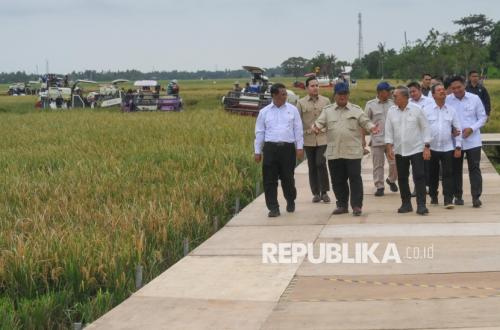
Therefore, if the administration of President Prabowo intends to make food self-sufficiency one of its priority programmes, there is no harm in the ‘Red and White’ Cabinet looking to the previous successes in rice self-sufficiency. Many believe that rice self-sufficiency is the gateway to overall food self-sufficiency. With abundant production such that Government rice reserves can exceed 3 million tonnes, combined with the intention to cease rice imports starting in 2025, many conclude that Indonesia has effectively achieved rice self-sufficiency once again.
The critical question is: are we capable of realising a sustainable or permanent rice self-sufficiency starting now? This is the answer we need. This is interesting because the rice self-sufficiency achieved so far tends to be ‘on trend’. This means that while we were able to write a success story of self-sufficiency in 1984, a few years later, we once again imported significant amounts of rice. Consequently, this nation cannot claim to be self-sufficient.
The same occurred in 2023. After being honoured by the IRRI, which is supported by the FAO, the government announced the success of boosting production to achieve self-sufficiency. However, shortly thereafter, the Government was forced to import rice because domestic production could not meet domestic demand.
Climate anomalies, such as El Niño, left many nations unable to find an ideal solution. For our nation, which was also preparing for the ‘Democracy Feast’, Indonesia once again faced a ‘rice emergency’. Consequently, rice imports became the policy choice that had to be taken.
In 2024, national rice production was truly distressing. This was not only due to climate and weather conditions that were unfavourable to agriculture, but also the impact of white-collar crime within the Ministry of Agriculture involving the then-Minister of Agriculture, which was felt in 2024. The national rice production yielded was significantly lower than the previous year.
Even more distressing was the fact that the rice imports undertaken for 2024 reached a spectacular figure. According to the Central Bureau of Statistics (BPS), rice imports in 2024 exceeded 4 million tonnes. This occurred despite President Jokowi previously expressing his happiness because Indonesia received an award for its success in achieving rice self-sufficiency.
Such experiences should remind us that the task of realising rice self-sufficiency is not only about the fanfare of achievement, but equally important is the preservation of what has been attained. The rice self-sufficiency achieved must be sustainable; it can no longer be merely ‘on-trend’ rice self-sufficiency.
We ought to stop ‘on-trend’ rice self-sufficiency. We must strive to immediately transform it into sustainable rice self-sufficiency. As a nation of fighters, we must work hard to ensure that the success story of rice self-sufficiency remains our nation’s ‘trademark’. In other words, sustainable rice self-sufficiency is a ‘non-negotiable’ priority that must be seriously guarded and secured.