
The Traces of Pesantren Students in Aid Mapping
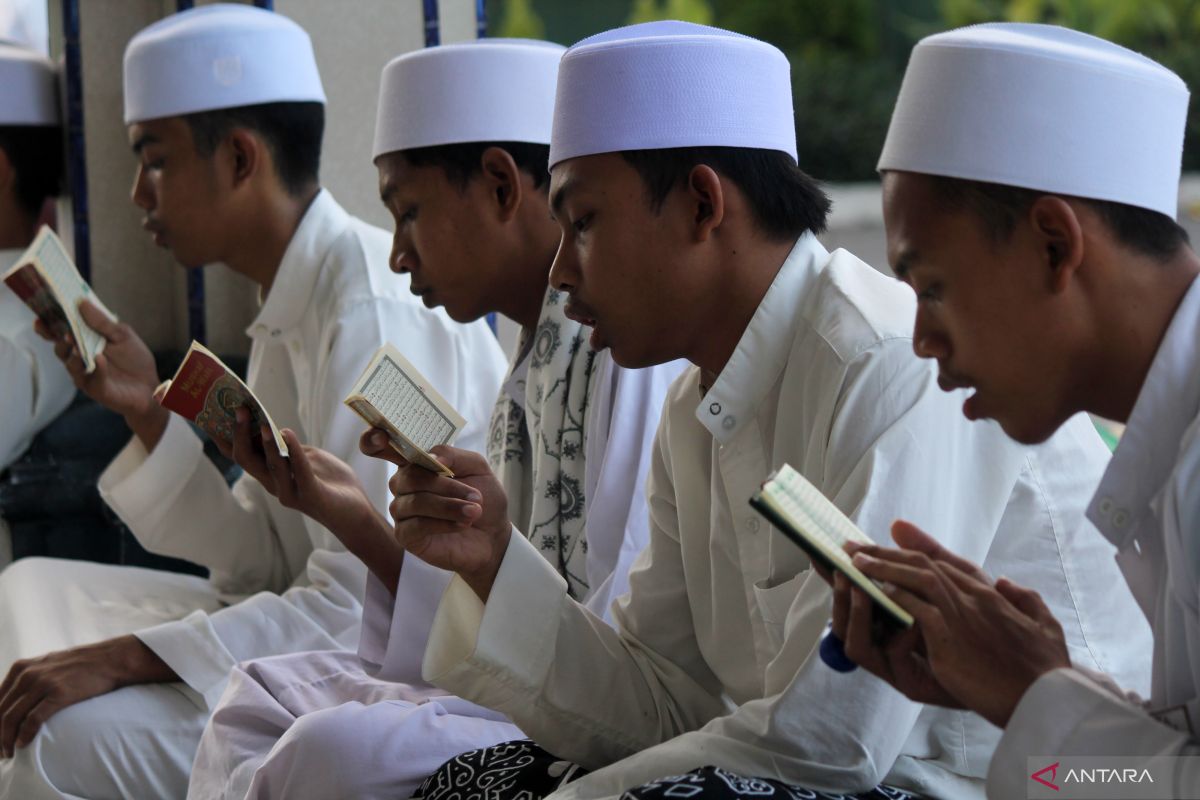
A child may change schools, enter a pesantren, live in the same house, remain a resident of Surabaya, and still possess the same right to obtain an education.
Surabaya (ANTARA) - There are children who appear to have disappeared from a list, but in reality, they have never stopped learning. They have simply moved through a different door, from general schools to Islamic boarding schools (pesante).
Their names no longer appear as expected during the data matching of educational levels, yet every day they continue to read, memorise, discuss, and undergo the learning process.
This phenomenon was discovered in the city of Surabaya, East Java, when primary school graduate data was matched with junior high school enrolment data within the Basic Education Data (Dapodik) system. It was found that some children not recorded in the formal education track were actually continuing their education in pesantren.
This finding has prompted the Surabaya City Government to design an expansion of the reach of the Regional Education Operational Assistance (Bopda) for students in pesantren and other non-formal religious educational institutions.
The plan poses an important question at the heart of the city’s educational policy: Is the right to educational support determined by where a child learns, or by the needs and rights of the child themselves?
This question becomes increasingly relevant as Surabaya continues to develop data-driven social policies. The Central Bureau of Statistics (BPS) recorded Surabaya’s poor population at 105,09 thousand people in March 2025, or 3.56 per cent of the population. The city government aims to reduce the poverty rate to 3.48 per cent by 2026.
In this context, education is not merely a matter of schooling, but an investment to break the cycle of intergenerational economic vulnerability.
For years, discussions regarding educational equality have often been trapped by focusing on school buildings, the number of classrooms, teachers, and participation rates. However, the more difficult issue lies with children who switch educational tracks and are no longer easily readable by certain administrative systems.
Surabaya is identifying that gap. Children not recorded in the formal track have not necessarily dropped out of school. They may be in madrasahs, diniyah education, pesantren units, or other forms of religious education.
Therefore, the disappearance of a name from the Dapodik system should serve as a signal to investigate, rather than a reason to draw conclusions.
The Surabaya City Government’s finding is significant because it demonstrates that educational data should not stand alone. The Ministry of Religious Affairs maintains EMIS (Education Management Information System) as a data collection system for religious education, including pesantren, equivalence education in Salafiyah pesantren, formal diniyah education, Muadalah educational units, and other religious educational institutions.
The Ministry of Religious Affairs itself has implemented EMIS 4.0 as a system to strengthen valid and integrated religious education data.
Source: jawawa.id (https://jawawa.id/newsitem/the-traces-of-pesantren-students-in-aid-mapping-1790906237)
Originally published by Antara (Indonesian) (https://www.antaranews.com/berita/5767795/jejak-santri-dalam-peta-bantuan), translated from Indonesian