
The Tour Against Oligarchy
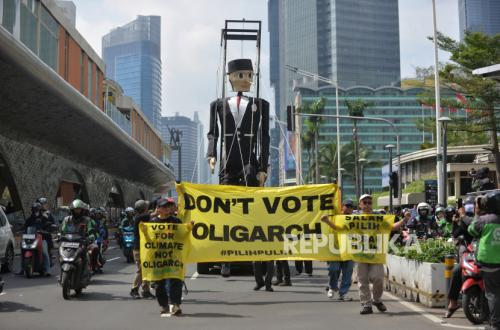
The word “oligarchy” is increasingly heard on the global stage, from Washington to Kyiv, and from Moscow to Jakarta. It is not merely an academic term, but a bitter reality that explains why modern democracy appears alive, yet its soul is increasingly paralysed. Oligarchy, derived from the Greek ‘oligos’ (few) and ‘arkhein’ (to rule), is a condition where political and economic power is concentrated in the hands of a small elite.
Today, the term is no longer confined to textbooks but is part of daily news. In the United States, progressive senator Bernie Sanders has launched his ‘Fighting Oligarchy Tour’ to raise public awareness so that democracy is not colonised by corporate billionaires. In Ukraine, President Volodymyr Zelensky rose to power amidst a political system previously controlled by media and industrial conglomerates. In Russia, oligarchy has become synonymous with the post-Soviets tycoons who control energy and politics.
What about Indonesia? Does oligarchy also take root here, in a softer form but with no less influence?
In his tour, Bernie Sanders argues that America is losing its soul. He asserts: “We must not become a nation ruled by billionaires for the benefit of billionaires.” This statement is not mere political rhetoric, but a protest against what he calls “extreme capitalism”—where the wealth of the top 1 per cent of the population is capable of controlling the entire economic and legal structure. Oxfam International (2024) data shows that the five richest billionaires in the world now possess wealth equivalent to the combined wealth of the 4.7 billion poorest people on the planet.
In America, Wall Street is not just an economic symbol, but also a pivot of power capable of determining who sits in the White House. Political campaigns cannot be separated from massive funding. Loose campaign finance laws turn corporations into “democratic donors”—a cynical term for those who purchase influence with money. This is why Sanders’ tour is significant: he is attempting to return democracy to the hands of ordinary people.
Meanwhile, in Ukraine, oligarchy appears in another form. Since the collapse of the Soviet Union, a number of large entrepreneurs have controlled the energy, mining, and media sectors. They fund political parties and even determine news narratives. According to a report by Carnegie Europe (2023), Zelensky himself rose through the support of media owned by Igor Kolomoisky—a controversial gas and banking oligarch.
This story demonstrates that oligarchy is not about “which country,” but about how wealth is used to control discourse, policy, and public belief.
Oligarchy in Indonesia: Changing Skin, but the Same Character
Indonesia, the third-largest democracy in the world, is not immune to similar symptoms. We call ourselves a state governed by law and the people, but in practice, many public policies serve the interests of a handful of conglomerates or natural resource controllers.
Professor Jeffrey Winters, a political expert from Northwestern University, wrote sharply in his book Oligarchy (20lar) that Indonesia is a classic example of “electoral oligarchy”: formal power is won through elections, but control over the state remains in the hands of the economic elite.
The most visible example is the structure of political financing. To run for regional head or parliament member, a candidate must prepare billions of rupiah. Consequently, politics becomes a field for investment rather than a public mandate. When they hold power, the priority is no longer public service, but “recouping costs” and ensuring the continuity of the oligarchy that financed them.
The natural resources sector has become fertile ground for oligarchs. From nickel mining to palm oil forests, many permits are issued without considering environmental carrying capacity. The result: widespread ecological damage, agrarian conflicts, and structural economic inequality. The people merely become “spectators” in the battle of the elites. In Sanders’ words: democracy without economic sovereignty is merely an “illusion controlled by money.”
To understand the dangers of oligarchy, we must look at its three faces:
First: Economic Oligarchy. Economic power concentrated in a few large corporations. They determine the prices of basic commodities, energy, and even access to land and water. In Indonesia, 20 business groups control more than 60% of national corporate assets (Credit Suisse Global Wealth Report 2023 data).
Second: Political Oligarchy. This emerges when political parties become vehicles for tycoons or ruling families. Loyalty is no longer to ideology, but to “political investors.” As a result, policies born in parliament are often adjusted to meet capital pressures.
Third: Information Oligarchy. The digital era presents a new form: media and digital platforms controlled by a few tech giants. Algorithms, rather than public reason, determine what we read and believe. This phenomenon aligns with what Yanis Varoufakis calls “cloudalism”—a digital colonialism replacing industrial capitalism.
These three forms conspire to form a dependency ecosystem: money buys influence, influence creates policy, and policy protects the source of money. A vicious cycle.
Oligarchy is not an enemy because of its wealth, but it becomes a problem when wealth is used as a tool to control state policy, shape public opinion, or influence the law for the benefit of specific groups. Therefore, in a healthy democracy, what must be controlled is not business success or individual property rights, but the excessive concentration of power. The state must ensure that no economic, political, or media group possesses such significant influence that they can stand above the interests of the nation and its people.