
The Tears of Kiai Hasan Abdullah Sahal at Gontor's Centenary
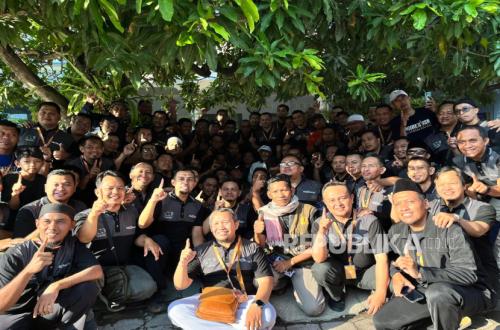
On the morning of Sunday, 20 September 2026, before the sun had fully risen, the Gontor football field began to fill with people. Despite the morning dew and the cold air, the boarding school was busier than usual.
Thousands of alumni arrived, some from distant cities and others from across continents, to participate in a morning exercise session. In that field, age seemed irrelevant; those with whitening hair stood alongside recent graduates, all moving in the same rhythm, reminiscent of the dawn bells that once woke them.
Following the exercise, formations formed naturally. Without much instruction, everyone knew where to go, as each ‘marhalah’ (batch) represents a second home within the larger house of Gordor. Some waved batch flags, others wore uniform shirts displaying their graduation years, and many were busy capturing the moment on their phones. As one batch began to sing, others responded, with chants echoing through the mosque courtyard and the BPPM area.
The noise reached the residence of the school’s leadership. At his home, KH Hasan Abdullah Sahal heard the unusual commotion. “What is happening?” he asked his nephew.
“People are taking photos between batches and singing their batch chants,” Gus Thoha replied.
The Kiai did not call for anyone or wait to be fetched. He stepped out of his house, took a plastic chair, and slowly carried it to the courtyard to sit under a tree.
There was no stage and no formal welcoming speech. No special place had been prepared for him. A Kiai sat on a simple chair, watching the processions arriving from all directions.
Walking before him were his former students. Once, they arrived with meager suitcases, anxious faces, and eyes searching for their mothers. Now, they have become fathers, teachers, entrepreneurs, bureaucrats, scholars, academics, professionals, and prominent figures within their respective communities.
Amidst the sounds of the chants, the Kiai’s tears fell. These were not tears of sadness or loss, but the tears of someone watching his children return home.
Perhaps before his eyes, time was moving backwards. The children he once saw in line now walked with grey hair. The faces he once called forward now arrived bringing their children and grandchildren. He may also have been remembering those who could no longer attend, whose names now live only in prayer.
We can never know exactly what was in his heart that morning. Perhaps he was reminiscing, perhaps expressing gratitude, or perhaps simply enjoying the simplest happiness a teacher can possess: seeing his students gather once again in the place where they were forged.
What Does Not Fade with Time
Anyone who has studied in a ‘pondok’ knows that Gontor is more than just a place of learning. There, one learns languages, classical texts, and public speaking. However, one also learns to wake before sunrise, to queue patiently, to wash one’s own clothes, to work within committees, and to live alongside peers from various regions. We learn that life is not just about receiving, but also about giving.
None of these lessons are left behind at the school gates upon receiving a diploma. These values are carried wherever one goes: to the office, the classroom, the household, and to distant lands. Their significance often grows stronger with age, as humans often only realise the true value of a place after having left it for a long time.
That is why, when the batch chants echoed across the field, they were not merely singing songs. They were singing fragments of their own lives.
Source: jawawa.id (https://jawawa.id/newsitem/the-tears-of-kiai-hasan-abdullah-sahal-at-gontors-centenary-1790175262)
Originally published by Republika (https://analisis.republika.co.id/berita/tltkyg451/air-mata-kiai-hasan-abdullah-sahal-di-seratus-tahun-gontor), translated from Indonesian