
The 'Tangping' Trend Brings Disaster: The 'Rotten Tail Children' Phenomenon Emerges in China
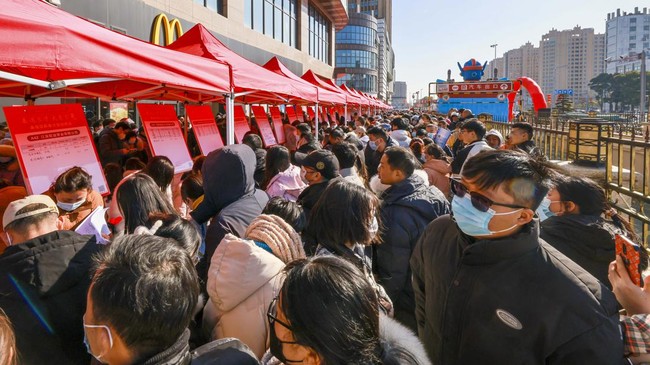
The employment problem for China’s younger generation is worsening. A phenomenon called ‘rotten tail children’ has now become one of the most serious social and economic challenges facing the country. The term ‘rotten tail children’ refers to millions of university graduates who are highly educated but have failed to obtain jobs matching their field of study, are forced to work for low wages, or are even unemployed and entirely dependent on parental support. The phrase is taken from the expression ‘rotten tail building’, referring to stalled housing projects that have been a major economic burden since 2021, depicting the fate of a young generation that is trapped, powerless, and unable to provide the expected economic benefits. At the Lishuiqiao job market in Beijing, many young job seekers revealed how difficult it is to secure a position matching the skills they spent years studying for at university. Hu Die, 22, a design graduate from Harbin University of Science and Technology, said, ‘I see the prospects as very bleak, the labour market is quiet. In the end, I had to abandon my intention of finding a job that matches my skills.’ Li Mengqi, 26, a chemical engineering graduate from Shanghai Institute of Technology, has been unemployed for eight months since graduating. She found no vacancies at all that matched her educational background. Chen Yuyan, 26, a vocational college graduate in Guangdong since 2022, now works only as a package sorter at a courier company. ‘Many companies are looking for people who are already experienced, who can start work immediately. We fresh graduates have no experience. They say they have no budget to train new employees, and the salaries offered are very low, not even enough for a decent living,’ she said. These stories are not isolated cases, but a real picture of a widespread crisis, said Zak Dychtwald, founder of the Young China Group research institute in Shanghai. ‘The biggest problem now is the huge gap between the hard work they put in during university and the reality of the jobs in front of them,’ he said. Zhou Yun, assistant professor of sociology at the University of Michigan, added that although graduates from elite schools or majors like automation and AI are still sought after, increasingly fierce competition and the contraction of industries that used to absorb many young workers—such as internet start-ups and the education sector—are making the situation more difficult. ‘There are deep structural reasons behind all this,’ he stressed. This situation is triggering a major shift in attitudes among Chinese youth. Unlike their parents’ generation who were willing to accept any job to survive, today’s graduates are increasingly reluctant to take low-quality, unstable jobs, or those far below their expectations. Many are also no longer interested in starting small businesses like street vending, which was once considered an economic way out. Eli Friedman, professor of global labour at Cornell University, explained, ‘For young people aged 22-23 who have just graduated, doing odd jobs or small-scale trading is no longer considered a reasonable or dignified option. Their work culture has changed.’ This has given birth to the ‘tangping’ or ‘lying flat’ phenomenon—an attitude of withdrawing from overly intense job competition, refusing to work excessively hard, and choosing a simple life or unemployment over accepting a job that does not match their self-worth. Many are deeply disappointed because the promise that ‘higher education will guarantee a better life’ has not materialised. Psychologically, the impact is profound. ‘The inability to get a job is not just an economic problem, but it strips away self-respect and life purpose. This demolishes the belief they have held for so long,’ said Zhou Yun. The situation is actually worsening over time. The number of university graduates in China continues to break records. In 2025, 12.22 million new graduates were recorded, a sharp increase from 9 million in 2021. In 2026, the number rose again to 12.7 million, the highest in history, tightening competition to the maximum limit. On the other hand, the youth unemployment rate remains high. The latest official data as of April 2026 shows the unemployment rate for ages 16-24 reached 16.3%, down slightly from 16.9% in March, but still very high and far above the national average of around 5%. While millions of graduates are unemployed, China actually lacks around 30 million skilled workers in the manufacturing, construction, and technical services sectors in 2025-2026. There are many graduates, but their skills do not match what industry needs. This skills mismatch is the main root of the problem. The Beijing government has acknowledged this problem is very urgent. In the 2025-2026 Government Work Report, they targeted creating more than 12 million new jobs per year, providing wage subsidies, tax cuts, unemployment assistance, and entrepreneurship support. However, the results have not been clearly felt because the economic recovery is slow, the private sector is hesitant to hire, and changes in industrial structure are proceeding slowly.