
The Tale of a Hamlet in Banjarejo, Gunungkidul, That Disappeared After Its Residents Left
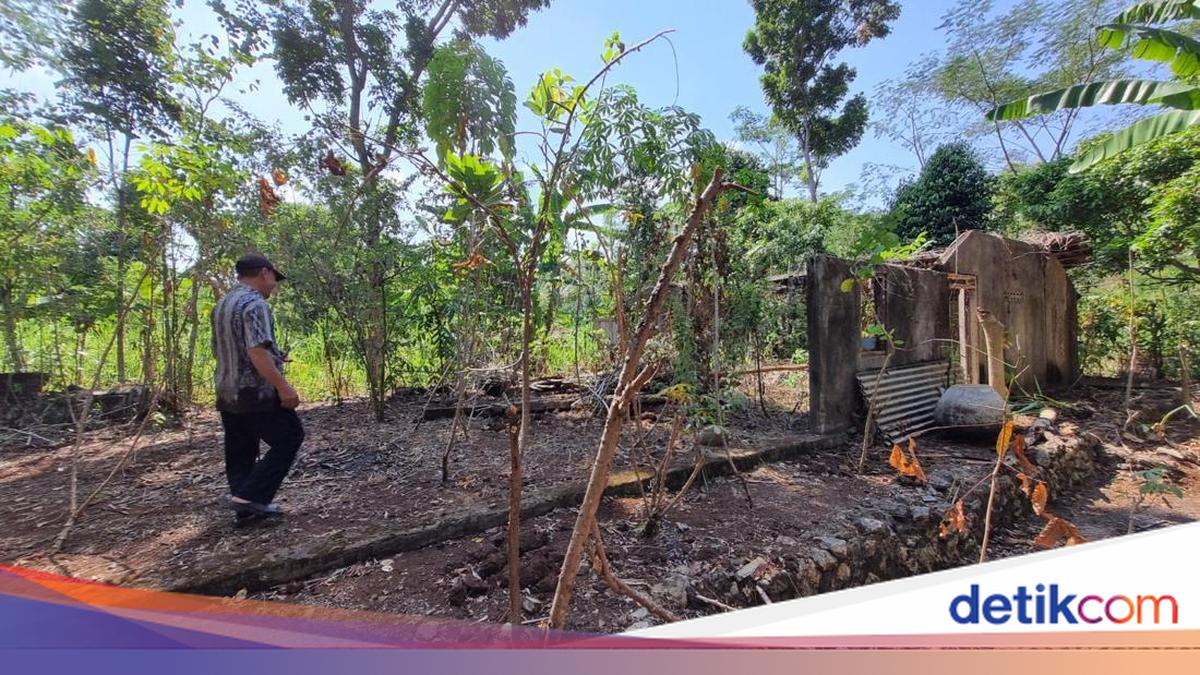
Pedukuhan Sari in Kalurahan Banjarejo, Tanjungsari, Gunungkidul, has been forced to disappear from the village administration. The cause was the mass relocation of Sari’s residents after neighbours joined transmigration and family planning (KB) programmes.
According to detikJogja’s observations, Pedukuhan Sari is located not far from the Banjarejo Village office, approximately 500 metres away. Access to Sari is relatively easy, with a concrete block road and a compacted dirt village path.
Upon arrival at the site, two houses are visible. One is severely damaged and roofless, whilst the other has been converted into a chicken coop. A bed can still be seen inside the house that is now a chicken coop. In contrast, the walls of the other house have collapsed and are overgrown with dense vegetation.
Dukuh Sangen I, Suparno, stated that these buildings were once the homes of Sari residents. He had visited Sari when he served as Dukuh in 1998. “I served as Dukuh in 1998, and at that time, the Dukuh of Sari was still active and even became my friend. But now, the Dukuh of Sari has passed away,” he told reporters in Banjarejo, Tanjungsari, Gunungkidul, on Thursday (18/6/2026).
The man, wearing a hat, recounted that Pedukuhan Sari was once inhabited, albeit with a small population. Most of the residents worked as farmers. “Pedukuhan Sari was small back then, there weren’t many heads of families. The residents’ activities were normal, mostly farming and cultivating the land as usual,” said the 59-year-old.
However, the residents of Sari gradually left one by one. By 1998, only a few families remained. “As I recall, in 1998 when I served as Dukuh, there were only three or four families living here,” he said.
Suparno admitted he did not know the reason why the residents suddenly left Sari. He never had the chance to ask his colleague, the Dukuh of Sari. “I don’t know why they disbanded or where they went, because I didn’t ask my friend, the Dukuh of Sari, at the time,” he said.
After the hamlet was left with no residents, Suparno stated that the Banjarejo Village administration eventually removed Pedukuhan Sari from its administrative territory. The number of hamlets was thus reduced from 22 to 21. “Administratively, it is no longer recorded. Pedukuhan Sari no longer exists,” he said.
Banjarejo Village Head, Dwi Haryanto, confirmed that Pedukuhan Sari once existed in Banjarejo. However, around the 1990s, the hamlet was removed from the village’s administrative area. “If I’m not mistaken, it was in the 1990s. The number of families in Sari was already small, and because it kept decreasing, it eventually ran out and was removed,” he said.
Regarding the cause, Dwi mentioned that during a transmigration programme to Sumatra, several residents of Sari participated. Subsequently, the children of Sari residents left to start new lives. “Back then, there was a transmigration programme to Sumatra and some Sari residents joined. Besides that, many children from Sari got married and moved out,” he said.
As a result of the mass departure, Pedukuhan Sari was left with only elderly residents. When these elderly residents passed away, those who remained felt lonely. “Gradually, because there was no population growth and the elderly who stayed died, the ones who were still alive eventually decided to move one by one,” he said.
By the 1990s and beyond, no residents remained in Sari. Dwi revealed that the road access in Sari was not poor and the location was not remote. “Actually, road access was not a problem. It was close to Pedukuhan Padangan and not isolated because it was also near the village office,” he said.
Regarding where the residents of Sari moved, Dwi stated they relocated within the Banjarejo area, to places like Pedukuhan Padangan, Ngepoh, Wuluh, Kunang, and Weru. Dwi emphasised that the residents’ departure was purely due to a lack of companionship in Sari. “The reason they moved one by one was because they had no friends, not because of other things. Why did they have no friends? Because of the KB and transmigration programmes, which led to a lack of population growth,” he said.
Source: jawawa.id (https://jawawa.id/newsitem/the-tale-of-a-hamlet-in-banjarejo-gunungkidul-that-disappeared-after-its-residents-left-1781945436)
Originally published by detikJogja (https://www.detik.com/jogja/berita/d-8539909/kisah-padukuhan-di-banjarejo-gunungkidul-kini-hilang-usai-ditinggal-warganya), translated from Indonesian