
The Sunda Strait in the Shadow of the Banten Sultanate: An Unfinished History
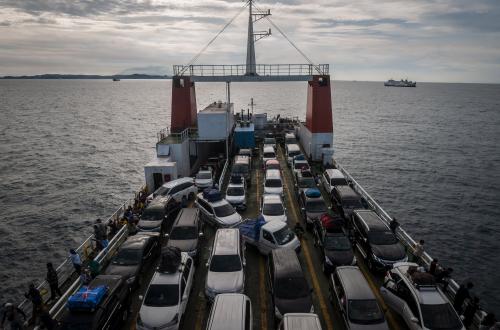
The Sunda Strait is not merely a sea passage between Java and Sumatra. It is a historical space that once gave birth to a great maritime power known as the Banten Sultanate. In the 16th and 17th centuries, global trade flows passed through this route, and from this point, power was built. Yet today, the Sunda Strait stands in the shadow of its own past—once strategic, but no longer decisive.
During the era of the Banten Sultanate, the Sunda Strait served as a crucial node in the global trade network. When Malacca fell to the Portuguese in 1511, global trade flows were disrupted. In this situation, the Banten Sultanate emerged as a strategic alternative. Its port became a meeting point for traders from the Middle East, India, to East Asia. In this context, the Sunda Strait was not just a transit route, but an instrument of economic and political power.
Historian Anthony Reid notes that Southeast Asian port cities during that period functioned as “cosmopolitan trading hubs integrated into global commerce.” The Banten Sultanate was one of the most prominent examples of this phenomenon. It was not only a regional port but part of a growing global trade system.
However, this glory did not last long. When the VOC arrived, the game changed fundamentally. Banten continued to operate within the logic of open trade, while the VOC worked within the logic of an integrated and monopolistic global system. The VOC did not just trade; it controlled distribution, prices, and trade directions.
The key to the VOC’s strength lay in its ability to master the narrow points of world trade. After seizing Jayakarta from the Banten Sultanate and renaming it Batavia, the VOC made this city its operational centre, effectively controlling the flow between the Sunda Strait and the Malacca Strait. These two routes were the main gateways connecting the Indian Ocean to the East Asian trade network. Historian Leonard Blussé points out that the VOC’s power in Asia did not rely on controlling vast territories, but on control over “strategic nodes of trade and shipping.”
Through a combination of military strength, trade monopolies, and financial innovations, the VOC created a system in which ships passing through not only moved geographically but also entered the economic control structure they had built. This is what distinguished the VOC from local powers like Banten. The VOC did not merely exploit the Sunda Strait but made it part of the global system they controlled.
As emphasised by Fernand Braudel in his analysis of the world economy, “whoever controls the nodes of circulation controls the economy itself.” This statement aptly explains how the VOC was not merely present as a trader but as a controller of the global circulation structure.
Furthermore, within the world-system framework, Immanuel Wallerstein asserts that “the modern world-system is organised around a core that monopolises high-profit production while peripheral regions supply raw materials.” In this context, Banten’s position becomes clear: it was trapped as a supplier, while the VOC controlled the mechanisms of value accumulation. Herein lies a lesson often overlooked: mastery of space without mastery of the system is an illusion of power.
From Banten to Indonesia: An Old Pattern That Repeats
What happened to Banten is not merely a historical episode but a structural pattern that appears to repeat in a more modern form. Today’s Indonesia remains an important player in global trade, but for the most part, it is still in the position of a raw material supplier. Nickel, coal, and palm oil flow out of the country in large volumes, while the greatest added value is enjoyed by foreign countries and corporations.
This situation reflects the peripheral position in the world system: regions that provide resources but do not control distribution and value accumulation. In this context, Indonesia is not entirely different from Banten several centuries ago.
The Sunda Strait concretely illustrates this paradox. Thousands of ships pass through it, but Indonesia has no significant influence over the global trade flows passing through that route. There is no control over strategic tariffs, no dominance in international logistics, and no capacity to make that route an instrument of geopolitical bargaining.
Meanwhile, modern global powers, whether states or multinational corporations, operate with a logic very similar to that of the VOC in the past, where they control the system, not merely the space. They simultaneously control supply chains, technology, financing, and markets.
The key question for Indonesia is no longer whether the Sunda Strait is strategic, but whether Indonesia can make it truly strategic. Without serious policy interventions, the Sunda Strait will remain an alternative route that is only relevant in emergency conditions, not in the normal architecture of global trade.
To change this, Indonesia cannot settle for merely building physical infrastructure but must enter into mastery of the system: global logistics, downstream industries, maritime technology, and the architecture of international financing. Without that, every ship passing through the Sunda Strait will only reinforce Indonesia’s position as a spectator in its own territory.
Thus, the Sunda Strait is not just a matter of maritime strategy but also a mirror of an unfinished history. As long as Indonesia has not mastered the system that drives that route, the Sunda Strait will remain in the shadow of Banten—once strategic, but never truly sovereign.