
The Story of Two Indonesian Students Bringing Mental Health Issues to the Forefront Through Film
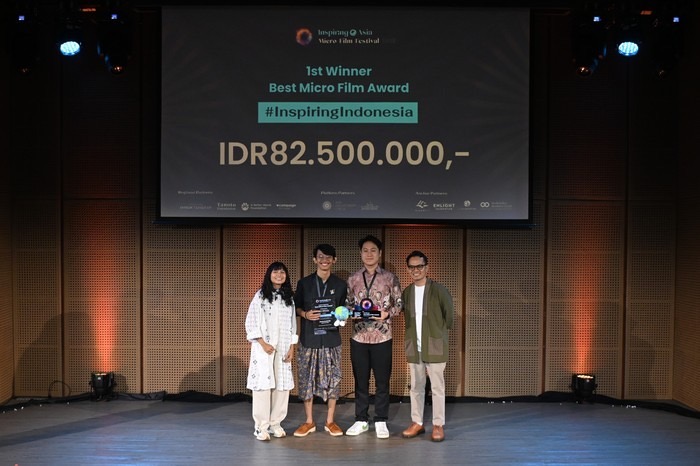
Amidst the relentless torrent of daily digital content, two Indonesian students have chosen a different medium to voice their generation’s anxieties: short film. Through their work titled ‘Mania Dunia Nia’, Januar David Ciu and Yosafat Prasetya highlight the issue of student mental health and the social pressures increasingly close to young people’s lives today. Unexpectedly, the film won them 1st place at the Inspiring Asia Microfilm Festival #InspiringIndonesia 2025 and will represent Indonesia in the final round of the Inspiring Asia Micro Film Festival in Singapore.
Competing with young filmmakers from various Asian countries, the duo discovered that the strength of Indonesian stories lies in things that are simple, close, and honest. “I once heard a story from a friend who wanted counselling with a campus psychologist, but the schedule was fully booked for one or two months. From that, I realised that many people are actually facing psychological issues, they are just often invisible,” Januar said, as quoted from an official statement on Tuesday (9/6).
That everyday experience became the foundation for the story of ‘Mania Dunia Nia’. Instead of chasing spectacular tales, they chose to highlight the reality that quietly lives around students: fatigue, social pressure, and loneliness amidst a fast-paced digital world. For Yosafat, honesty in storytelling is the main strength of a work. “There is no need to force themes that are far from ourselves. Find an issue that is close and specific, then find a unique visual way to convey it,” he said.
Januar and Yosafat do not come from film schools. Yosafat is a master’s student in the Faculty of Forestry. For him, environmental issues and mental health have a fairly close connection. “I once learned that forests can also provide a sense of calm for people experiencing stress or depression. So there is actually a relationship between nature and mental health,” he said. Meanwhile, Januar is an Industrial Engineering student at the University of Indonesia, whose daily life is full of lab work and academic pressure. Amidst that routine, making films has become a space for reflection as well as a way to maintain life balance.
Behind the success of ‘Mania Dunia Nia’, both believe that team strength plays a major role. As a recipient of a Tanoto Foundation scholarship through the TELADAN programme, Januar admits he gained many lessons on self-leadership, time management, and team management. He applied that experience directly in managing the film production with limited time and resources. “What is most felt is how to manage people with the same goal. Film production turns out to be not just about creativity, but also about leadership and communication,” he said.
Now, both hope that more young Indonesians will dare to convey their perspectives through creative works. Because, in an increasingly noisy world, honest stories often become the strongest voice. The success of ‘Mania Dunia Nia’ shows that local Indonesian stories have universal resonance. In an international competition with much larger production support, their film was still able to steal attention because it offered something authentic: real human experience. “Sometimes we feel our story is too small. Yet, the stories closest to everyday life are often the easiest for others to understand,” said Yosafat.
That spirit is also promoted in the Inspiring Asia Micro Film Festival 2026 #InspiringIndonesia, a short film festival with the theme Community Empowerment: Belonging, Resilience, Thriving. The festival encourages young filmmakers, students, communities, social organisations, and independent creators to highlight stories of change from their respective communities. Not just a film competition, the festival is also designed as a collaborative movement that brings together art, social action, and public participation. Through a community vetting mechanism, the public is involved in supporting works deemed most relevant and impactful. For Januar and Yosafat, festivals like this are important because they provide space for young people’s perspectives that are often unheard.
This year, the Inspiring Asia Micro Film Festival 2026 #InspiringIndonesia opens three main categories: Best Micro Film Award, Best Project Award, and Best AI Film Award. The AI category was introduced to open wider access for young creators to work without being constrained by large production costs. Interestingly, the festival is not only open to professional filmmakers. Students, communities, social organisations, social enterprises, and creative individuals can also participate as long as they have a story about community empowerment they wish to convey through a short film. “Don’t be afraid to try. Maximise existing resources and find a community to collaborate with. Sometimes the most important thing is not how big the production is, but how honest the story you want to tell is,” said Januar.
The Inspiring Asia Micro Film Festival 2026 #InspiringIndonesia is part of a series of Asia-level film festivals that provide a space for stories of change from various communities. The festival is supported by various organisations and cross-country strategic partners in Indonesia and Asia, such as Bakti Pendidikan Djarum Foundation, Tanoto Foundation, and Campaign for Good. Unlike conventional film festivals, #InspiringIndonesia focuses not only on cinematic quality but also on public engagement and the resulting social impact.