
The Story of Those Maintaining the Energy Chain in Porong
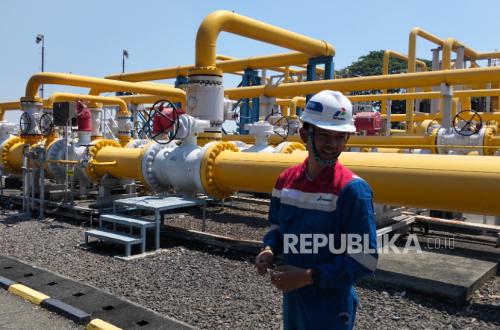
As in many other parts of the country, rain has not visited Sidoarjo for more than a month. In Permisan Village, Jabon District, which is not far from the sea, the heat shows no sign of easing.
Despite the weather, the work of inspecting the Porong Onshore Receiving Facility (ORF) managed by PT Pertamina Gas through Operation East Java Area (OEJA) never stops.
Every two hours, control officers must report conditions and record them in a log book. They work 24 hours a day, seven days a week, alternating in pairs across three shifts per day.
In other areas, maintenance and security personnel are also at work. “There is no stopping, Mas. Control and inspection must continue,” said Muhammad Maura Gomez, Maintenance Supervisor for the Gresik District of Pertagas OEJA, to Republika on Wednesday (26/8/2026) in Sidoarjo.
What exactly are they watching over so closely?
From a distance, the facility may look like an ordinary industrial complex. Steel pipes stretch out, equipment stands in measured formations, while the sound of machinery is part of daily life.
But behind the intertwining pipes, a long journey is underway.
The natural gas that arrives at ORF Porong does not simply appear. It travels hundreds of kilometres from offshore gas fields before finally reaching the Sidoarjo mainland. In Permisan Village, that journey meets one of its most important nodes.
ORF Porong is a facility for receiving, regulating, and distributing natural gas managed by PT Pertamina Gas through Operation East Java Area (OEJA). The facility has been operating since the early 1990s and is an important part of the natural gas transmission network in East Java.
This is where gas arriving from offshore areas is received, measured, regulated, and then sent back to centres of energy demand on land.
That is the flow that Maura Gomez and his colleagues must safeguard. “The worst case is a blocked pipe or a leak. The supply line would ultimately be cut off,” he said.
To understand the importance of ORF Porong, imagine the journey of gas from the east. One of the main routes in the network is the East Java Gas Pipeline (EJGP), which stretches from the Pagerungan Island area to Porong. This subsea pipeline is approximately 360 kilometres long. Government documents record the Pagerungan–ORF Porong section at around 369.7 kilometres.
This means that before gas arrives in Porong, it has travelled a long distance along the seabed. One of the main historical sources for the network is the Pagerungan Field in the Kangean Islands. In addition, the East Java network also receives gas from a number of other offshore fields around Madura.
Operational data that has been published shows that ORF Porong’s supply comes from, among others, the Pagerungan Block, Santos Peluang, Santos Maleo, and the Terang Gas Field. During that period, the total flow received and distributed by ORF Porong reached hundreds of MMSCFD.
This network is not merely a route from point A to point B. It is designed to collect supply from multiple sources and then direct it to various consumers according to need.
Over time, the sources of supply have also expanded. One example is the integration of the MAC Field owned by Husky-CNOOC Madura Ltd. (HCML) into the transmission network through tie-in work at the end of 2023.
In this way, ORF Porong serves as a meeting point between gas arriving from various sources and the energy needs on land.
Once it arrives at ORF Porong, the gas’s journey is not over. The gas then moves through the pipeline network to a number of consumption centres, especially towards Gresik and the Pasuruan area.
The Porong–Gresik section is one of the important routes in the system. Government data records that this section stretches approximately 52.63 kilometres from Sidoarjo, through Surabaya, to Gresik.
In the Gresik area, the gas meets one of the largest industrial concentrations in East Java.
There are power plants that need gas as fuel. There are fertiliser and petrochemical industries. There are also various other industrial activities that require energy continuously.
Historical data shows that distribution from ORF Porong has included supply to PLN, PGN, Petrokimia Gresik, Pertagas Niaga Waru, and customers in the Gresik area. During one documented operational period, the volume distributed reached around 326 MMSCFD.
In subsequent network developments, gas from East Java can also move towards a wider network. From Gresik, the transmission network connects to the Gresik–Semarang section. The network then integrates with the Cirebon–Semarang (Cisem) system.
At this point, the significance of ORF Porong becomes even greater. The facility is not only about the energy needs of Sidoarjo or Gresik. It is one of the links in the chain that allows natural gas to move from production areas in the east to consumption centres in other parts of Java.
For the public, the journey of gas over hundreds of kilometres may be invisible. What is visible is the electricity that comes on. Factories that keep producing. Industrial machines that keep working. Fertiliser that is produced. Economic activity that continues.
Behind all of that lies an infrastructure network that must operate with little room to stop. Natural gas requires a reliable transmission system because its consumers also need certainty of supply.
“Alhamdulillah, so far there has never been a supply disruption, either from the source or the receiver,” said Maura Gomez, who was born in Prabumulih, South Sumatra.
For this reason, ORF Porong is not merely a place where gas “comes and goes”. Within it, processes of flow regulation, measurement, and control take place so that gas can be distributed according to need.
In other words, ORF Porong sits in the middle of a long energy chain. It is one of the nodes in a network that connects gas sources with consumption centres.