
The Story of the Less Than 1 Per Cent of Paddy Fields Remaining in Metropolitan Jakarta
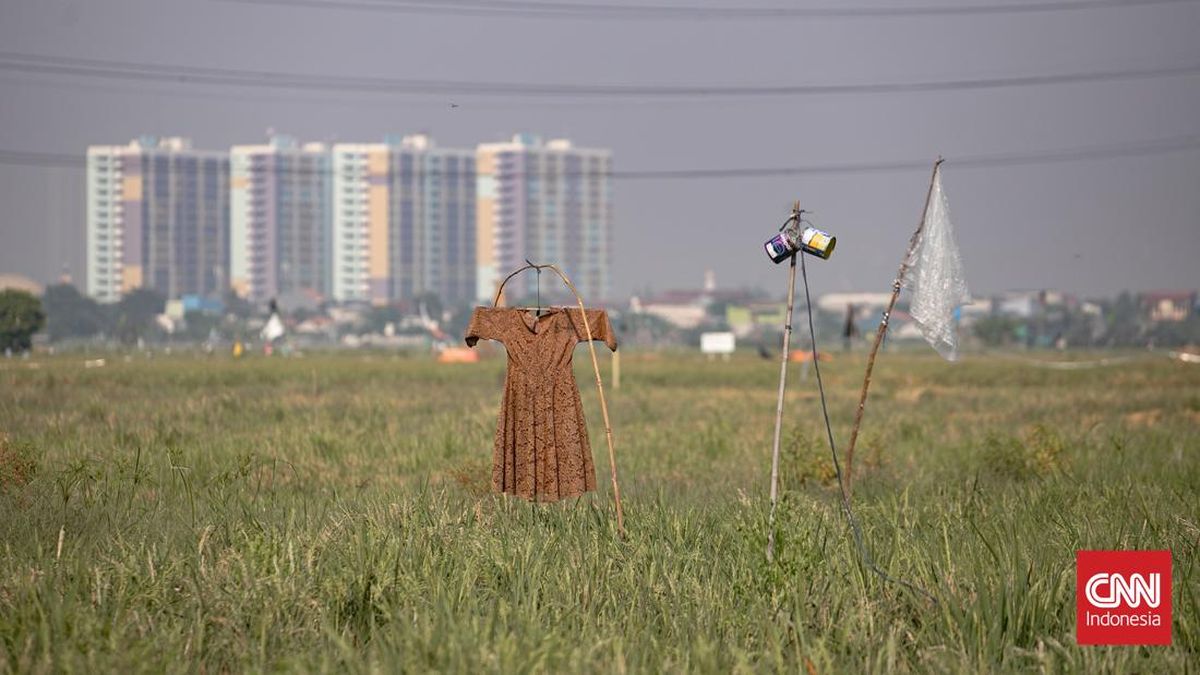
Expansive paddy fields stretch across Rorotan, Cilincing District, North Jakarta. Lines of earthen embankments divide the agricultural area, serving as paths for farmers in this border region between Jakarta and Bekasi Regency, West Java.
On a Wednesday afternoon, birds could occasionally be seen flying low, foraging among the rice plants (Oryze sativa). In several corners, black flags flutter in the wind, acting as deterrents against pests. A gentle breeze provides relief amidst the heat.
The rice fields stand adjacent to residential areas, roads, and the Rorotan RDF waste processing plant. Rorotan is one of the few areas in Jakarta that still possesses agricultural land.
According to data from the Jakarta Food Security, Marine, and Agriculture Office, the area of active paddy fields as of 2026 is approximately 279 hectares. This figure represents only about 0.42 per cent of Jakarta’s total area, which exceeds 66,233 hectares including the sea. These fields are scattered across Kalideres District in West Jakarta, Cakung District in East Jakarta, and Cilincing District in North Jakarta.
Based on the 2025 Jakarta Central Bureau of Statistics (BPS) report, the largest area of paddy fields remains in North Jakarta. In 2024, this region recorded a harvest area of 442.75 hectares, accounting for more than 88 per cent of the total rice harvest area in the Jakarta Province. However, in 2025, despite remaining dominant, the harvest figure decreased to 193.86 hectares.
A decline in harvest figures was also recorded in East Jakarta, dropping from 28.31 hectares in 2024 to 24.92 hectares in 2025. Meanwhile, West Jakarta saw an increase from 27.25 hectares in 2024 to 54.75 hectares in 2025.
“Rice production in Jakarta Province is still dominated by North Jakarta with a contribution of approximately 70.65 per cent, followed by West Jakarta at 20.17 per cent and East Jakarta at 9.18 per cent,” according to the report on Rice Harvest Area and Production in Jakarta Province 2025 published on the BPS Jakarta website.
Amidst the continuous development of Jakarta and the scarcity of agricultural land, Sirojudin Abas (47) is one of the farmers in Rorotan who has chosen to persist in cultivating the fields in the Cilincing District.
The head of the Maju Farmer Group was born and raised in Rorotan. He admits he has been involved in farming since childhood.
“If you ask how long I have been farming, I have been farming since I was in my mother’s womb, because my father and mother were farmers,” Sirojudin told CNN Indonesia during a visit to his fields.
Before entering primary school in the 1980s, he was already helping his parents in the fields. His childhood tasks ranged from cleaning embankments and weeding to hoeing. His involvement in farming in Rorotan was temporarily interrupted while he pursued education at an Islamic boarding school in East Java. In 2003, upon returning to Rorotan, he began farming and livestock rearing more intensively.
Currently, he cultivates approximately 3.1 hectares of paddy fields spread across four locations. However, this land does not belong to him; he manages land owned by relatives and several other landowners.
“In Rorrotan, the area cultivated by private owners is only about 0.00-something per cent. The rest is managed land. Some belong to Jakpro and Sarana Jaya (State-Owned Enterprises), and some belong to government departments,” he said.
He explained that the cultivation patterns in Rorotan vary. For land owned by the government or SOEs, farmers are generally not charged rent. For private land, some use a rental system, profit-sharing, or payment after harvest.
Sirojudin noted that this mechanism differs from agricultural land rental systems in other regions. In West Java, for instance, he mentioned that land rent can reach around Rp6 million per hectare, paid in advance. In Rorotan, payments to landowners are sometimes only made after the harvest. In fact, according to him, some landowners do not even demand payment from the farmers.
“So, you only pay after the harvest, and even then, it is at your discretion, because the owners do not demand it, and the local government does not demand it,” he said.
In a year, the fields in Rorotan can typically be harvested twice, depending on conditions. After harvest, the grain is usually sold directly to traders. He noted that during the previous harvest season, grain was absorbed by Bulog. However, currently, Bulog’s prices are lower than those of local traders.
“Now, local traders are offering Rp7,700 to Rp8,000; farmers are smart. Local traders offer prices higher than Bulog,” he said during the visit in early September.
Reflecting on the history of the area, Sirojudin vividly remembers the condition of Rorotan when he first returned to farming in his hometown amidst the concrete jungle of metropolitan Jakarta in 2003. At that time, he recounted that most of the areas now filled with buildings were still paddy fields.
He noted that besides residential areas, several development projects using paddy fields included the creation of a cemetery for Covid victims a few years ago and the construction of the Rorotan RDF waste processing facility. Sirojudin also mentioned hearing about the planned construction of a station near Rorotan, which would once again utilise paddy land.
“For the Covid cemetery, my farmer group lost about 4-5 hectares. It was private land purchased by the local government to be turned into a cemetery,” he said.
He estimates that the agricultural land in Rorotan is now only around 250 hectares. According to him, this is the largest amount compared to other areas in Jakarta. “It is under threat; it won’t be long before even the area to the north…”
Source: jawawa.id (https://jawawa.id/newsitem/the-story-of-the-less-than-1-per-cent-of-paddy-fields-remaining-in-metropolitan-jakarta-1790226008)
Originally published by CNN Indonesia (https://www.cnnindonesia.com/nasional/20260922030207-20-1406566/cerita-dari-kurang-1-persen-lahan-sawah-tersisa-di-metropolitan-dki), translated from Indonesian