
The Story of Resilient Women in South Solok Plantations and Family Hopes
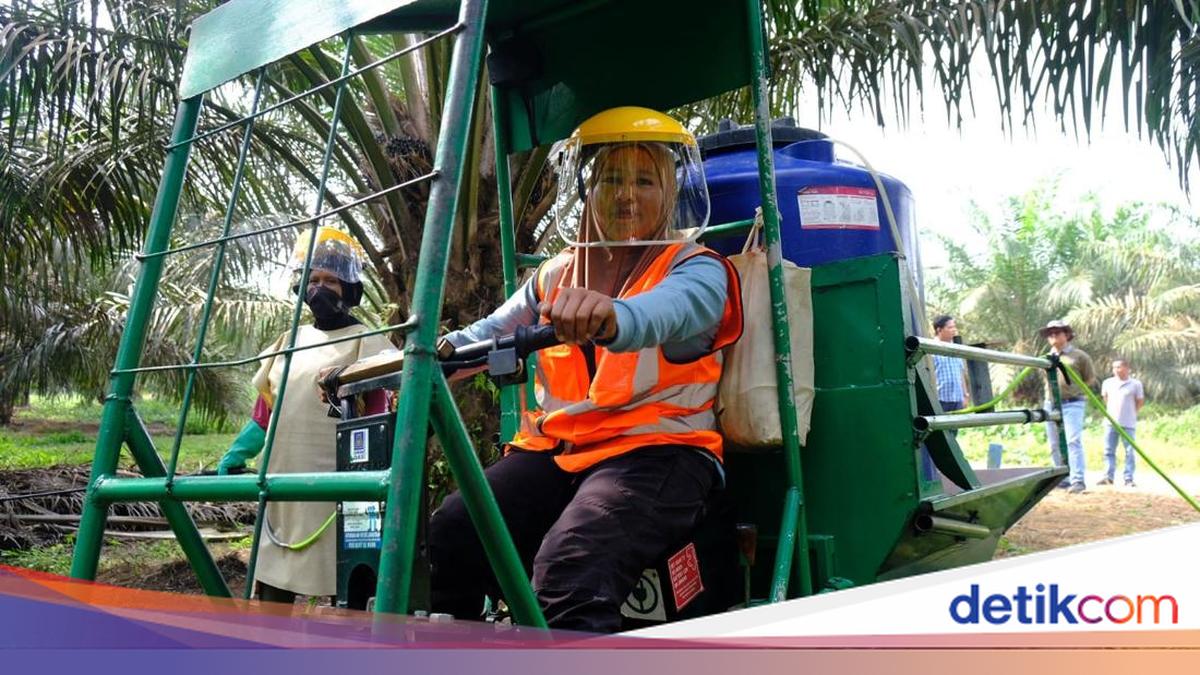
The sun has not yet risen high when activities in the plantation begin. Amidst the rows of plants stretching across South Solok, workers carry out their respective duties.
Amidst this activity, there are women participating in various field tasks. They perform spraying, operate mini tractors used to carry spray liquids, tidy harvested fruit, and even operate excavators. These tasks are performed with individual skill and responsibility. Beyond the plantation, they also have families to care for, children to raise, and aspirations to realise.
One such person is Yusmi. This 50-year-old woman has worked as a sprayer applicator for PT Kencana Sawit Indonesia (PT KSI), part of the Wilmar Group, for 14 years. As a sprayer applicator, Yusmi is responsible for weed and pest control in the plantation area using chemicals. In performing her duties, she is accompanied by a Ginga operator, or mini tractor, to assist in the spraying process around the base of the plants.
Because she works with chemicals, safety is a vital part of Yusmi’s activities. She is required to wear full Personal Protective Equipment (PPE), including a respirator or filter mask, safety goggles, a waterproof apron, long rubber gloves, and boots. This equipment is used during field duties as part of Occupational Health and Safety (K3) standards to reduce the risk of chemical exposure.
In a single day, Yusmi and her team can complete spraying on approximately 13 to 14 hectares of land. When it rains, work is halted and only resumed once weather conditions permit. Having worked in the field for over a decade, Yusmi admits she has not faced significant obstacles despite being 50 years old. “Alhamdulillah, at fifty, I feel very strong and face no difficulties while working in the field,” said Yusmi.
For Yusmi, this job is more than just a routine. It represents a long journey for her family, which has grown from the proceeds of plantation work. Her husband also works at PT KSI as a harvester, and her son and son-in-law work in the same environment. Now, Yusmi’s children are independent; her youngest has completed her education and works as a midwife in Kalimantan. For years, Yusmi and her husband have funded their children’s education through their earnings from the plantation.
“All of my children’s school fees since the beginning were purely sourced and funded from the sweat of our labour in this plantation company,” she said. These earnings were also set aside for savings. From these savings, Yusmi and her husband were able to build a private house and own a small-scale independent palm oil plantation. For Yusmi, the results of years of work provide a sense of security for the future. “For us, the most felt benefit of working here is not just the ability to fund our children’s education to success. More than that, the company provides a certainty of welfare that allows us to prepare for our future and old age very well.”
Another story comes from Aisyah. Having worked for 14 years, she is accustomed to helping tidy harvested palm fruit to make it easier to count and transport via truck. This work requires both physical strength and proper technique. Aisyah understands how to manage her body movements so that the work can be done effectively without causing rapid fatigue. “The technique is not to rely on the abdomen, otherwise, it will ache if done too long. Strengthen your legs and hands,” said Aisyah.
The weight of the fruit bunches she handles varies; some are around 5-10 kilograms, while larger bunches can reach approximately 40 kilograms. Aisyah’s task is to tidy these bunches before the lifting process is carried out using an excavator.
Fourteen years of experience have made Aisyah adept at reading field situations and managing her energy. This skill was formed through the daily rigours of her job.
Meanwhile, Yudiana Fera has only been working as a mini tractor operator for two years. Yudiana is responsible for operating the Ginga to carry the spray liquid used for weed and pest control in the plantation area. Like the sprayers, she also faces the risk of chemical exposure, making the use of PPE mandatory. During her duties, Yudiana uses full PPE, including a respirator, goggles, waterproof apron, long rubber gloves, and boots, to support K3 implementation and protect herself.
The opportunity to become an operator arose when her supervisor mentioned that the company needed female operators. Yudiana saw this as a challenge she wanted to try. Previously, she had no skills in operating a tractor. She subsequently underwent approximately one week of training alongside more experienced operators. Initial training was conducted in flat areas. Once deemed capable, Yudiana was trusted to operate units in the field, including transporting water and Tedmon tanks. The plantation terrain presents its own challenges, with uphill roads, descents, and narrow terraced areas that require high concentration when controlling the machine. “In the small terraced areas, controlling the levers or the Ginga controls is indeed more difficult and requires high concentration,” she said.
Source: jawawa.id (https://jawawa.id/newsitem/the-story-of-resilient-women-in-south-solok-plantations-and-family-hopes-1789617595)
Originally published by detikcom (https://news.detik.com/berita/d-8666435/kisah-perempuan-tangguh-di-kebun-solok-selatan-dan-harapan-keluarga), translated from Indonesian